
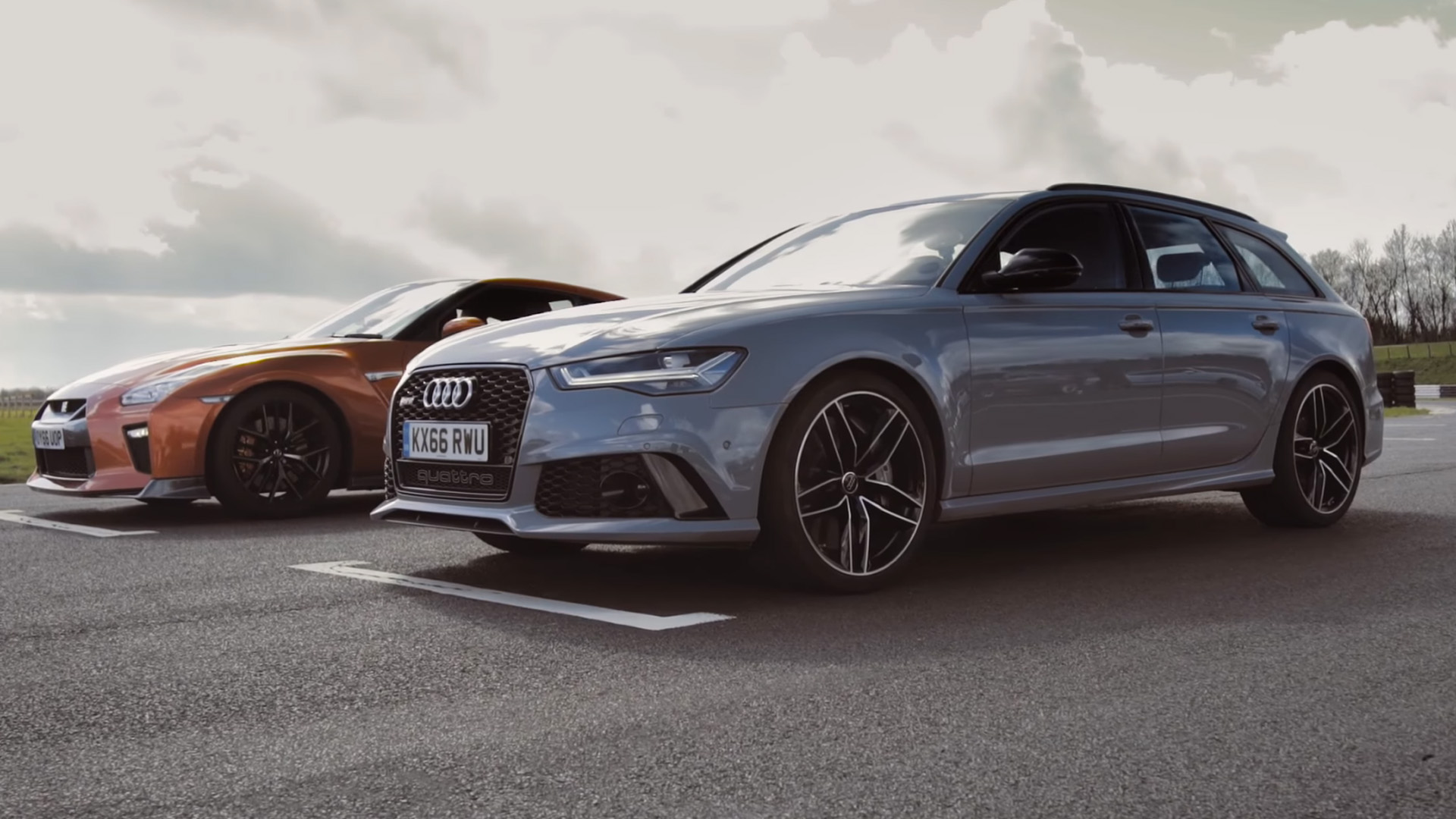
The RS6 is a proper sports wagon. Its 4.0-liter V8 engine is fitted with two turbochargers, producing a whopping 553 horsepower and 516 lb.-ft. of torque. This is enough to propel it from 0-60 miles per hour in just 3.9 seconds and to a theoretical 189 mph top speed—though for safety reasons, the car is electronically limited to 155. The 4,299-pound station wagon costs around $101,156 for a base model.
The 2017 R35 GT-R is the slightly less heavy of the two, tipping the scales at 3,911 lbs. Its 3.8-liter V6 also packs a pair of turbochargers under the hood to make big numbers. And it does just that, pumping out 562 horsepower and 469 lb.-ft. of torque. Less weight, more horsepower —it seems like it should demolish the RS6 on paper, right? You might not want to bet its $109,990 price tag on that.
The boys over at Carfection decided to treat the pair to a drag race to see which of the six figure monsters would take out the other. The answer is surprising, especially since the Audi is more of a usable “family car” (I use that term lightly, since you typically won’t be wreaking havoc around town with your wife and kids in it) and less of a sports coupe. After all, it is a station wagon, right? That may just be the reason that you aren’t greeted with the same “look, a sports car!” feeling when stepping up to the door or the RS6 as opposed to the GT-R. Let’s check out the results:

DRAG RACE: Audi RS6 v Nissan GT-R – Carfection
So for $8,834 less, you get two more doors, usable boot space, and a quicker car in a straight line. I can’t say the same would occur around a track, so that’s left in the air until somebody with more money than I makes the effort to pit the two against each other in the twisties.
Loading comments…
Comments couldn’t be loaded. Please refresh the page.