
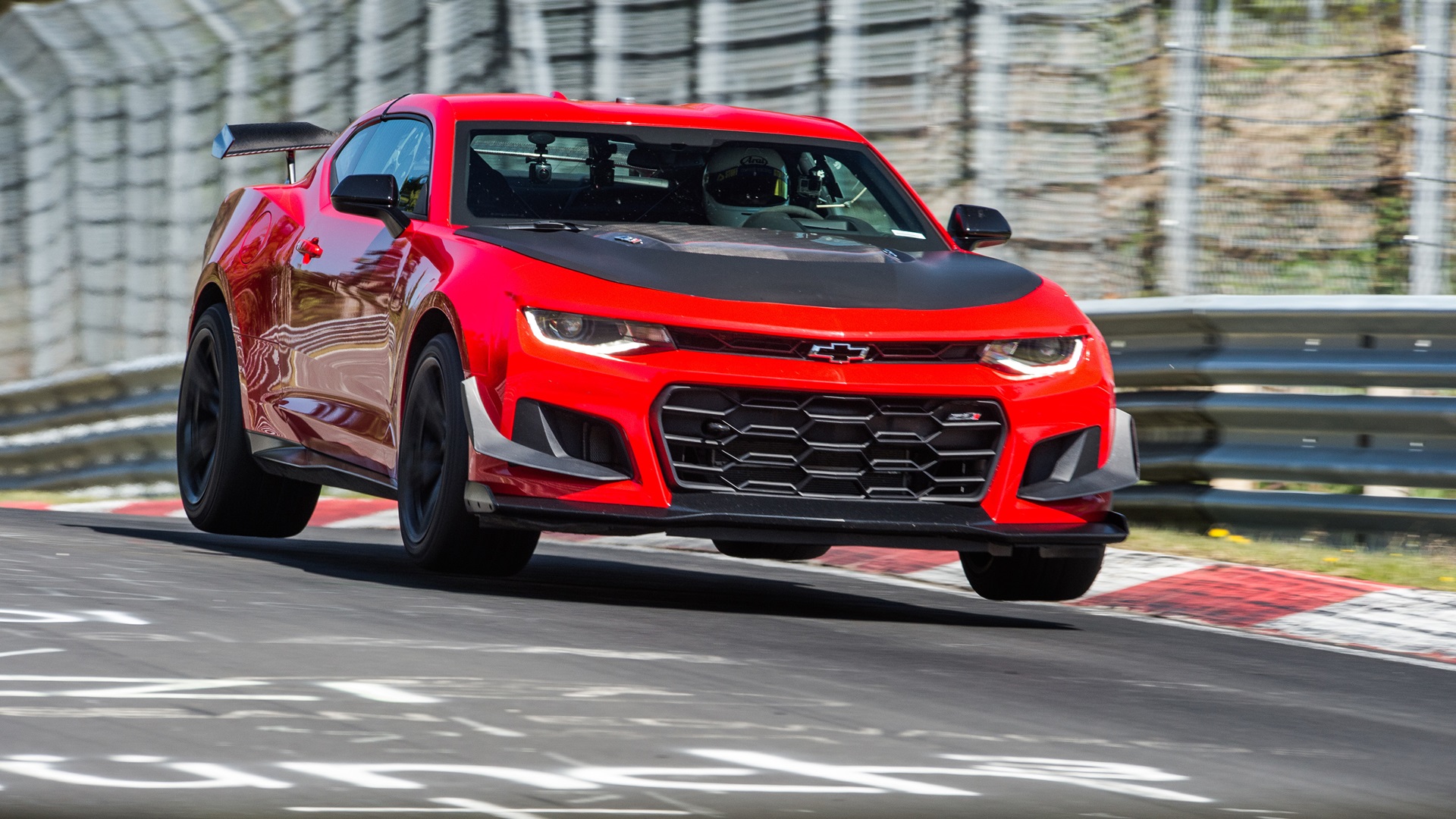
This week, the GM rumor mill is working overtime. Word has it that we’re not only on the verge of seeing the next Chevy Camaro, but that it will share its underpinnings with new sedans to be sold elsewhere in the GM lineup. None of that is new, strictly speaking (we first heard about a gasoline-powered CT5 replacement last fall) and the last-gen Camaro and Cadillac CT4/5 shared both their underlying platform and an assembly line at GM’s Lansing Grand River plant in the Michigan capital. But there’s a twist: this time around, there’s going to be a Buick too (if Automotive News is to be believed, anyway). That’s interesting, to say the least, especially considering what GM president Mark Reuss has already said about repurposing Chevy’s pony-car nameplate.
I’m curious to see what Chevy has in store for the next Camaro, but even if it ends up being a slam-dunk of sports coupe with a V8 engine and a manual transmission, it won’t change the simple fact that the pony car as we know and love it is already dead.
Yes, the Mustang exists. And technically the Camaro is only mostly dead—gone from our showrooms but not from our hearts development cycles, or something like that. Dodge makes a two-door Charger, but like the Challenger before it, it plays much more strictly in the muscle space. It’s big, wide, and heavy, and with its standard all-wheel-drive, destined for straight-line greatness. But a pony car it ain’t.
The pedantic could argue the finer points to death, but the pony car was born from the same reliable formula that has consistently produced excellent results: it combined a relatively lightweight, compact chassis with a respectable engine and some basic nods toward everyday practicality. Not as compromised as a two-seater but not quite as practical as a four- or five-door. And when it did something practical, you made it sound cool. It’s not a cramped four-seater, it’s a 2+2! It’s not an economical hatch; it’s a fastback!
I say that this formula is consistent because it’s the same fundamental approach that gave us the hot hatchback and sport sedan. Take something practical and compromise it with a little bit of fun. Boom, enthusiast car.
As a product of the time in which they came about, pony cars inherited another quality that they’ve thus far been unable to shake off: rear-wheel drive. Ford learned that the hard way with the Probe; Chrysler, likewise, with the 1980s revival of the Dodge Charger. While the former is appreciated to this day for things that make it very unlike a Mustang, the L-Body Charger is remembered less fondly.
But another key element has indeed been lost. Above all, the traditional pony car was affordable, even when you opted for the V8. Sure, it cost more; but it didn’t break the bank. There was once a time when you could by a Mustang GT for the same price as a base Miata. Sadly, the V8 pony car’s reputation as an affordable entry into automotive enthusiasm is now long behind it.
The last-gen Camaro was an excellent driver’s car and certainly a high water mark for the nameplate, but a good SS spec was already pricey (relative to a Mustang GT, anyway) when it debuted for the 2016 model year. If you ask me, the Mustang peaked with the introduction of the S550 in 2015. You could buy one with the 5.0-liter V8 back then for less than the price of a base Subaru WRX in 2026.
And if you actually want to do something besides parade around listening to V8 noises, things get even dicier. In the space of just that one generation, an enthusiast-spec Coyote Mustang (equipped with the Recaro seats and performance-package suspension) went from being a $35,000 proposition to a $55,000 proposition. Sure, the car got better for it, but enough to justify a nearly-60% price increase? Nuh-uh.
There are forces at work here beyond simple corporate greed. Sticking with the Mustang as an example, one would assume Ford’s goal has always been to sell as many higher-margin V8 models as possible, and that’s true to an extent, but volume was the enemy when it came to high-performance cars in the CAFE era. Selling a lot of thirsty V8s lowered the company’s average fuel economy. Either Ford had to offset that by selling more fuel-efficient alternatives, or it would end up paying a fine. By nudging the GT’s price point up, Ford both increased the profit it made per unit and reduced the number of cars it needed to sell in order to keep the lineup profitable.
This same mechanism also contributed to the lack of availability of V8s (and other gas guzzlers) in midsize pickups. The penalties simply made it smarter to shunt V8 customers toward half-ton models, which the rules better accommodated (and hey, they’re more profitable too). Note that all of that was in the past tense, because the feds gutted CAFE’s enforcement provisions last year. If you were wondering how Dodge suddenly figured out how to sell cheap V8 Durangos, well, now you know—and to further the point, even Stellantis still can’t build Hemis fast enough to keep up with the volume it wants from its midsize SUV.
Surely, somebody could do what Dodge is doing in the Durango, only with something more enthusiast-friendly… right? This is where the pony car should shine, but Ford’s too busy trying to beat Chevy around the Nurburgring in a track-spec Mustang that costs ten times more than the base model—a car equipped with a four-cylinder engine and an automatic transmission. Even Dodge is too busy selling more-profitable SUVs to rush the Hemi into its brand-new Charger sedan.
Even pickup trucks are not immune to the shifting market. Ram itself will tell you that the volumes it enjoyed with a last-gen V8 pickup sitting at the $35,000 mark aren’t going to return with the revival of the Hemi, which now commands a premium over the Hurricane I6. That price point died with the Classic. The cheapest four- and six-cylinder half-tons will start at $45,000 before the decade is out; $40,000 will soon be the playground of midsize pickups.
While the Durango’s last gasp will go down as one for the weird-car-history books, the reality is that the volume V8 is dead, and with it, the traditional pony car. So, in the immortal words of the most respectable president of the past three decades, what’s next?
Got a tip about the new Camaro? Let us know at tips@thedrive.com!
Loading comments…
Comments couldn’t be loaded. Please refresh the page.