
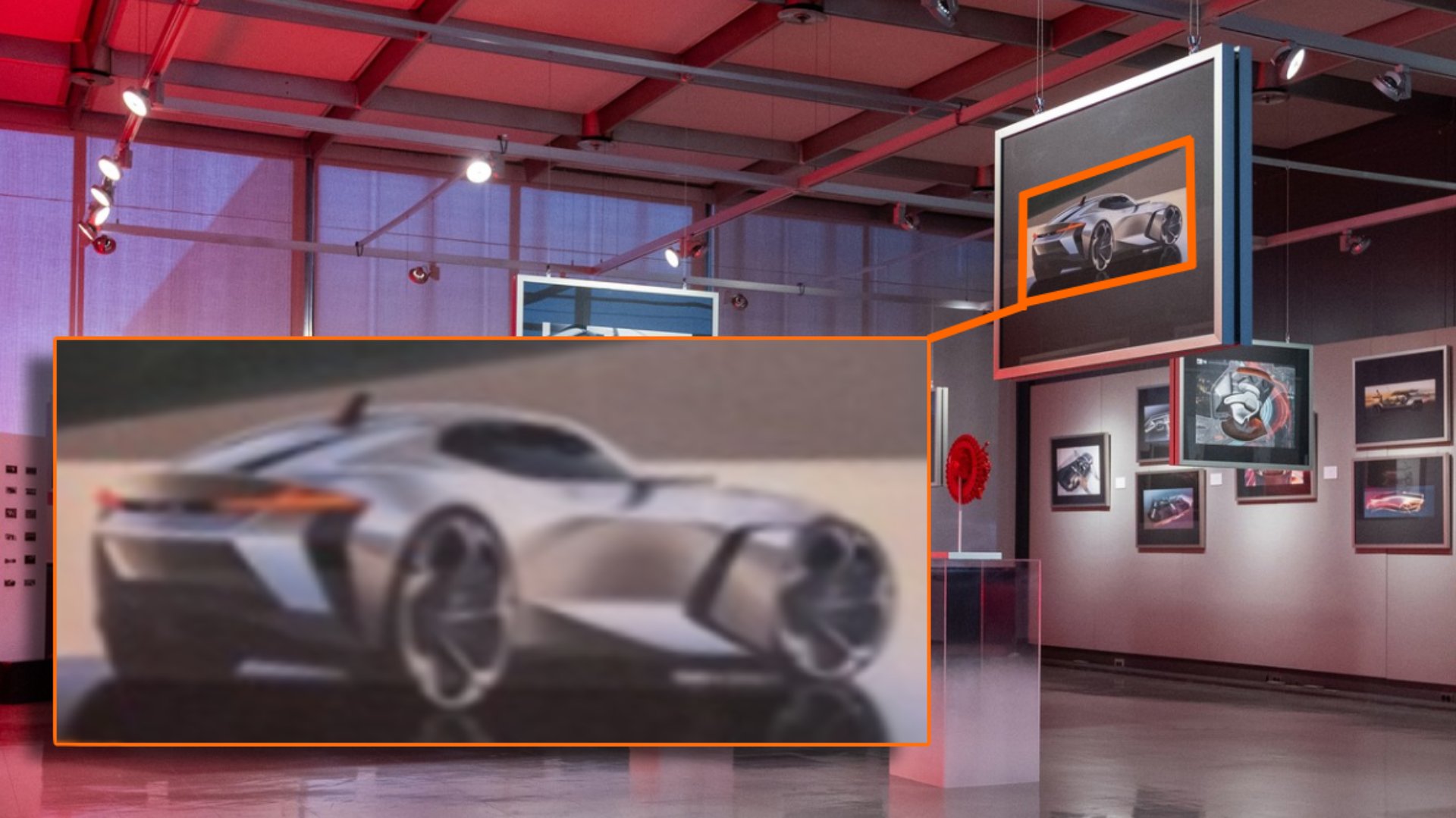
It can be dangerous to read too much into a corporate social media post, especially in the age where every decent-sized company farms the work out to an agency of some sort. But the flip side of that coin is that most social media content gets a great deal of scrutiny before being handed off to a third party. So when we say you should take this image of what appears to be a design study for a new Chevy Camaro with a big grain of salt, those are just a couple of the reasons why. But man, do we want this to be real.
Swipe through the post too fast and you might mistake it for a rear-end shot of the C8 Corvette, but if you look closely at the image hanging in the middle-ground of this image from inside one of GM’s design studios, you’ll realize you’re seeing something that does not exist. It’s a low-slung two-door that clearly borrows stylistically from the Corvette, but lacks the mid-engine C8’s short front overhang and squat rear end, instead boasting the long hood of a front-engine coupe. Normally, we’d go to the tail lights for some better clues, but there’s no decipherable signature here that we can discern at this distance.
This was one of four images shared on GM Design’s Instagram a few days ago to promote its “Tomorrow’s Vision Today” exhibit, which is largely focused on future “mobility” (read: self-driving) concepts. It’s no wonder that that this sports coupe study has dedicated space apart from the rest of the exhibit.
Our hope is fueled by other factors. For starters, we know the Camaro name itself is still alive. Second, the Trump administration has stripped the EPA of its ability to assess fines for emissions violations, essentially giving GM the green light to sell as many high-performance engines as it likes (for the time being, of course). And third, we know for a fact that GM is spending money on a next-gen V8.
It’s not all roses, however. While the regulatory window may be wide open for the moment, vehicle development takes years. A 2026 “Blue Wave” could slam that shut and leave GM with hundreds of millions invested in a project that no longer has a viable path to production—much the same thing that has happened to automakers’ EV programs this year. So long as the political climate remains unpredictable, it’s unlikely that any automaker will take any big risks. And let’s be honest with ourselves: Even if the EPA were to disappear tomorrow, reviving the Camaro would be a risk. Just look at Mustang sales.
Got a tip? Let us know at tips@thedrive.com.
Loading comments…
Comments couldn’t be loaded. Please refresh the page.