
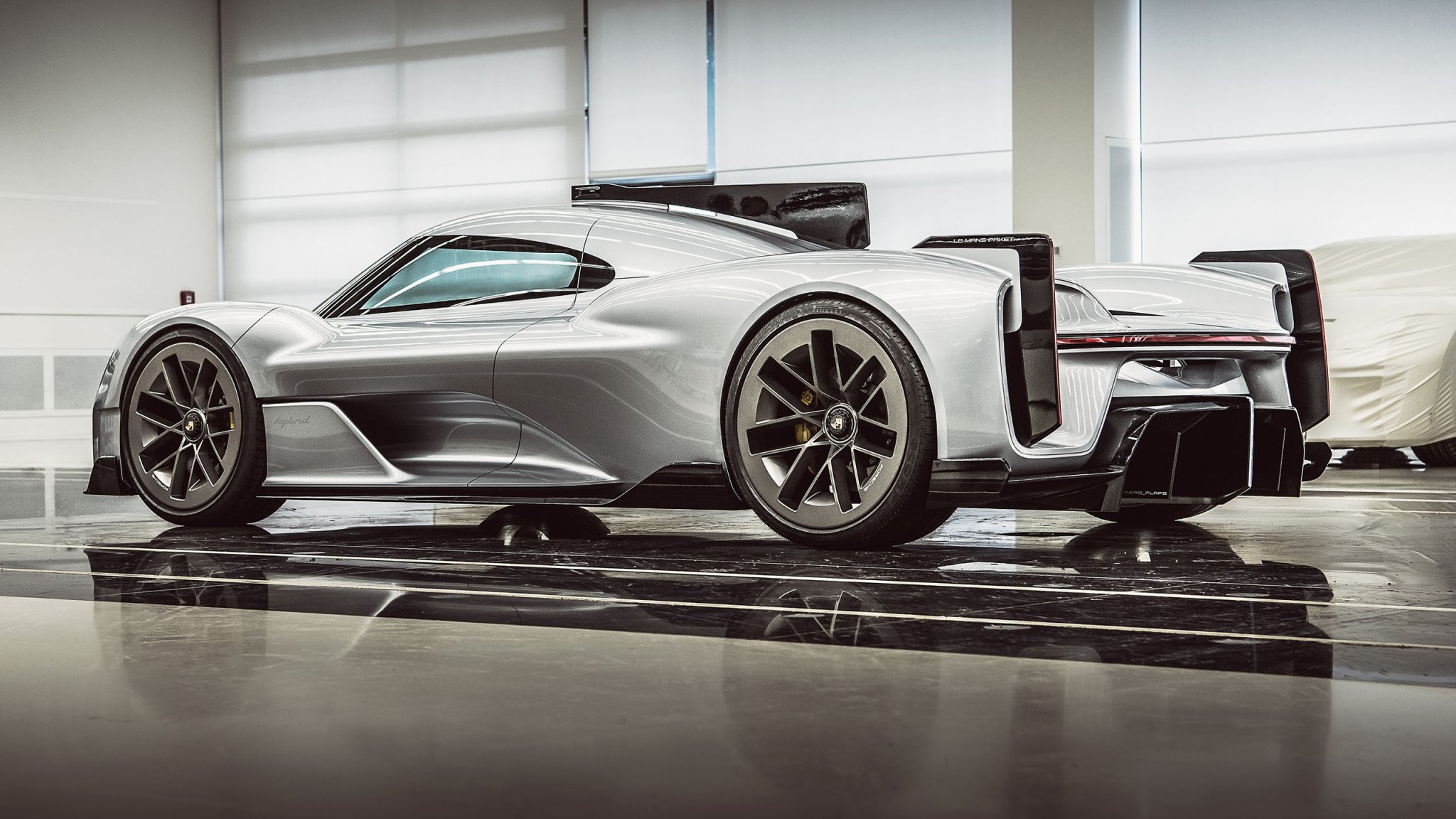
Patents are interesting, because while they aren’t representative of any product we are destined to see, they still tell us where an automaker’s head is at. And patents like the one the World Intellectual Property Office just published from Porsche for a W18 engine are especially curious, considering everything we know about the brand’s current lineup and direction. Sure, Stuttgart may be walking back the planned onslaught of EVs, but an engine with 10 more cylinders than any they currently sell sounds like quite the left turn in this era of downsizing combustion and instead making big power through electrification and forced induction.
Hat tip to CarBuzz for spotting this patent, which was published on Oct. 16 and first submitted last December. In the application, we see two drawings: a head-on one, clearly displaying the proposed three banks of six cylinders, and an isometric one. Volkswagen faithful will note that this W18 is fundamentally unlike the W12 engine seen in cars like the Phaeton, and the W16 of the Bugatti Veyron and Chiron. Those were more like Volkswagen’s VR6 design, in that they staggered pistons with a narrow bank angle, uniting two banks in one cylinder head. Double the VR6 and you get the W12, and add two more pistons on each side and you get the W16.
This proposed W18 is different, though. In fact, it’s probably more like what you’d imagine if someone mentioned a W18 to you, and you’d never heard of or seen those prior Volkswagen designs. It’s a three-headed beast of an engine, with a trio of six-cylinder rows. And part of the benefit here, per the literature, is that the intakes for each bank are laid right on top, rather than at a perpendicular angle, to mitigate airflow losses due to friction. The exhaust ports would be lower down the side, and keeping those two channels far apart would theoretically improve thermal efficiency.

Porsche leaves the door open to fewer cylinders per bank, including a 12-cylinder arrangement of groups of four cylinders. It also mentions, per Google Translate, that “each cylinder bank is preferably assigned an exhaust gas turbocharger,” for a triple-turbo power plant. I like the sound of that.
The question then becomes, “Why and where would Porsche use it?” We’re seeing a bit of a resurgence in internal engine combustion development, since practically every automaker has scrapped its plan to ditch gas by the end of this decade or the middle of the next one. We want to believe that Porsche might seize this opportunity to introduce something truly unique, as Bugatti has done with the Tourbillon’s naturally aspirated V16 that revs to 9,000 rpm. In this age of electric motors, output doesn’t really make cars special anymore; what makes you stand out is how you achieve that power.
In all likelihood, this W18 concept is destined to be filed away like other patents, perhaps to serve as the basis for a lawsuit one day. But there’s every reason for it to become more than that. How many years has it been since the 918 Spyder, anyway?
Got a tip? Send us a note at tips@thedrive.com.
Loading comments…
Comments couldn’t be loaded. Please refresh the page.