
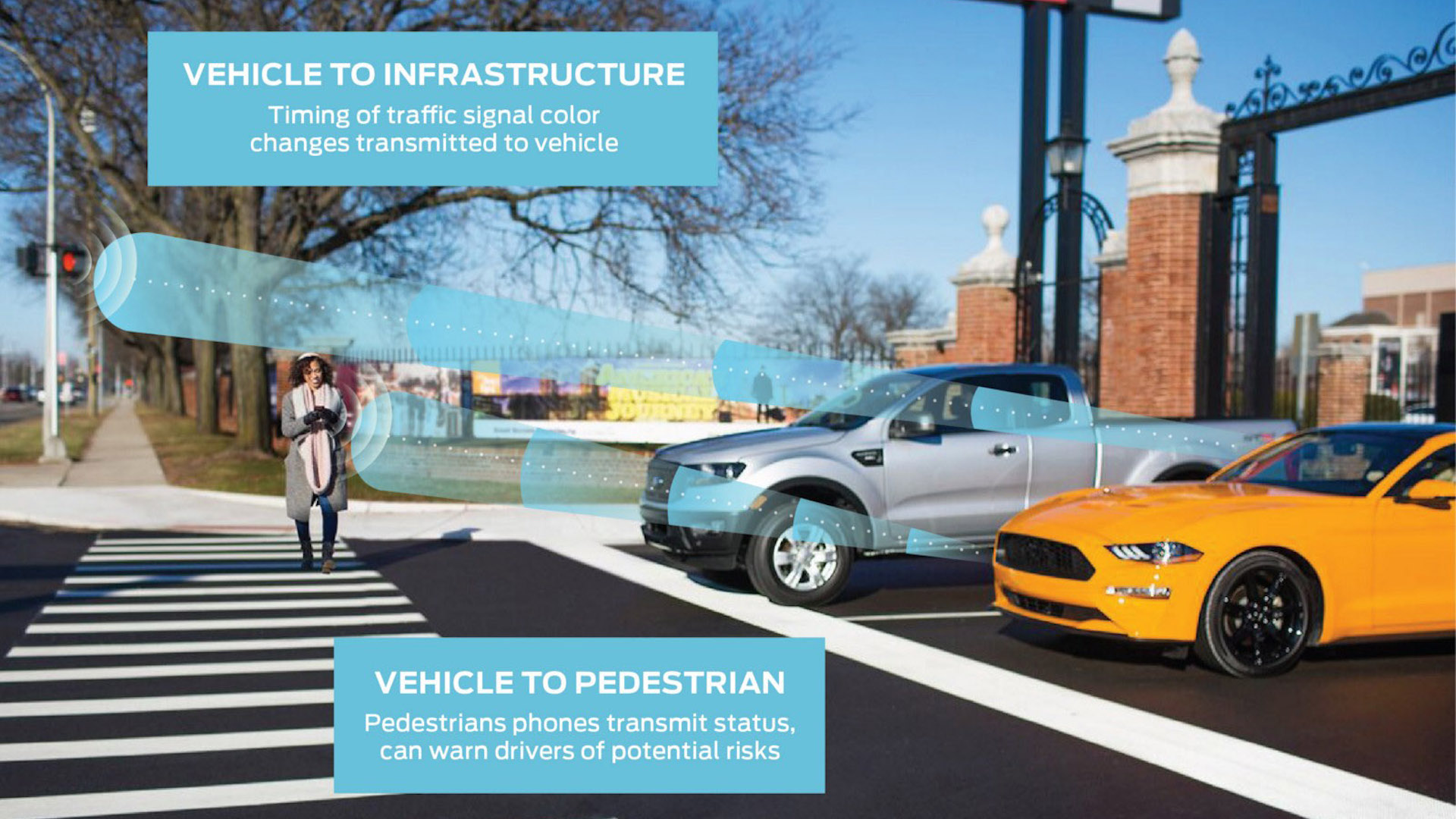
Executive Director of Ford Connected Vehicle Platform and Product, Don Butler, announced this week the automaker’s firm intentions of deploying cellular vehicle-to-everything (C-V2X) technology in all of its new vehicle models in the U.S. starting in 2022.
The auto and tech industries have been increasingly curious about connected vehicle and infrastructure technologies that could improve our traffic patterns, collision avoidance, and efficient vehicular navigation for a few years now, with Ford’s own Co-Pilot360 suite (or intentions to refine traffic lights) pointing toward the brand’s existent focus on improving road conditions for drivers and pedestrians alike.
By establishing a vehicle-to-vehicle (V2V) framework, cars could inform each other of nearby accidents, re-route drivers, and avoid danger or delays. V2X technologies are attempting to take this even further, including Internet of Things (IoT) connected devices, networks, and people to their systems.
While other companies are betting on the inevitable standardization of 5G cellular networks to provide the required communication speed and power to process such mass amounts of data, Butler’s blog post argues that Ford’s C-V2X approach will far outperform 5G, as it will allow connected devices to communicate directly without relying on cellular networks and towers.
In terms of vehicles and devices, Butler presents a four-way stop as a prime scenario for Ford’s solution, stating the tech would help all four vehicles assess which driver has the right of way. Additionally, a car involved in an accident could notify nearby vehicles of its potentially dangerous status and safely re-route them to avoid any escalation. Even a smartphone-carrying pedestrian’s location could be used by the C-V2X tech to guarantee they’re safely using the sidewalk, and not crossing the street in front of an un-attentive driver.
Regarding a vehicle’s connectivity to surrounding infrastructure, Butler posits our age-old stoplight and road sign methods could see dramatic improvement, as well. A traffic light utilizing C-V2X, for instance, could send a driver signals notifying him that it’s about to turn green or red. It could even let them know if there’s a risk of running the latter, thereby arguably further reducing the risk of unnecessary accidents.
Butler claims that Ford’s Co-Pilot360, a driver-assist technology that includes “automatic emergency braking with pedestrian detection, blind spot information system, lane keeping system, rear backup camera, and auto high beam lighting” will be fully compatible with C-V2X technology. He argues that while the onboard sensors, camera arrays and navigation systems currently used to improve driving and safety conditions are a great start, could be vastly complemented by complete cellular interconnectivity between devices and vehicles.
Not unlike its aerial counterparts in the drone industry, Ford must first navigate the requisite regulatory hurdles, technological adoption, and legislative landscape to properly, uniformly implement an interconnected framework like this. Butler says Ford has already begun working with both industry and governmental entities to foster the necessary conversation and collaboration, inviting automakers, infrastructure and road operators, and government agencies to speed the process up.
It’s quite possible that the next few years will see substantial support for this type of endeavor, and bring about a standardized framework of connected vehicles, people and devices more populated than ever. As competition firmly remains the driver of technological innovation, and Ford’s peers are certainly eager to corner this modern niche of vehicle technology, as well, it’s at least likely we’ll see some impressive advances in the field. Stay tuned.
Loading comments…
Comments couldn’t be loaded. Please refresh the page.