

British firm YASA claims its axial flux motors will make big power while eliminating the need for big brakes—at the rear of the car, at least.
Regenerative braking means EVs rely less on their mechanical brakes than internal-combustion vehicles. And because most braking force is distributed to the front wheels regardless of powertrain type, rear brakes can be downsized. That’s how the Volkswagen ID.4 gets away with rear drum brakes, for example. But YASA is taking this to the extreme.
In a recent LinkedIn post, the company announced a prototype in-wheel motor combining its existing axial flux design with a compact inverter. The combination can deliver up to 750 kilowatts (986 horsepower) per wheel with “the potential for dramatically downsized rear brake hardware,” according to the company, which is a wholly owned subsidiary of Mercedes-Benz.
YASA Chief Technical Officer Tim Woolmer elaborated in the comments, saying that “the motor is designed to meet all the thermal requirements of a rear brake” and that safety backups could include a small emergency brake or dumping power from the motor so that it acts as a brake even if related electronics are damaged.
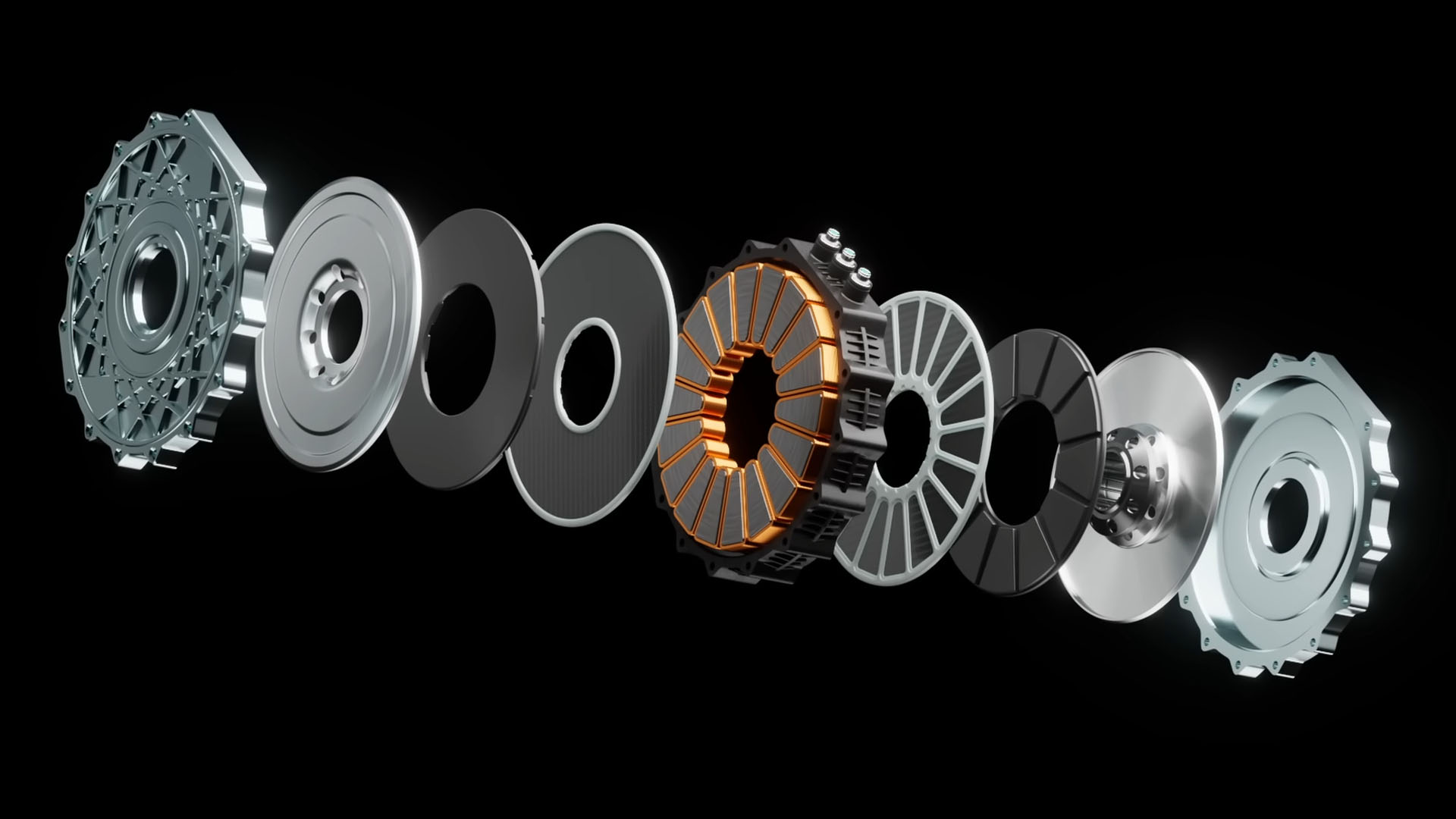
The potential advantages include lower weight and more compact packaging. Without its inverter, the motor weighs just 27.9 pounds and is very power dense. In a dyno test, it generated 26.7 kW per pound, which YASA claims would be a world record if it had been officially verified. Factoring in the reduced weight from downsized braking hardware and other component reductions, YASA claims the in-wheel setup could save 440 pounds.
Several companies have tried to market in-wheel motors for EVs, and YASA’s tech is an especially good fit. Axial flux motors are much thinner than conventional radial flux motors because the magnetic force that spins them—the flux—travels parallel to the axis of rotation rather than outward, or radially. That allows for a more compact form factor, which could fit more easily into wheel hubs.
The weight reduction YASA is claiming is also extra important for an in-wheel motor, as unsprung mass is one of the major obstacles to commercialization. YASA’s design is still just a prototype, so some of those obstacles may still have to be overcome. The company isn’t discussing firm production timelines, but owner Mercedes has showcased YASA motors in its Vision One-Eleven and AMG GT XX concepts.
Got a tip? Send it in: tips@thedrive.com
Loading comments…
Comments couldn’t be loaded. Please refresh the page.