
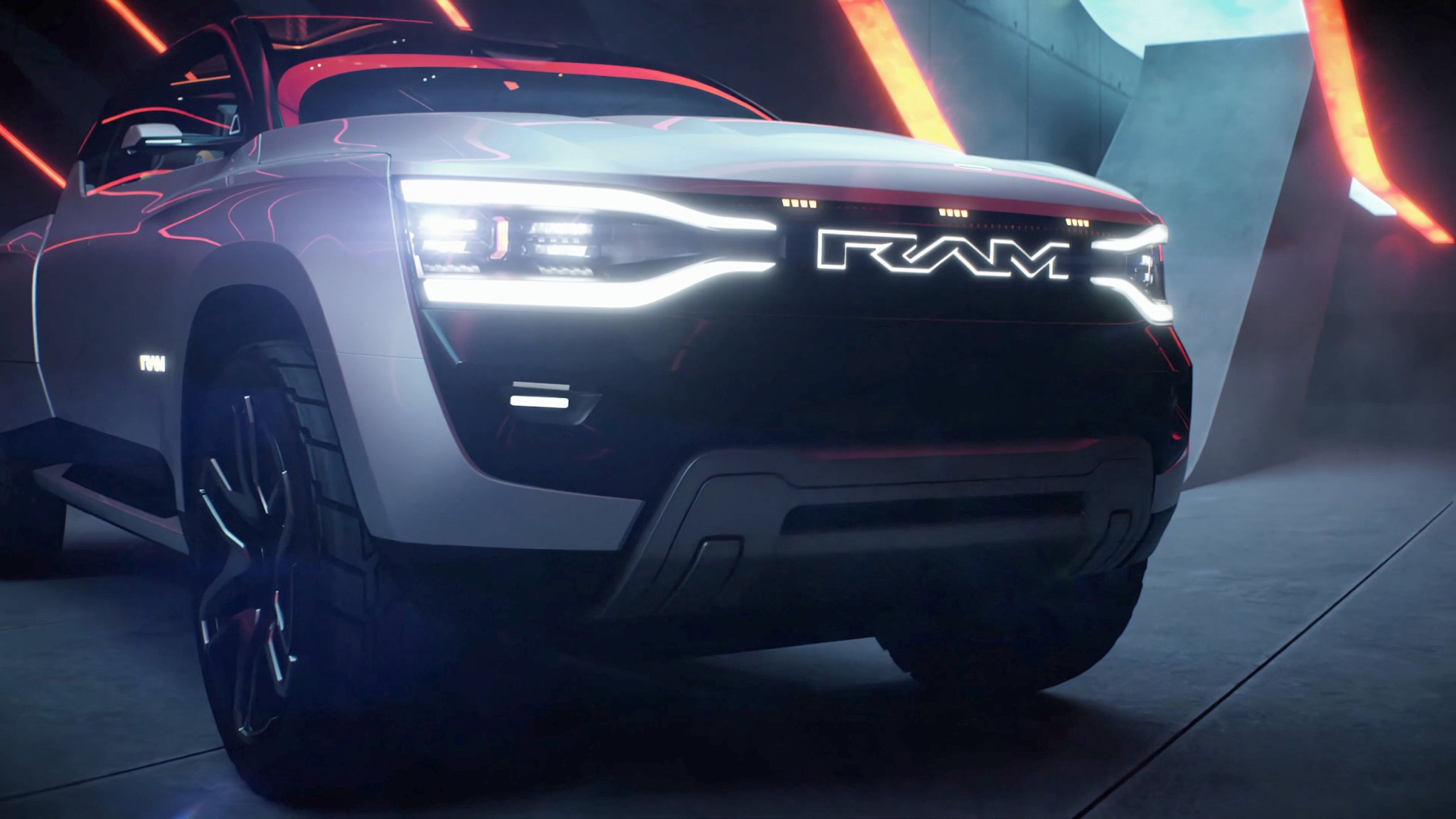
Stellantis has big plans in the next four years with a massive product push to turn things around that will include 60 new vehicles and 50 refreshes by 2030. Ram is a key player in this plan and one of those models is the brand’s first SUV, the three-row Ramcharger.
Set to arrive in the coming years, the Ramcharger will open an entirely new door for the brand to capture buyers it can’t touch today. But how does that work in the same showroom as its sibling, the Jeep Grand Wagoneer? Ram CEO Tim Kuniskis exclusively sat down with The Drive for a one-on-one discussion on the latest episode of The Drivecast and explained how the Ramcharger will be differentiated, and appeal to different buyers than the Jeep. Spoiler: It’s not just one thing. We’re talking engines, design, and how it drives.
Listen to the entire conversation starting at the moment Kuniskis explains the details behind the plan for Ramcharger vs. the Jeep below.
Kuniskis confirmed that the Jeep Grand Wagoneer will stick with its turbocharged inline-six engine lineup, which is about to gain an EREV powertrain option later this year, while the Ramcharger will be more truck-like with a more V8-focused engine lineup.
The Ramcharger will have a full trim walk including an SRT-badged variant. That will likely translate to the model having everything from a 5.7-liter Hemi V8 to both the 392 cubic-inch 6.4-liter Hemi V8 and the supercharged 6.2-liter Hemi V8 (yes, from the TRX and Hellcats, now with 777 hp in the former) in SRT-badged models. They all drop in. The Pentastar 3.6-liter V6 engine would also drop in, though so would the turbo-six from the Jeep, but that sounds unlikely in the name of differentiation.
Kuniskis noted how the competition manages to pull this scenario off with GM selling the Chevrolet Tahoe, GMC Yukon, and Cadillac Escalade while Ford sells the Expedition and Lincoln Navigator. But in both these other automaker’s scenarios these models are sold in separate showrooms. Stellantis doesn’t have that luxury, and so the Ramcharger and Grand Wagoneer have to be differentiated entirely beyond their exterior, and likely to an extent interior, designs.
Kuniskis said, “So our whole intent was: look at what the other guys are doing with multiple versions in different showrooms and see how much we can differentiate these two sitting next to each other so it’s not like, ‘Hey, that one’s got a Jeep badge on it and that one’s got a Ram badge on it.’ They needed to look, feel, and act different. And I know nobody can see this that’s listening to this, but I think when you see them—and we purposely parked them side-by-side—when you see them side-by-side, they look different.”
Continuing on that train of thought, Kuniskis said, “There’s going to be people that are going to look at the Jeep and go, ‘Oh, hell yeah, that’s the one I want, I don’t want that other one,’ and there’s going to be people that look at the Ram and say, ‘Hell yeah, I want that one, not the other one.’ I liken it exactly to Charger and 300 when we had them in the showroom together.”
The Chrysler 300 and Dodge Charger were indeed the same car, but as Kuniskis noted, “They were absolutely different buyers, and that’s exactly what we’re trying to do with this. We want one to be very focused on who a Ram customer is and one very focused on who a Jeep customer is. And powertrain matters. Our intent is to leave the powertrains as is on the Jeep, as is as in the architecture. That doesn’t mean that we won’t have multiple versions, different power levels, but the architecture. And then the architecture of the Ram would be more V8-based.”
Kuniskis didn’t give any hints on pricing, but after the rejiggering of the lineup with the 2026 refresh the Grand Wagoneer now costs $66,790 including an insane $2,795 destination charge. Whether it’s slightly more or a little less, it’s hard to imagine the Ramcharger starting at a dramatically different price point given a Chevy Tahoe costs $63,495 and a Ford Expedition costs $65,495. But we’ll know soon enough.
Got a tip about future product? Send us a line at tips@thedrive.com
Loading comments…
Comments couldn’t be loaded. Please refresh the page.