

We’re entering the iPhone dongle era for EVs, and it’s going to be confusing for new owners when it comes time to charge. The latest example is that every Porsche Cayenne Electric will have two charge ports when the car launches next year, one on each side of the car. Sounds convenient, right? Not exactly.
In America, one side will have the usual J1772 port compatible with most Level 1 and Level 2 chargers. The ones in your garage, at work, at the movie theater, etc. The other side will have a NACS port solely for DC fast charging at Tesla Supercharger stations after Porsche decided to adopt that standard for the U.S. market. But even though Tesla makes 240-volt home and destination chargers with the NACS plug, you won’t be able to use them with the NACS port on the car. For that, you’ll need an adapter to plug them into the other side, the J1772 port. I told you, it’s confusing.
The idea of having two charge ports on one car isn’t new. The Porsche Taycan and Audi E-Trons all launched with two charge ports, CCS and J1772. The setup was billed as an ease-of-use situation enabling customers to plug in and slow charge from either side, since both ports were of the same style, though only one side was capable of fast charging.
But as The Drive learned during a briefing by executives in Leipzig, Germany, the wiring behind the Cayenne Electric’s NACS charge port on the rear driver’s side fender isn’t set up to support AC slow charging, leading to the situation a number of automakers are caught in now. The parallels of how consumers got caught in the switch between USB-A and USB-C on myriad electronic devices and had to hoard cables and adapters is undeniable. And the reason comes down to timing.
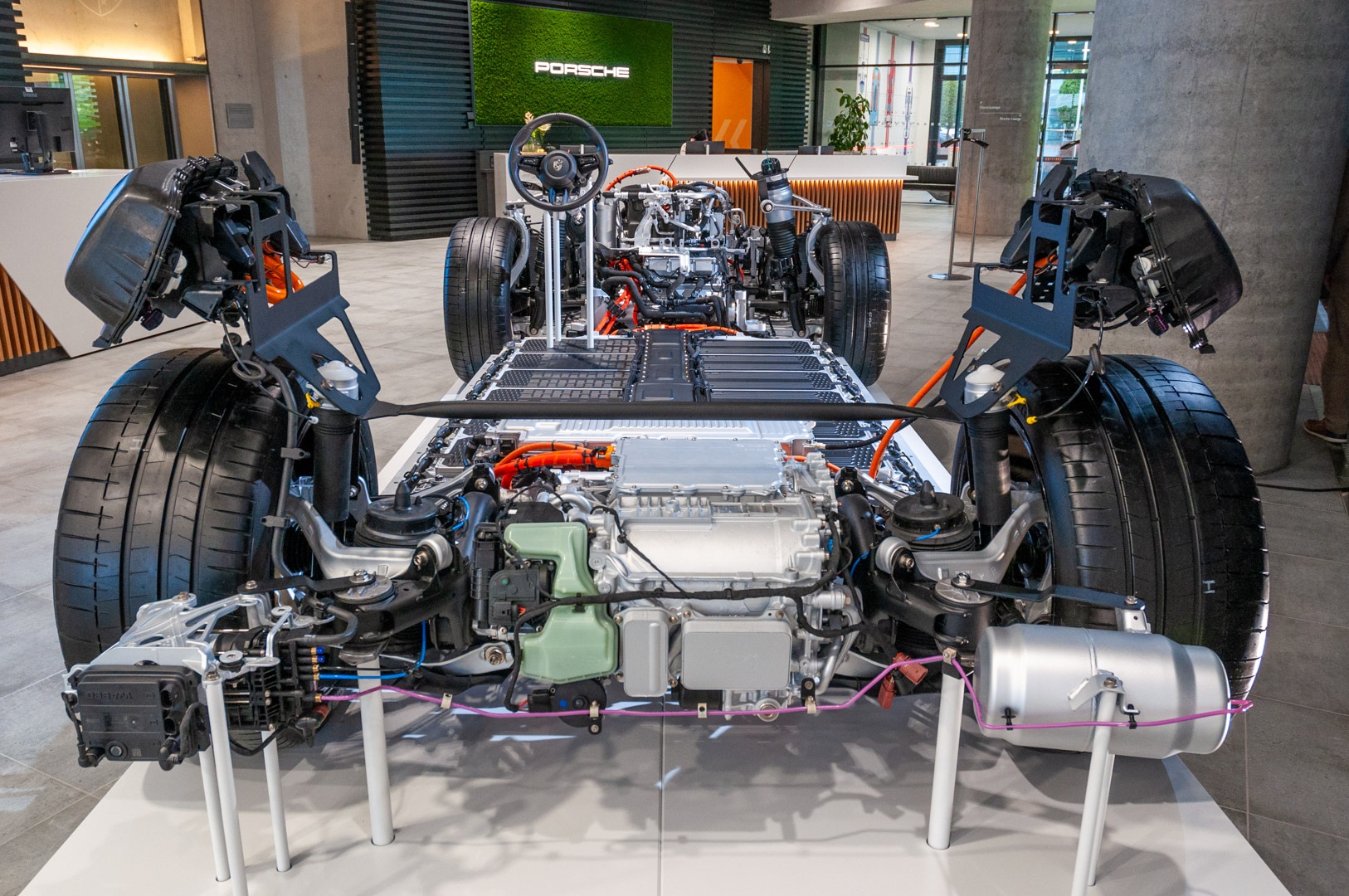
Initially the Cayenne Electric was set to have CCS as the fast-charging standard, but when America made a quick pivot to NACS given how terrible our charging infrastructure is here outside of Tesla Superchargers, Porsche pivoted as well. The development of the electric Cayenne was too far along to integrate a NACS port for both AC and DC charging, leaving the J1772 port on the passenger side as the only one to support AC.
The director of the Cayenne’s energy systems Marco Schmerbeck told us that the team understands this is a problem and is already engineering the driver-side mounted NACS port to be able to perform both AC and DC charging. But it’s not a quick fix that can be implemented before production. So early Cayenne Electrics will be like this, and it’ll be that way for the life of the car, there’s no over-the-air update that can tackle this hardware issue. Nor can a special adapter unlock AC charging through the NACS port. It just won’t work.
Schmerbeck noted there’s no timeline but the idea is to have the situation corrected as quickly as possible. Porsche High Voltage lead Dr. Maximilian Müller imagines the updated cars will roll off the assembly line whenever the hardware design update is implemented and the automaker wouldn’t wait for a model year change, though no firm decision has been made yet.
A rolling change could make things messy and extremely confusing on the second-hand market. Confusion will also ensue if a customer is unaware of this issue and plugs their early Cayenne Electric into a Level 2 Tesla destination charger only to find the next day it’s not charged.
Müller said the team hasn’t decided how the update will be implemented, but, in a perfect world there would be a NACS port on both sides, no J1772 port, and the driver side port would handle both AC and DC while the passenger-side port will handle just AC. We’ll see about that.
Got a tip about a weird packaging decision? We want to hear from you at tips@thedrive.com
Loading comments…
Comments couldn’t be loaded. Please refresh the page.