
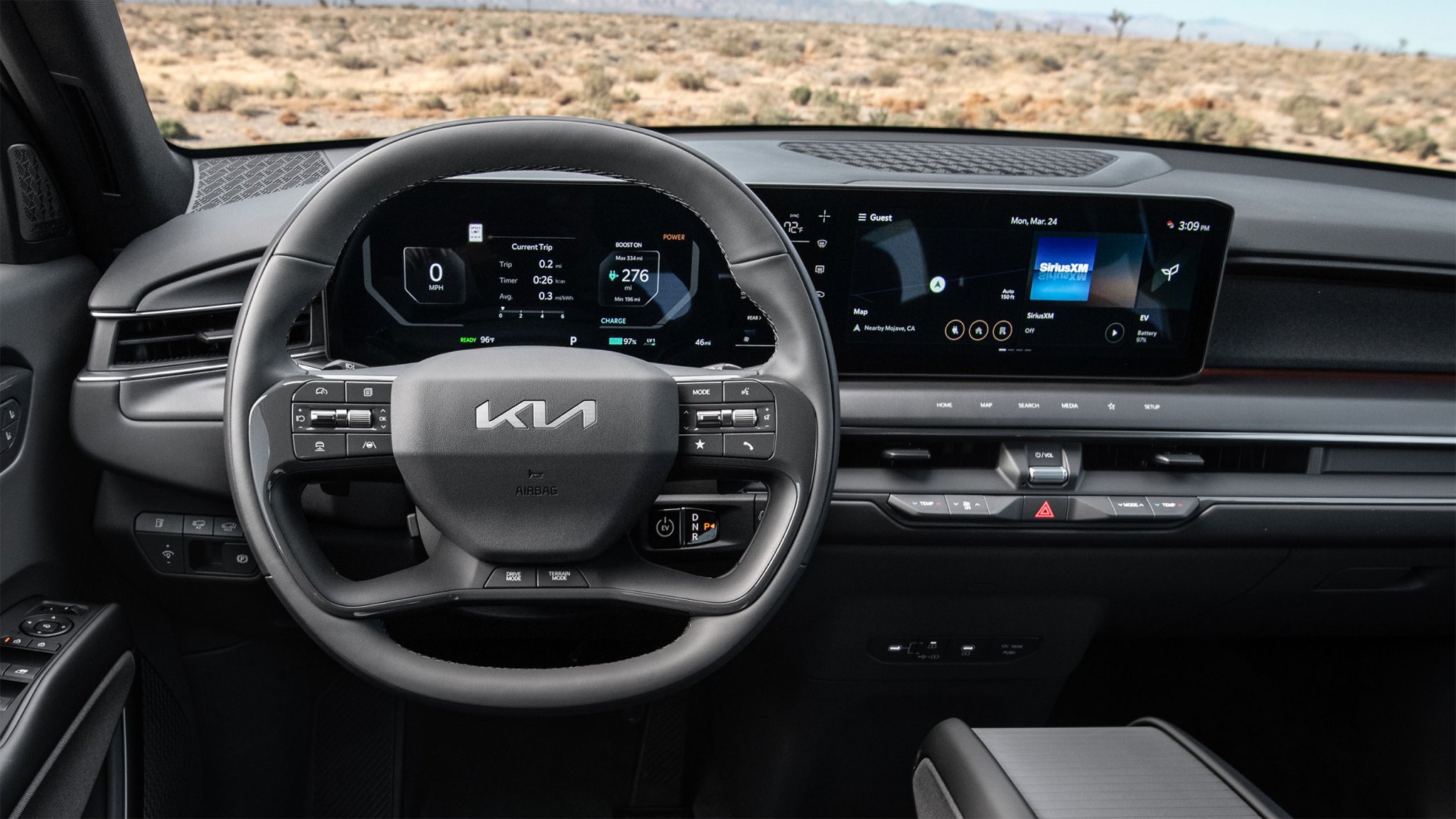
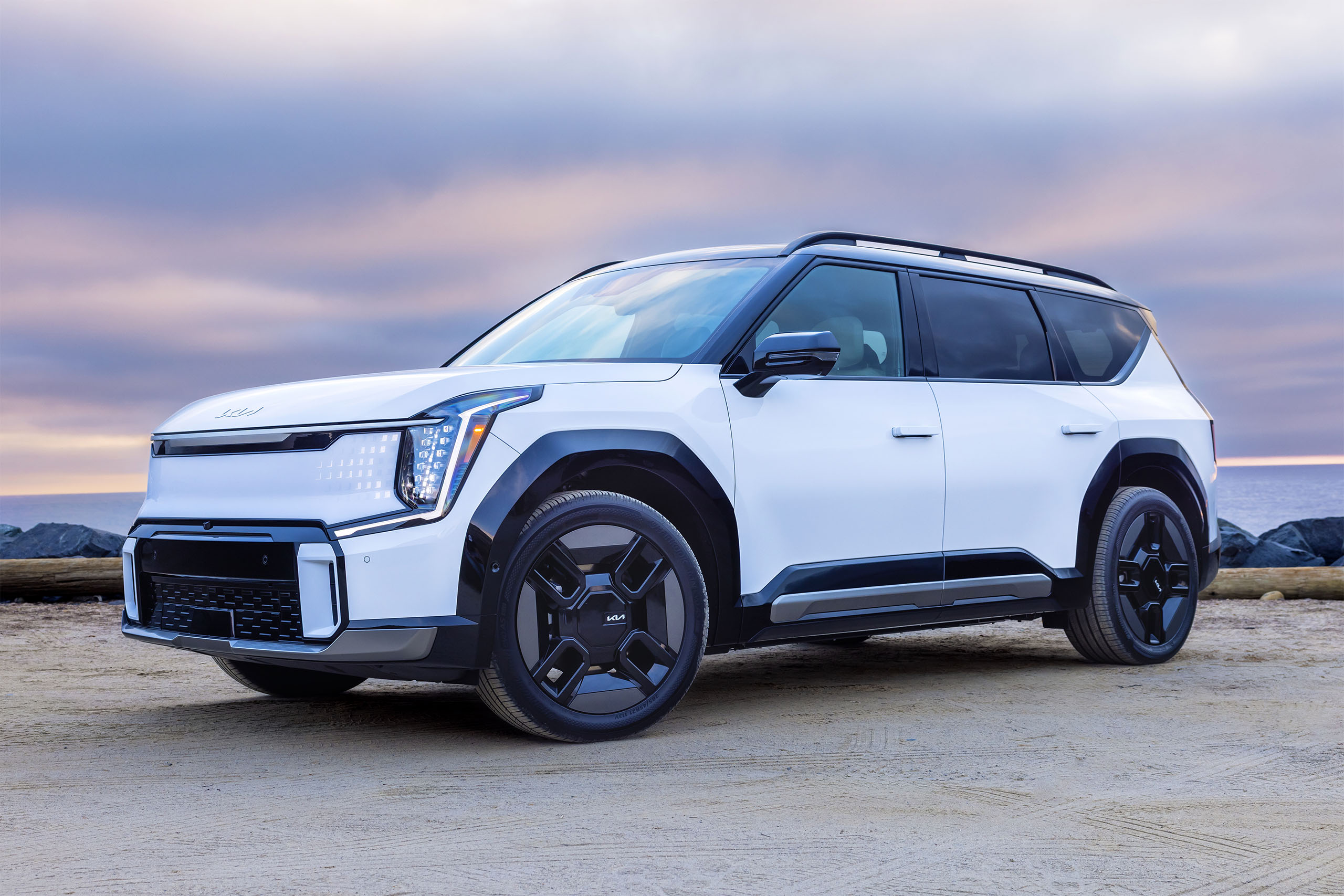
If you’re buying an EV in North America, these days you’d be hard-pressed to find something better equipped for the money than Hyundai and Kia’s latest products. Not only are they just plain good, but they’re also not overly complicated to use, thanks to fairly conventional interiors that retain some physical buttons at a time when those have been vanishing from cars. Even the EV9, for example, uses hard switches for climate and volume, as well as all of the steering wheel’s controls. Fortunately, Kia doesn’t view this as a fad.
When asked by The Drive whether he sees the brand going “full touchscreen” in the future, Tom Kearns, Vice President and Chief Designer at Kia Design Center America, responded with a firm “no.”
“I think consumers, for the things that they use often—which is probably volume control, radio, and temperature—it’s so nice to touch something,” Kearns said, adding that he views the matter of keeping physical controls not simply down to tactility and expectations, but safety as well.
“I think when your eyes are on the road, you can reach down and touch a knob and adjust it without even looking at it. But the same can’t really be said if it’s a touchscreen. You can’t feel it, so you have to look at it. But if you can feel it, you don’t have to take your eyes off the road. You can not even look, and you’re like, ‘Oh, there it is,'” Kearns said.
A 2020 U.K. study evaluated the behavior of drivers when interacting with Apple CarPlay or Android Auto phone projection systems that typically require the use of a touchscreen. Researchers found, among other things, that “controlling the vehicle’s position in the lane and keeping a consistent speed and headway to the vehicle in front suffered significantly when interacting with either Android Auto or Apple CarPlay, particularly when using touch control,” and that “use of either system via touch control caused drivers to take their eyes off the road for longer than NHTSA recommended guidelines.”
There’s certainly an argument to be made against the safety of capacitive or touchscreen controls with no physical feedback. However, when it comes to consumer preference, Kearns stresses this is a regional matter.
“I think that most consumers in America—I don’t know about other continents, like, Asian countries or Korea or Europe, I’m not sure—but I feel like most American customers like some tactile feel,” Kearns told us. “A few buttons.”
This is something we have heard before from other automotive executives, particularly those in a position to compare the tastes and priorities of the buying public across global markets. Volkswagen’s Ralf Brandstätter notably said last year that “Chinese consumers expect AI-first, connected vehicles, with seamless voice control, and smart cockpits as the norm,” highlighting that the average age of an EV buyer in China was under 35, whereas in Europe, it was 56.
The lifelong level of comfort with computers and software that a younger customer has means everything in this age of selling software-defined vehicles. “These aren’t just preferences,” Brandstätter summed up. “They shape the entire product and UX strategy from day one.”
Perhaps that means we’ll see further differentiation in interface design across continents. At least for North American buyers, though, Kia appears inclined to continue giving them what they want for the foreseeable future.
Got a tip? Reach out to tips@thedrive.com
Loading comments…
Comments couldn’t be loaded. Please refresh the page.