
Key Takeaways
- Rivian aims to expand its charging network. CEO RJ Scaringe plans to make it one of the largest in the U.S.
- Current growth is steady but not rapid. Expansion will accelerate with the launch of the power cabinet 2.0.
- Competition and reliability are crucial. Scaringe emphasizes the need for multiple reliable networks.
- Significant growth expected in a few years. Major expansion tied to new product launches from Georgia facility.
Bottom line: Rivian is strategically planning to expand its charging network, aiming for significant growth in the coming years to compete with Tesla and improve EV infrastructure.
AI assisted, editor reviewed
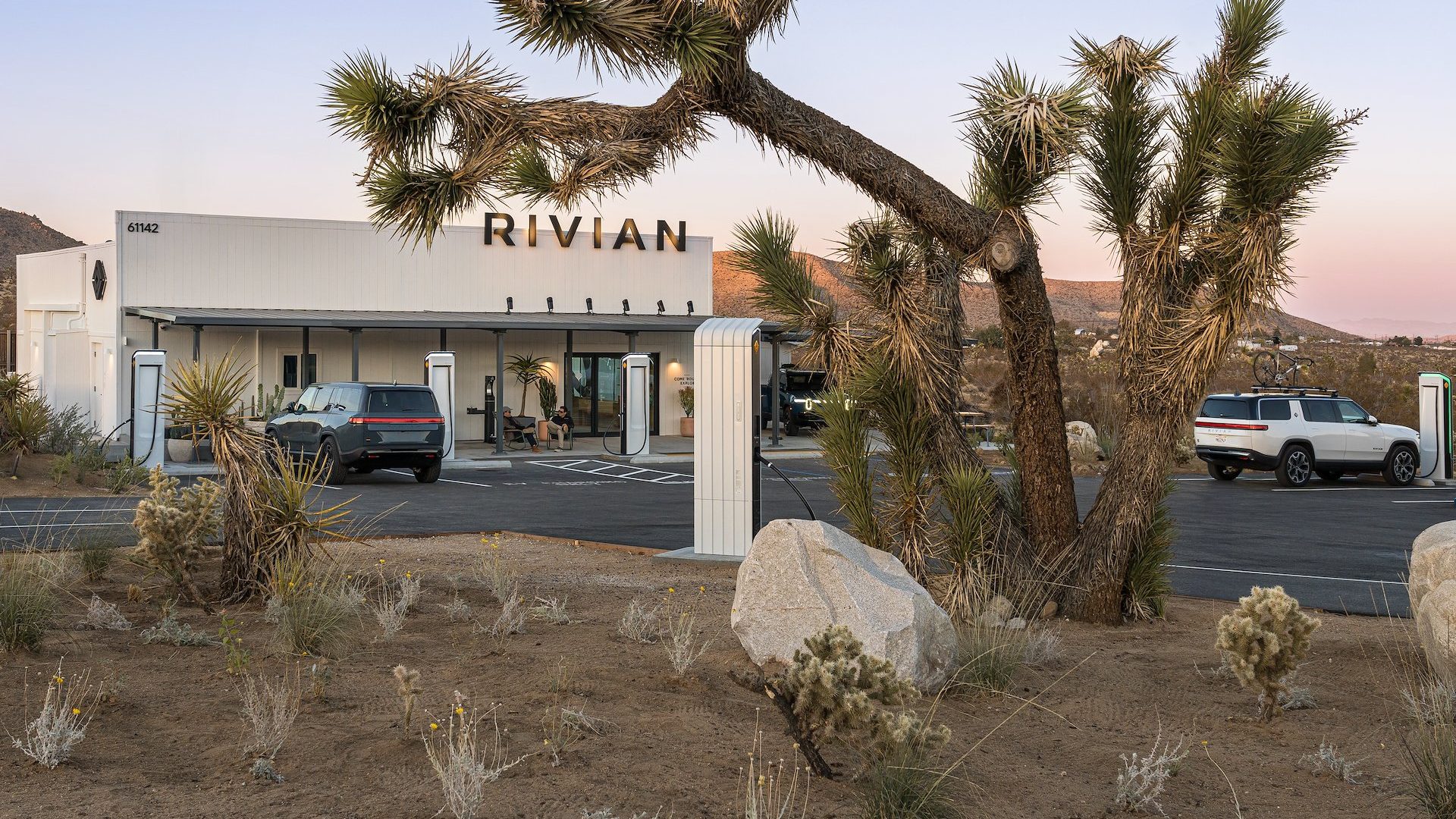
Electric car chargers are about to be busier than ever, which means the continued ramp and expansion of charging networks is more important than ever. Rivian knows this, has a plan, and big goals.
In Park City, Utah, Rivian Founder and CEO RJ Scaringe in an exclusive interview on The Drivecast said, “our goal is to be one of the largest [charging] networks in the United States.”
Listen to the entire conversation starting at the moment Scaringe talks about the Rivian Adventure Network (RAN), its expansion, timelines, and where it is today below.
Scaringe recommitted to building out Rivian’s charging network noting, “It’s a pretty linear buildout as it is today, meaning the rate at which we’re adding new RAN locations.”
Despite the mass-market, and less expensive, R2 launching right now, Rivian will not accelerate the RAN network’s rollout, according to Scaringe. But there will come a time that will change.
“Now saying that, and we’ve got on the order of, I guess I should know the exact number, it’s like a 150 RAN locations. But that’ll continue growing. Where we will start to see a big inflection point where we build out a lot faster is when we launch what we call our power cabinet 2.0. And so that’s when we update the all the power electronics that go into the cabinet that sits behind the charging dispensers. And the reason we’re waiting for that big inflection of ramping a lot faster is the power cabinet 2.0 has been optimized for cost and optimized—it’s being optimized, I should say, for cost and for ease of installation,” Scaringe said.
If that sounds like the Rivian R2 of charging networks your thought tract is both accurate and in-sync with Scaringe. “That’s exactly right. And so when you think about building out the network, we want to wait before we put a very large amount of investment. But it’s going to be, think of it as being timed around the launch of products coming out of our Georgia facility. So it’s not going to happen in the next few months. It’s we’re going to continue growing over the next, call it two years, and then we’ll see a like a notable step in the rate at which we build this out. But our goal is to be one of the largest networks in the United States,” Scaringe said.
Scaringe noted that competition is a good thing, options for charging is a good thing, but that up time and chargers actually working is imperative. “So today, as you said already, there’s two networks that have extremely high uptime—Tesla, which is a great network, and ours. Tesla’s a much larger network, it’s, you know, our network’s maybe 4% or 5% the size of Tesla’s. But as we think in the end state, it’s going to be important to have more than one great network in the U.S. And and to be clear, we would love to have others. We’d love to say there’s ubiquitously great charging where uptime is 99% plus, locations are easy to access. But unfortunately, it’s taken a little longer to get that built out than than I think many of us thought, myself included,” Scaringe said.
How long until electric car chargers dot interstates like gas stations is anyone’s guess, but it will be a few years before Rivian doubles, or triples, down on its charging network. Then the juice is going to really start flowing.
Got a tip about a pain point? Send us a line at tips@thedrive.com
Loading comments…
Comments couldn’t be loaded. Please refresh the page.