
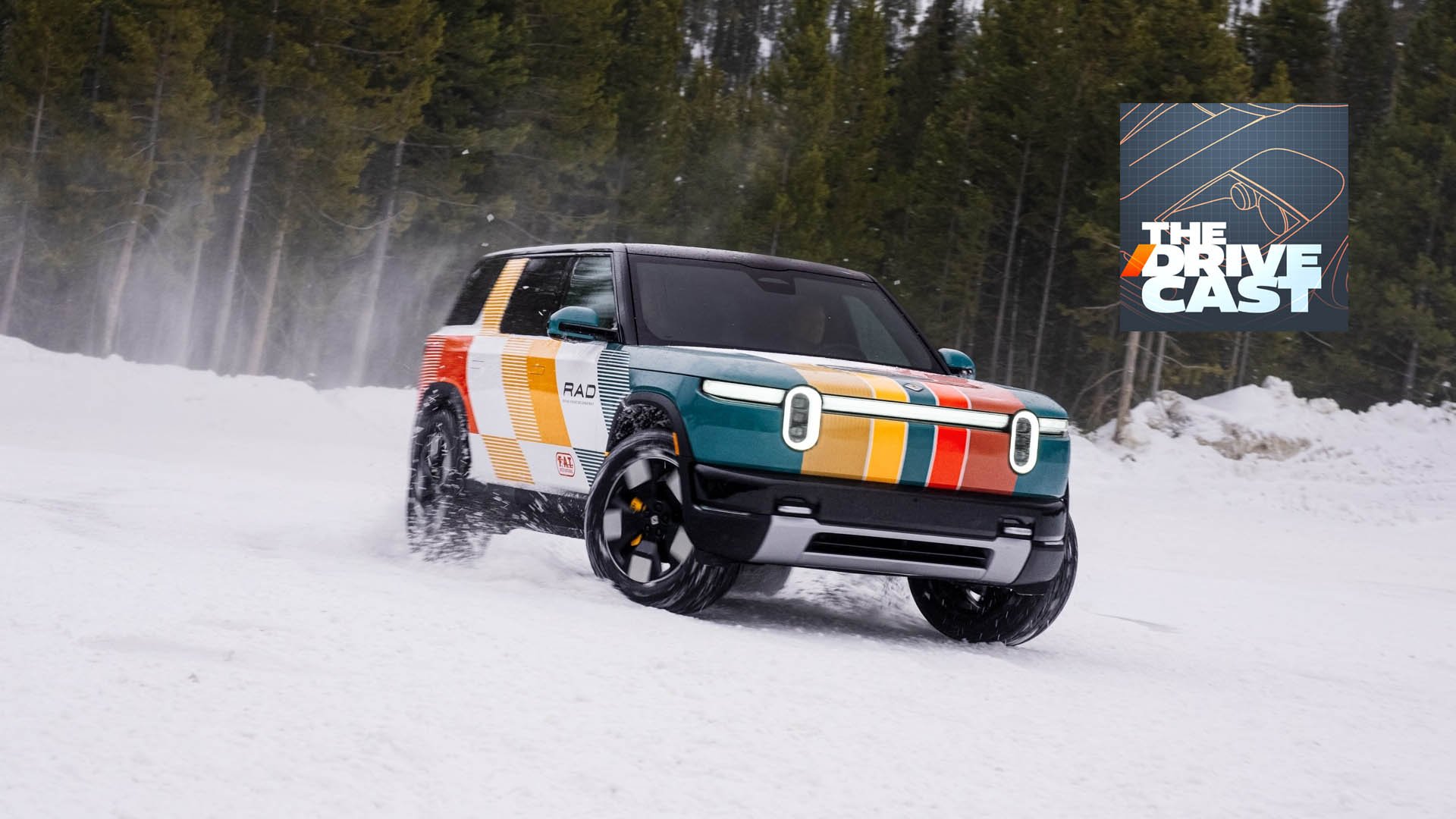
Rivian is ready for its breakout moment. The startup automaker is stepping out of the realm of lower-volume higher-priced large SUVs and trucks and into the mass-market arena with the 2027 R2. The warmup act was impressive, but the R2 is make or break for the company.
In Park City, Utah, Rivian Founder and CEO RJ Scaringe sat down with The Drive for an exclusive one-on-one discussion ranging from the entire company being built around this moment and the R2, to the automaker’s new factory in Georgia, the Rivian Adventure Network buildout, scaling a service division, growing pains, and more.
The latest episode of The Drivecast goes behind the curtain and inside Rivian’s roadmap as the automaker goes after mainstream consumers, the most important automotive segment, and up against the best-selling vehicles. Scaringe speaks about how scaling service was painful and didn’t go well out the gate along with where it is today, the timeline for the Georgia factory and its charging network, and gives a brief hint on the R4 while discussing what RAD vehicles need to be and what enthusiasts can look forward to.
First time? The Drivecast is The Drive‘s weekly podcast that takes you behind-the scenes on the largest controversies, stories, and characters shaping the automotive industry along with the way our roads look today. Powered by The Drive‘s inside access, original reporting, exclusives, and insights, The Drivecast aims to make everyone an insider.
You can listen to The Drivecast via Spotify, Apple Podcasts, or Amazon Music. Of course, you can also listen to The Drivecast on The Drive via the Podcast tab at the top and check out all the previous episodes. Like it? Love it? Leave us a five-star review on your streaming platform of choice. It really does help get The Drivecast in front of more people. Have a tip, request, suggestion, or feedback? Send us a line at feedback@thedrive.com. We read every single email, you have my word.
Full Transcript
Joel: So, RJ, I’ve known you a long time. You’re the founder, CEO of Rivian. I still remember with you when I met you at the LA Auto Show, I think it was 2018, and we were supposed to have a 30-minute interview, and after an hour and a half, you and I got ripped out of the room. They’re like, “You’re done, we’re having enough.” But we were asking all these questions, and at the time, I mean, Rivian was super young, right? It was the coming-out party. And you were so honest with so many of the answers. It was like, “You know, I don’t really know yet,” because it was day one. And you’re like, “We could do this, we could do that.” It was kind of refreshing. But for people that don’t know who you are, you’re actually a true car enthusiast. If I remember correctly, one of your favorite cars is a Porsche 911 from like the ’80s and like rally spec, lifted, and all that stuff for like dirt roads. Am I remembering this correctly?
RJ: I don’t know if I have a favorite, but that’s an interesting car for sure. Yeah, I have but uh, had to pick a 911, I’d probably pick a 993.
Joel: 993?
RJ: Yeah.
Joel: Okay. Which spec?
RJ: I would go Carrera 4S or a Turbo.
Joel: Okay, so you’re definitely—
RJ: Or Carrera 2S is pretty cool as well. I mean, they’re all they’re all great.
Joel: So you’re a true enthusiast on this stuff.
RJ: Yeah. Yeah.
Joel: All right. So I just drove R2. R2 is literally launching, I mean, yesterday when this comes out. Uh, obviously we’re both tired. Yesterday was a long day, but R2 is now getting in the hands of people. Let’s start with R2. R2 is arguably make-and-break. We talked about this yesterday as a collective group at lunch. This you’ve bet the company on this and AI essentially, right? Like, this has to fly. Right now, last year you guys made gross profit margin on the actual R1s you were making, but obviously, your net negative because you’re spending all that money on autonomy and chips and all the other stuff. Talk to me about R2’s profitability in the sense of when do we get to profitability on the actual car? And the reason I ask, for context, is Volvo’s CEO just told me a couple of months ago, the EX60 that’s coming out right now, which arguably starts at 60 grand—a little more money—it’s profitable on day one, car one. Less than their gas cars, but they’re making a profit on their EV on day one. So where do you guys stand on that?
RJ: R2 gets to profitability very quickly. So we’ve we’ve said publicly and I’ve been really um, emphatic on this. We’re, you know, the R2 profit trajectory will start to shine through by Q4.
Joel: Of this year?
RJ: Of this year. Uh, on a on a on a vehicle basis. I think something you said though, which I do want to touch on, which is really important, is Rivian hasn’t generated a net profit as a business yet, and we haven’t been cash flow positive as a business. But that’s not an accident. It’s actually a very intentional and methodical build-out of a bunch of capabilities in order to build a much larger business. And, on the product side, we’ve taken the decision of vertically integrate in almost all technically important areas. So, software, electronics, all the high-voltage systems—so that’s power electronics, the motors, everything associated with the driveline—so gearbox, inverters. And we’ve done that because we want to make both really capable products, but we also wanted to have a structural cost advantage as we got to scale. And so, in addition to the product, we also vertically integrated on the rest of the business. So, direct-to-consumer, we build our own distribution network, so our own sales channel, our own service channel. And this is, you know, many, many billions of dollars to build this out. A huge infrastructure to support distribution of the cars. So, you know, lots of parking lots and warehouses across the country. And all that investment was happening over the last few years as we built up to get ready for R2. And what’s I think missed is that that investment was, think of it as like a preloading, anticipating the volume that comes with R2. And so the volume of R2 is what ultimately allows everything that we’ve done to make rational sense. It’ll be like, “Oh, that’s why there was so much investment, this pull-forward investment in in service infrastructure, in distribution network,” and as you said, autonomy, electronics, software. And so R2’s scale is what—it’s, uh—you know, people say, “Is this a make-or-break product?” It’s it’s the product the whole business has been has been designed around. And so we absolutely intend for this to be a high-volume program. We launch it first out of our Normal facility where we have around 160,000 units of R2 capacity. We then bring on another plant we’re building in Georgia. And we’re building that across two phases. The first phase is a 300,000-unit phase, and the second phase is is roughly the same. But, Georgia will build, importantly, R2, it’ll also build R3, and it’ll build a bunch of cool variants, some—
Joel: Oh, you’re getting way ahead.
RJ: Yeah, so much we haven’t talked about yet.
Joel: We’ve got so much to cover here, and we can come back to that. But there are a couple of things before we get to any of that stuff, and I don’t want your guy’s PR people to come across the table and choke me. But there there’s so much you said in there that we have to address quickly. So just off the bat, we’ve heard various numbers, some confirmations, but how many R2 reservations do we have today? Reservations, to be clear.
RJ: We’ve only given a number once, like 20 hours after the launch event in 2024. So this was like March 7th or 8th in 2024. We decided to give a number once just to make it clear that there’s excitement. And so the number was just under 70,000 reservations.
Joel: Long time ago.
RJ: That was a long time ago. So since then, we’ve accumulated more reservations. We haven’t said how many, but—
Joel: No time like the present.
RJ: Uh, no, but but I think the the the point is we’ve we’ve we have a lot of excitement, and that is that’s that’s a wonderful thing. It’s exactly what we want to be launching into. It also does present a challenge because we have, you know, there’s there’s a lot of people that would like to get their car next week. So when we say we start deliveries next week, there’s many, many thousands of people that would like to be among the first.
Joel: In the first, yeah.
RJ: Yeah, and there is no practical or realistic way to do that. So because we’re ramping production, and so we’ve learned some things because on R1 we had a—not as big of a challenge, but a similar challenge where there was a lot of backlog or excitement around the brand and around the product. And so here, we’ve we’ve put together a very intentional and thoughtful way to decide how we roll out the volume, deliver vehicles. We’ve simplified what we’re launching with, where we have a single launch edition. But nonetheless, when there’s a like when there’s any kind of line, whether it’s at a restaurant or whether it’s at a, you know, a launch of a piece of electronics, or whether it’s launch of a car, it’s it is challenging to manage. And so we’re we’re trying to be as transparent as we can on that. And we also have to recognize that one of the things that makes this so difficult is when you have a very large pool of of reservations, we have to make predictions as to what the conversion rate is. And and if we’re off by just a small percent, it makes it very hard for being accurate and predicting when the delivery windows can be for other folks because the whole thing compresses or expands if 100% convert versus 80% convert, it has a big swing on on reservation or delivery windows that we provide folks. So we need some data to help inform how we can predict those delivery windows.
Joel: And for context for people listening that don’t know how the launch stuff works, to your point about simplifying the build configurations, you guys also have to do a prediction of like, okay, we have this many reservations, but you also have to do the context of the conversion rate, how many of those are for the launch edition, how many are for a standard, how many are for a premium, etc. And so when you’re not building those cars, those guys are automatically lower in the line because they’re coming later. And they know that because we’ve talked about the later.
RJ: Yeah, that’s actually a helpful mechanism to help like spread the line out, if you will, that like spreads across time.
Joel: So the takeaway people should have is patience is a virtue, even though it’s not something I have as one of my virtues. I understand. So, so we don’t have a solid number. Would you say it’s over 200,000?
RJ: I, yeah, we’d rather not get into it, yeah.
Joel: So, moving on—
RJ: After this, I’ll tell you off the record at least, we’ve—
Joel: Okay, we can talk when we’re no longer here, and the people won’t know. So, more more more to the point about other things you were saying, let’s talk about service. So, I mean, you’re all—I know you’re very active on the internet. Anyone that strolls through a forum or Reddit or Twitter or X or whatever they call it now will see the frustration some people have had with service. And you and I have talked about this before. You’ve been very clear, and you’re very outspoken about we’ve had some shortcomings. But we’re about to launch a product that could have multiples, exponential number of volume vehicles going out there, right? And a positive customer experience on day one—forget recalls—like just if something happens, someone needs service, a positive experience is required so that you have that love and feeling continuing about your car. How do you address what people have experienced, and how we go forward from here as we grow as a company?
RJ: Yeah, the service challenges are are—this is a really important topic. And Rivian, when we first launched in ’21, we didn’t have a lot of our service infrastructure built. And so we were building it as we were scaling, and we absolutely fell behind in a number of key markets, and a number of markets just had more volume than we had anticipated. And so that it overwhelmed the service infrastructure. And building service infrastructure, it’s not as if you sort of say, “Oh, I want to add another service station in Seattle, let’s add it next week.” It’s it’s a pretty long process. You have to identify a site, you have to build the site, you have to get permitting. You know, so it can take anywhere from, you know, 9 to 18 months depending on the location, depending on the permitting process. And so we got to a point where in a few of our markets, there were lead times for non-critical items. Let’s say, you know, like something that was broken but the vehicle was still fully operable, or something that was rattling, or something along those lines, where it would be, you know, 40, in some cases, 50 days. So you’d say I’d like my car serviced, and they’d say, “Yeah, we’ll get it in in a month and a half.” That was really critical for us just as a brand to work that down, get that from tens of days down to at most a couple of days. And we’ve done that across all of our locations today, but it’s it’s taken us some time. But a key goal for launching R2 is to have our service network ready where we have wait times for non-critical, critical items, like if a vehicle is inoperable, it’s it’s within hours. That’s just how we built the system. But non-critical items we want to have within a couple of days. And so that that was a big lift, and it was like one of the things that when we talk about launching R2 that’s probably not—we think, “Oh, product, manufacturing, supply chain,” but a lot of the rest of the business had to get ready as well. But as you said, when you go if you go scour Reddit or you go scour social media, there’s a lot of hysteresis of of past experiences, like, not surprisingly, because we’re such a young company. You know, that would have if you think of other companies, if you were to imagine like what Toyota’s service looked like in the 1960s, you probably had some similar dynamics. It’s just that wasn’t captured, and it was such a—it was like, you know—
Joel: We live in a very real-time communication.
RJ: It was a long time ago. So you don’t see those growing pains because they’ve already happened. So I think what what what I’m happy to see though is you are starting to see on a lot of those forums folks say, “Boy, my service was terrible in 2023. I had a wait for a month and a half. It was this, this, and this went wrong.” And then you’ll see somebody come back on and say, “Well, I went to that same service location. It worked out much, much better.” And so you’re starting to see even the community recognize that we’re improving in service. But it’s a huge focus for us. And with the R2, it’s a mass-market vehicle. So, unlike R1 where in many cases, it’s a second or third or maybe fourth vehicle, R2 could be your primary vehicle or it may be one of two vehicles. And so your willingness to have the vehicle out for service or to have an issue like that for extended periods of time is much lower.
Joel: So parlaying that question real quick onto one more on service, then I want to move on to a couple of other topics real quick. Right now, for the most part, historically, if you have an R1 and it has service, for the most part, you get a loaner car. That’s a that’s a pretty premium perk for, you know, usually a premium brand here in America. I’m curious now the R2 is going into production, that’s a much more mass-market car, and there’s going to be a higher volume of those. But to your point of this is usually someone’s daily driver, does that continue? Do you guys have to figure out is this a critical area, how long will the car—how is that going to be handled?
RJ: Well, you know, one of the things about service that we have not talked about enough, and I see it starting to emerge in in customer forums, is more than half of our service is done with mobile service. And so the the goal is for that to grow to a very high percentage. We’d like that to be 75%, 80% of our service activities. And so, what what mobile service is, for those that haven’t experienced it, your car is sitting in your driveway, it has an issue, you flag a ticket or you say, “I’d like to have it worked on,” and we send a technician to your house. And we have a fleet of around 800 mobile service vehicles. So it’s- mostly our our vans, which are like a a service station inside of a van. We also have some what we call RSTs, Rivian service trucks. The cool thing about the trucks is they can go anywhere. So they can if you’re in of need service and you’re on the side of a mountain, we can send a truck there. But, it’s around it’s just under 60% of all service activities today happen with mobile. And the beauty of that is you don’t need a loaner, you don’t need to worry about dropping off, you don’t even need to be there. We can let ourselves into the car, you can be you can be out of town—
Joel: It’s convenient.
RJ: It’s super convenient. Now, in the event that you need to bring the vehicle in for service, we do have a loaner program, but given the scale, this is, you know, this is something that depending on the location, depending on the type of service, it’ll it will have to assess. And so the so when you think of it broadly, there’s the service is quick, we can happen while you’re there. The service takes a while, in which case you get a ride from somebody, you use a ride-share service, you we provide you a loaner, or if you need a vehicle and we don’t have a loaner available, we provide a rental. But like, ideally not do that. One, it’s expensive to us; two, you’re we’re putting you in a car that’s not a Rivian.
Joel: Who wants to get in a gas-powered rental car?
RJ: Yeah, exactly.
Joel: Yeah. Uh, although it’ll probably sell you more cars. So, okay, moving on to charging and then product. So, charging, we’ve talked about the RAN Adventure Network, the Rivian Adventure Network. No matter how good R2 is, first off, just statistics, about 65% of America lives in single-family homes. Most America on average drive 40 miles a day, 5 miles in a shot. These are just statistics, it is what it is, black and white. But perception versus reality, we both know cars are emotional purchases, they’re not rational purchases. And people think they’re going to tow 500 miles, 5,000 pounds in a shot.
RJ: Yeah, yeah, I might buy a horse.
Joel: Yep, going to buy a horse tomorrow. Or I’m going to drive the boat to the lake every day, and it’s across the country, which, sure. But we’ve seen it time and time again. So with R2, and if so as we’re going more mass market, people obviously have charging anxiety. I wouldn’t even call it range anxiety. These cars have over 300 miles of range, EPA-rated. But charging anxiety. We’ve already talked about Tesla has the best network in the country, and you’re right behind in terms of uptime, 99%. Like, that uptime is the key here, right? You can have as many chargers as you want. But if you pull up and it’s broken, it doesn’t matter. Yeah, yeah. How quickly are we building out the RAN network? Are we still focusing on that? Have we shifted resources away from that as we’re going to autonomy and R2 launch?
RJ: We’re continuing to build it out. It’s a pretty linear buildout as it is today, meaning we’re we’re the the rate at which we’re adding new RAN locations—
Joel: No changes in plans as far as everything?
RJ: Aren’t changing relative to what we’ve seen so far. Now saying that, and we’ve got on the order of, I guess I should know the exact number, it’s like a 150 RAN locations. But that’s that’ll continue growing. Where we will start to see a big inflection point where we build out a lot faster is when we launch what we call our power cabinet 2.0. And so that’s when we update the all the power electronics that go into the cabinet that sits behind the charging dispensers. And the reason we’re waiting for that big inflection of of ramping a lot faster is the power cabinet 2.0 has been optimized for cost and optimized—it’s being optimized, I should say, for cost and for ease of installation.
Joel: So like the R2 of Rivian Adventure Network?
RJ: That’s exactly right. And so when you think about building out the network, we want to wait before we put a very large amount of investment. But it’s going to be, think of it as being timed around the launch of products coming out of our Georgia facility. So it’s not going to happen in the next few months. It’s we’re going to continue growing over the next, call it two years, and then we’ll see a like a notable step in the rate at which we build this out. But our goal is to be one of the largest networks in the United States. And so today, as you said already, there’s there’s two networks that have extremely high uptime—Tesla, which is a great network, and ours. Tesla’s a much larger network, it’s, you know, our network’s maybe 4% or 5% the size of Tesla’s. But as we think in the end state, we’re it’s going to be important to have more than one great network in the US. And and to be clear, we would love to have others. Like, this is not—we think we’d love to say there’s ubiquitously great charging where uptime is 99% plus, locations are easy to access. But unfortunately, it’s taken a little longer to get that built out than than I think many of us thought, myself included.
Joel: Let’s talk about product. R2’s launching. I was with you in February for the RAD debut. Rivian, the RAD is uh, the Rivian Adventure Department, right? And they make they, Brian Gase and his team, make the coolest stuff, right? Yesterday, on the drive for R2, I saw a RAD-wrapped R2. It didn’t look different, but it had a RAD wrap. It was a very clear indicator of like, don’t you forget we’ve got a RAD department, right? Talk to me about where RAD’s going. When will we when will we see the first RAD product?
RJ: We haven’t announced it. RAD is, it’s a one of the most enjoyable parts of developing a car, especially something like the R2, is you have all these tradeoffs and compromises you have to make. And I think the magic is when you can balance those tradeoffs really beautifully such that the vehicle feels really cohesive. But what that means is there’s certain parts of the vehicle where, for it to hit a price point, you have to decide, you can only spend so many dollars. And so where do you allocate the bill of materials? Do you put it into, you know, if you put it all into the chassis, that means you’re going to suffer in other areas. If you put all into the interior, you’re going to suffer in other areas. So we’ve tried to really evenly and thoughtfully deploy dollars across the vehicle to create the best possible combination of things. But inherently with that, we make decisions around certain aspects of performance that we think satisfy the most people. But we know that we could turn the dial up further. So, could we turn the dial to 11 and improve the performance of the vehicle dynamically? Of course, we have the the engineering capabilities to do that. And so RAD is an opportunity for us to take the vehicle which is really—it’s fantastic. I’m very happy with where we’ve landed with R2, but turn it to 11. And so what that means is thinking about it on-road, off-road dynamically, thinking about it in terms of its uh even some of the things that how it aesthetically appears—so some of the visual imagery around the vehicle. And so we launched RAD really recognizing that we create this really balanced set of vehicles, but we actually want to have some vehicles that are a little less balanced, if that makes sense, where we really go a little further on excitement, performance, and adventure. And, so that’s what you’ll see from us. So I think when when you see these, they’re they’re not just like new badging on them. They’ll going to be fundamentally improved under the skin, but that’ll add cost. And so it’s going to make them more expensive, but it’ll make them really, really exciting.
Joel: One of the things that the R3 and the R2 debut had was a tri-motor model, and I will note that on the spec sheet that I have sitting on my computer, there is—there’s a dual motor and a single motor, and there’s variants of those. There is no tri-motor. Did it evaporate? What happened to that?
RJ: Well, you know, when we—well, hence our discussion of RAD, and so there’s, you know, let’s stay tuned. I think, you know, we showed R3X, and at that time, we hadn’t announced RAD.
Joel: Really glad that we’re going down this path. Keep going.
RJ: But when you think of RAD and what it embodies, and R3X, R3X was spiritually representative of the types of things we’ll do with RAD. And we just hadn’t, when we launched ,when we showed R3X, we actually hadn’t arrived at and realized we wanted to create a performance sub-brand as a way to categorize these vehicles. But you know, if we’re where we launching or we showing R3X today, we would have called that a RAD vehicle. And so if you look at that, the track is wider, the vehicle is sitting a little higher, the wheels are, you know, these are they’re they’re both larger in diameter, and larger in diameter and and wider. The interior was really dialed up.
Joel: Got to love the cork, and those seats are awesome.
RJ: Yeah, and those the woven seats were just so cool. But it really had a like an motorsports-inspired feel to it, like a rally-inspired feel, and capability. And so that’s just one example of what this could start to look like. And and by the way, if you look at the colors that were on R3X, and you look at the colors on the RAD products, or the way we’ve talked about RAD, you can see how the inspiration really ties. Like, RAD is it’s the coolest thing about RAD, and having been a car enthusiast my whole life, you know, and growing up seeing like BMW’s M division or Mercedes AMG or, you know, the GT side of Porsche like GT2s, GT3s, you see you see these things and they’ve evolved and turned into things, and it’s fun to read the stories of like, how did M start or how did AMG start?
Joel: Skunkwork programs.
RJ: And they are. And they’re like, you can see a lot of those authentically were born out of that. And RAD is really that. It like the combination of a few people within the team, myself, authentically recognized a desire to make the vehicles even more capable, and as I said, in some ways imbalanced where you you weight put more weight on performance and capability. And I think that’s really cool. And so to now see it, to have a way to describe it with RAD, to have a product portfolio that we’re thinking about that’s going to capture that, assigning a skunkworks team whose objective is to make these cars more extreme is really cool. And the people that are going to be involved in the program, many of them you know. So you’ve already mentioned a few names, but…
Joel: I wasn’t going to start naming names again.
RJ: But there’s people like, you can probably imagine from the the cross-section of folks you’ve met at Rivian who will be on the, yeah, who’s part of like the skunkworks team.
Joel: So, the number of people online, the number of people that talk to me, and they’re like, “When’s an R3X coming? When am I going to get an R3X?” Is there any timeline? Because obviously, mass-market cars are R2, R3, these cars that get you to scale like we were talking about earlier, these cars that get you to mass market, lower price points—these have to come first. You have to make money. You have to make money before you can make really fun, low-volume, cool stuff. I get it. So does how every company works. Do we have any idea of timeline for anyone that’s waiting, and it’s like—
RJ: We have we, well, Rivian has a really clear idea on timeline. We just haven’t announced it yet, yeah. But they’ll come. Yeah, they’re coming. They’re just we just haven’t announced the date. Um, you know, it’s a couple of years away.
Joel: Okay.
RJ: Yeah. I mean, when you think about the product portfolio, there’s there’s R2, there’s R3, you can imagine there’s things we do on both of those platforms, is how I’d describe it. And there’s, of course, R1, don’t forget don’t forget we also have R1.
Joel: Big fan.
RJ: And R1 has a lot of great like with the quad-motor setup, there’s a lot of things we can push further on R1.
Joel: Also a big fan. So, speaking about R2, but I’m glad you brought up R1. R1 is R1S and R1T. R2 has R2, and today we have R3, which is R3, and then there was R3X. But you know, R2 and R3. There’s no S, there’s no T, there’s no none of that, right? There has been a lot of chatter. I mean, Ford Maverick sells in good big volume, right? We’re about to have a Ram Rampage, which is going to compete against a Ford Maverick in terms of that that compact size. R1 is not a small vehicle. Just the same reason that you’re not hitting the same market with R1S that you might hit with an R2. There are a lot of people that are online that have chattered of like, “Man, an R2T would be awesome.” And but it’s set up right now where it’s an R1 or R2. There is no R2S, right? That’s obviously a purposeful decision. Could we see an R2 pickup? Could we see a smaller pickup? Like how does it work, because we’ve set it up with R2, not S?
RJ: Yeah, that was intentional. And we’ve of course thought about all the things you’re referencing here. We’ve thought about R2Ts and even things beyond that. I would just say the platform’s capable of doing a lot. The real the like the real challenge we have is deciding what to do. And so there’s so many different cool things we can create. And so we as a company need to be focused on what’s the the next product we do or the next set of products we do that creates the most value, generates the most excitement around around the company. And that led to the portfolio that we’ve talked about publicly, so R2 and R3. I think the R3X was a really good, it was intended to be, and probably was picked up less, but it was intended to be a signal of the types of things that could come. To say, off the R2 platform there could—or off the R3 platform there is a—there’s a unique variant, and off the R2 platform there could be unique variants. There’s a lot of things you could do. And so in the fullness of time, I wouldn’t rule anything out. But in the in the immediate future, I wouldn’t I wouldn’t hold out, you know, I wouldn’t hold out for any any of those like very different variants. It’ll it’ll stay R2.
Joel: Do you see a a market, a viable market for a smaller than R1 electric pickup? Because we don’t have —
RJ: Yeah
Joel: … a smaller than R1 electric pickup right now in the market.
RJ: Oh, I think there’s a, I mean, you you’ve heard me talking about this before. I think in the world of electrified products, there’s a lot of different segments that just have not been addressed yet. The first, that really hasn’t been addressed is the true midsize SUV, we don’t have a great midsize SUV that consumers can buy today. There’s midsize crossovers, but not true SUVs. The smaller trucks space, I think there’s a a big opportunity, the idea of adventure-oriented crossovers. I think there’s a big opportunity, hence R3. There’s R4. So we we also have to recognize on the platform there’s going to be things that come beyond R2 and R3 that we also have to make a tradeoff against in terms of what’s the next set of things that we do.
Joel: What form factor might R4 take?
RJ: Oh, we haven’t that’s a it’s very cool, but not yet not ready to talk about it yet.
Joel: Could it be a pickup?
RJ: It could be a lot of things, we haven’t—yeah.
Joel: It could be a pile of goo, it could be anything.
RJ: We can’t —
Joel: Anything your mind wants.
RJ: Yeah.
Joel: So talk to me there there’s been cool patents that you guys have filed specifically I mean, they were earlier patents, right? For like R1 or whatever, with like brush guards and winches and like canopies and all these other things. Are these just ideas? Are these things we could see in accessories? Are these things that that could come to market, or is just like, we got to patent this because we came up with an idea, but —
RJ: A little bit of both, and sometimes we develop something, we decide not to launch it, but we still patent the idea. You know, a winch is something we’ve long wanted to put on an R1. It is a bit challenging, though, because it’s a—it really impacts from a regulatory point of view, it’s, you know, it’s a challenge to put a big chunk of incompressible metal on the front of the car. So it affects crash and pedestrian protection, and so the way that historically happens is third parties do that work. And so the aftermarket can can do these things. Because we create our own accessories and we are the OEM, it is a bit more challenging. But we’ve thought about it a lot. Coming back to RAD, I think there again, remember that discussion. I think there’s a lot of cool things that can come when we talk about RAD. We we the second word adventure, we intentionally use the word adventure department as opposed to like performance. The performance is an element of adventure, but adventure is a broader category, so that means that can enable a whole host of things. Things like winches, I’d I’d—
Joel: So the RAD department doesn’t have to necessarily be vehicles, it can be vehicles, it can be components—
RJ: Vehicles but but plus things that make the vehicles more exciting.
Joel: Okay. Let’s talk about repairability. So, if you go on—and this is a two-part thing, a two-part setup. One, if you go online and you see chatter, people are complaining just in general, forget Rivian, for a second, just in general in the marketplace. Cars are complicated, consumers don’t understand how complicated, to be frank, and cars cost a fortune to fix. “I can’t do it myself.” The days of taking a headlight bulb out and changing it myself, forget about it. And you know, I see people whether they have an R1, they have that little plastic trim right below the grill and it cracks, they’re like, “You got to take the whole bumper off, and it’s a three-piece thing,” or whatever. Mercedes just announced new headlights that are going to be components that are that are screwed together, that actually screw together, and you can take them apart and there’s certain components you can change a certain component and not the whole thing, whereas, you know, a Hummer EV, you got a $9,000 taillight, right? Rivian’s you got the taillights, they’re expensive. Like if you go online anywhere, “I cracked a taillight, that’s three grand.” “I dented my rear quarter panel, it’s 14 grand.” They’re aluminum.
RJ: Yeah.
Joel: How do you address repairability in this era where vehicles are, frankly, really complicated, but they have to be really complicated to be this capable and and and full of tech?
RJ: I mean, that was a big driver of R2, is this we designed for manufacturing ability. We also designed for repairability and cost for repair. That’s, and there’s two sort of two elements for repairability. One is something breaking, something wearing out, something being damaged through use, and then there’s also collision. And they’re they’re a bit different. And on the breaking side, that’s a very pretty trackable problem. On the collision side, it can be challenging because a lot of the things you do in the vehicle, you design it for safety, so there’s a combination of manufacturing, safety, and then repairability. And often those things are pulling in different directions. So safety, you want things to crush and and think of it as if you run into a brick wall, you actually don’t want the car to not crush. You actually want it to collapse and absorb energy. And so by virtue of that, you’re you’re absorbing energy into a lot of content and you break a lot of content, but by virtue of that, it’s a safer vehicle. And on the other side of the coin, if you’re thinking about it from manufacturing ability, you want to consolidate parts. You want to have a small number of parts. And so the best example of this is the use of very large high-pressure die castings to replace assemblages of stamped parts. And the benefit of that is you have less parts that have to go together. The challenge is if you break that one part, it’s like, you know, it can be a lot of the car is embodied there. And so we’ve tried to balance between those three competing objectives—cost, safety, and repairability. Of course, I say balance. Safety we didn’t we didn’t reduce. We’ve said the car has to be a five-star, it’s like we’re we’re targeting for this to be one of the safest vehicles on the road.
But we did make some decisions differently on R1. We used a one-piece body side, and so that that means if you damage like the rear fender, the repair operation, depending on the level of the damage, you can either do body work or you have to cut out a portion of the panel, re-weld the new panel on. And we actually, as part of our service parts for collision centers, we have subsets of the full panel so we don’t have to replace the full body side. And and one of the challenges on collision is you don’t go to Rivian collision centers. This is actually uses third parties. And so third parties, the reason you saw some of these really high numbers, is we’re like, “A Rivian? And what’s a Rivian?” So they they don’t know the car, and they quote an enormously high number, the insurance company agrees to it, and then that happens. We have standard procedures, and there’s no collision repair that should cost tens of thousands of dollars. These are like very unique anomalies that are a specific, you know, probably a mom-and-pop collision center has not seen a Rivian before, didn’t phone us, you know, call us as as as Rivian to say, “Hey, what’s the process?” didn’t look at the parts, like, you know, sort of quoted a really high number because they probably didn’t want to do the work.
But on R2, the way we’ve broken up the body in terms of panels is been very intentional for the types of collisions. So if you look at the rear fascia on the car, it actually wraps around pretty far, and the fascia is made of plastic, so it’s actually more resistant for, you know, basketball hits it, it’s not going to damage it, whereas the body side is made of metal, so if you dent that, it’s something else. And so we’ve been very thoughtful on trying to create a vehicle that has less need for body repairs for like day-to-day usage, shopping cart hits it, you know, back into, you know, back into something light, a basketball pole or something. But also recognizing that when damage does happen, we’ve sort of partitioned the vehicle in a way that’s more thoughtful for those collision repairs.
Joel: Got it. Let’s talk one last time about future product. Particularly around screens and controls. So we’ve been very clear, Wassym’s been very clear, your your chief software officer’s been very clear about Apple CarPlay. We’ve been very clear about new Rivian 2.0 OS, which is launching on R2, the simplified interface, feedback from consumers bringing in that bar, I think it’s called a—I don’t remember the bar, the vertical bar on the left side, bringing those controls closer to driver. But now we have halo wheels, right? And a bunch of your team was talking to me about that was driven by consumer feedback. We want some tactility. The stalks have a bunch of buttons now and roller knobs. Talk to me a little about integrating the that consumer feedback to bring controls while keeping the touchscreen interface into the future.
RJ: Yeah, the haptic wheels that are on the steering wheel, that’s that was a very large engineering effort because when you’re rotating those and you hear the like feel the haptic clicks—
Joel: Click, they’re clicking.
RJ: That actually software, so there’s not actually no indents like you’d have in a typical wheel that has that click.
Joel: Which is trippy, because I can feel the click click click in my fingers.
RJ: What it is, is it’s a little motor that’s creating that that torque rise and torque fall.
Joel: Similar to an iPhone, how it vibrates with the little motor thing.
RJ: Yeah, so it’s all software-driven. And the beauty of that is that those wheels now are completely configurable. So while they have all the haptic clicks, when you go to a different screen, the wheels update, or if we have an over-the-air update we want to change some of the capabilities of the vehicle and have those haptic wheels do something different or behave in a different way, that’s entirely possible. And so that was one of the reasons we initially were so philosophically aligned with using a multi-touch screen, is we liked the ability to continually refresh and update it. But as you said, we wanted to have some more haptic experience, and so we creating those wheels was a big a big part of that and a huge engineering effort. Far bigger engineering effort than it looks when you see it finished. Inside of that wheel, there’s a PCBA, there’s a motor, there’s a motor driver, there’s cooling systems, it’s quite complex. And then as you said on the stalks, we put more thoughtful design into some of the controls, or as you said, a little knob for rotating up and down on the speed when you’re in self-driving mode. But, you know, I think the element beyond touch, beyond some of the the physical controls, and then beyond the multi-touch, is we also see voice starting to play a role. I think that’s that’s going to take some time for consumers to start to adopt it.
R2’s going to be a higher level of adoption than what we saw in or than what I think you’ll see in even R1 because the way we’ve developed in R2 is we have an onboard, really capable inference platform, so 200 TOPS platform just for just for user interface. And the beauty of that is we can run fairly large models on the vehicle, and so we don’t have to like go up to the cloud for voice. And so if you say like, “Open my garage,” or, “I’m hot,” you know, the vehicle can interpret that in a very conversational way to to to respond. Like, the garage opens or the AC comes on. But I do think that that’s going to layer in over time. We look at those as having, you know, being a parallel path. So you can either go through the screen, you can go through the mechanical physical controls, or you can talk to the car and it’ll respond. Different demographics will respond differently to this. It’s, we’re at an inflection point, I think, from a society point of view where we’re starting to use voice more because it’s suddenly become a lot more capable.
Joel: That’s fair. I remember when Siri first launched, it was kind of a mess.
RJ: Yeah, it was very hard to use. It’s like, “Turn on the music,” and it’s like,
Joel: “But you didn’t use the right command, you didn’t use the password.” You got to have the right handshake. All right, so I want to be respectful of your time. You’re busy. One last question. If you were talking to Rivian owners who were either frustrated, Rivian potentials, Rivian enthusiasts, any any any demographic you choose, what would what would you say to them if they were sitting across from you of like the future of Rivian, the message? What would you tell someone who’s an enthusiast about Rivian to look forward to, to be excited about, whatever?
RJ: I’ve never been as excited about something that we built. This is, you know, even with R1 being our first car and, you know, so many years of time going into that vehicle, R2 represents all the learnings and so much progress as as a company. And so, I’ve never been as excited as I am about this vehicle. I think it’s it’s a really beautiful combination of performance, capability, and and engineering to achieve a price point that I’m excited for people to experience. And so that’s, you know, that’s the beginning of us moving to this mass-market realm. And and then the things that can come off those platforms. So for an enthusiast, imagining the RAD versions of those cars is pretty exciting, putting aside the fact that these are already high-performance cars. But even even looking beyond that, just the number of things that the vehicles can do and the experiences they can enable, it’s really exciting.
Joel: It’s funny, and this I don’t know if this a bonus question or whatever, but it’s funny you mention that because yesterday when I was driving the car, the thought that kept coming to my head is, how did you make this car cost what it costs and feel, look, and drive the way it does? That’s what kept coming to in my head of like, what am I missing here in this contextual equation? Of all the cars that I’ve ever driven, I’m like, I don’t understand how we got here because this feels greater than the sum of its parts. The Rivian R1 feels like an expensive car, and it is an expensive car, right? It is feels like it and it is. The R2, it feels more than it costs, and that’s the thing that bewilders me.
RJ: Yeah, that was the goal. It cost a lot less to make, yeah.
Joel: It’s truly it is an impressive feat.
RJ: Oh, well thank you. Yeah, yeah, well thanks, yeah. Yeah, it’s wild. I mean growing up, I remember, you know, reading car magazines and getting so excited to see a car that broke the 4-second mark, 0 to 60. You know, like the we referenced at the start of this, like the 993 Turbo when it hit 3.6 seconds, it was like, “Oh my gosh, that is so fast. I wonder what that feels like,” I would think to myself. And now our, you know, $50,000 R2, which can carry your kids, it can go off-road, it’s got a front trunk, it’s got all this capability, it not only does 0 to 60 in 3.6 seconds, but that’s that’s actually the less impressive part about the performance. It’s like the 50 to 80 or the 60 to 90. It’s so quick at higher speed, and then dynamically it’s beautifully balanced. I think we’ve dialed it in a way that it’s it’s very neutral for when you want to be neutral, but if you want to drive it quickly and reduce stability, you can you can let it slide around a little bit. And to do all that on a midsize SUV, it’s just so it’s so cool.
Joel: I mean, we’re not under embargo anymore, so I will say as someone who doesn’t work for Rivian, I can confirm that it is like a lot of EVs, people may have not driven EVs, you know, the 0 to 30 is the party trick, right? There was that joke that like there were Chevy Bolts that could do 0 to 60 or 0 to 30 as quick as a Corvette, right? But then after you hit 30 and really 60, speed in a lot of these cars drops off, right? It’s diminishing returns. But unless you get into something like a Rivian R1 or a Lucid Air or whatever, that 60 to 100 or whatever, it’s not as quick. It’s not dangerous on the highway, but it’s not as quick. I will say, you know, I was on the highway yesterday doing 65, and then I just put it all the way to the floor, and I mean, you can easily go to jail speeds very quickly, and I’m like, “All right, so that’s impressive.” And you reduce stability control a little, you can absolutely hang the tail out, not that you should do that on public roads, but it is controllable, it is fun, it is tossable. It’s it’s it’s a really complete package. I’m truly in awe.
RJ: Yeah, well thank you, thank you, yeah.
Joel: Thank you for taking the time, really appreciate having you on the podcast. We’ll be back.
Loading comments…
Comments couldn’t be loaded. Please refresh the page.