
That headline is not a typo.
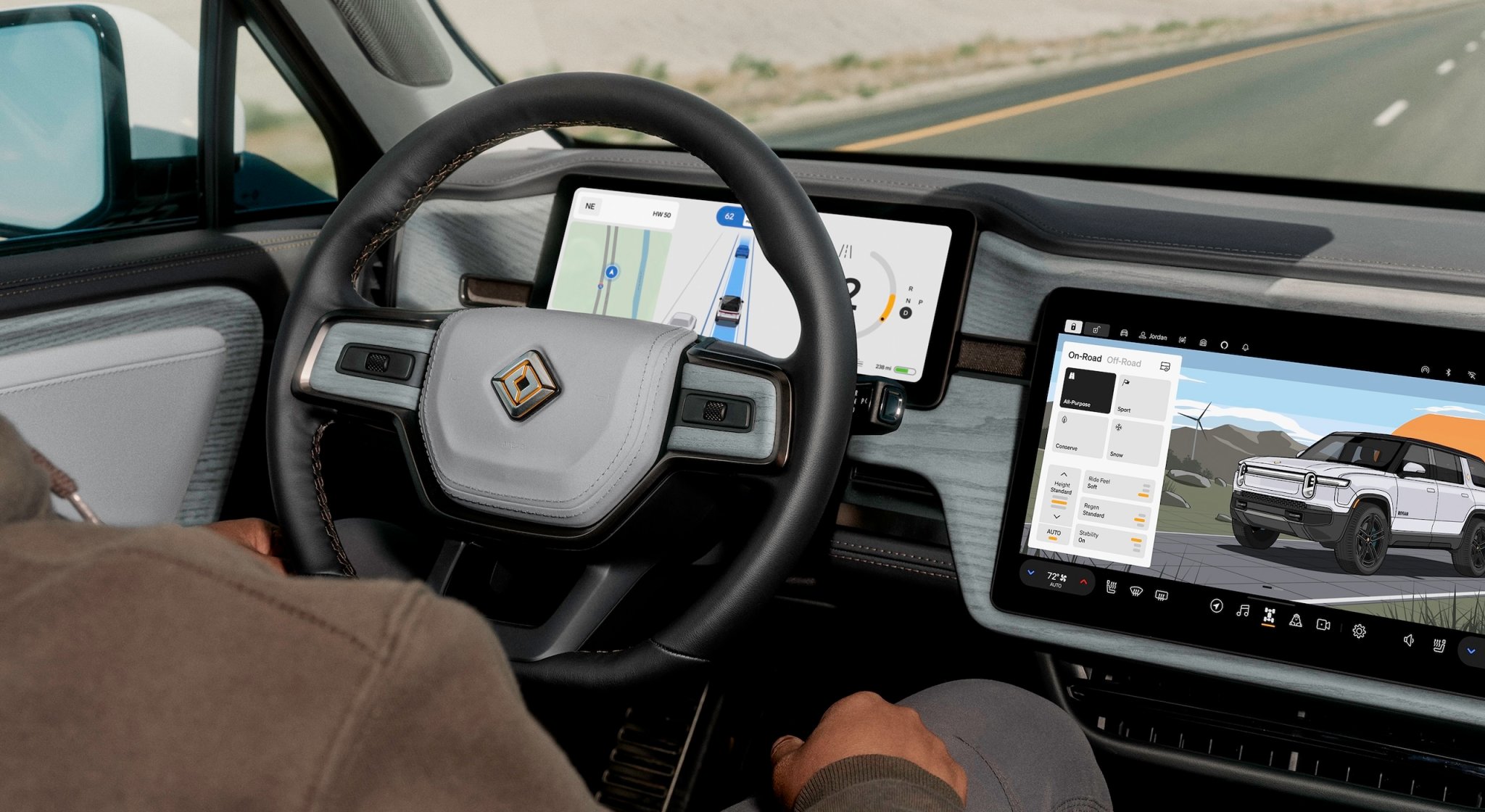
During Rivian’s Autonomy and AI Day in Palo Alto, California on Thursday, the automaker announced its new Universal Hands-Free (UHF) hands-free driver-assist system, and it’s going to be available on over 3.5 million miles of roads in the USA and Canada.
Set to launch later this month on second-generation R1 vehicles, the UHF system will be part of a free software update, which a Rivian spokesperson told The Drive will be 2025.46 for owners keeping track.
Rivian’s current hands-free driver-assist system, known as Enhanced Highway Assist, works on 135,000 miles of roads, namely highways, in the U.S. and Canada. The system relies on map data in conjunction with the vehicle’s cameras and radar sensors, and thus only works on mapped roads. The new UHF system moves into a real-time future.
Rivian said the system will operate on- and off-highway on roads with clearly painted lines, marking a large expansion of capabilities over today’s system.
A Rivian spokesperson told The Drive, “the 3.5 million (mile) estimate is based on our analysis of marked roads using a third-party data source.” This implies the UHF system is not relying on map data to operate like today’s Enhanced Highway Assist and is working in real-time to understand road conditions. This is also what unlocks the exponential increase of area in which drivers will be able to have Rivians operate in hands-free mode.
The UHF system will operate much like today’s Enhanced Highway Assist in terms of operation, a Rivian spokesperson told The Drive. It’ll be engaged by pulling the gear towards the driver twice.
The UGH system leverages Rivian’s second-generation electrical architecture and sensor array, meaning all second-generation R1T and R1S models will receive the free over-the-air software update unlocking the capabilities. First-generation R1 models, which do not have today’s Enhanced Highway Assist, will not be capable of UHF and will not receive this feature.
That hardware list is extensive and includes an in-house developed RTK GNSS (real-time Kinematic Global Navigation Satellite System) that uses a GPS plus ground station signal to refine the vehicle’s position to within 20 cm of its latitude and longitude, 10 external cameras, 12 ultrasonic sensors, 5 radar units, and a high-precision GPS receiver.
To date, Rivian has given second-generation R1 owners its Autonomy+ suite, which includes the Enhanced Highway Assist function, for free billing this as a free trial through the end of 2025. When UHF rolls out, and it replaces today’s system, Rivian will continue this free trial for customers initially. The automaker plans to start charging $49.99 per month or a one-time $2,500 in 2026 with new owners receiving a 60-day free trial. If the one-time $2,500 is paid rather than a monthly subscription the lifetime Autonomy+ access will follow the vehicle for its entire lifecycle regardless of ownership change.
This is all the start of what’s to come, a Rivian spokesperson told The Drive. The UHF system will continue to evolve with more capabilities rapidly. Over the next year UHF will see the addition of stoplight and stop sign detection, among other features.
The trajectory of Rivian’s hands-free system, according to the automaker, is full Level 4 point-to-point eyes-off hands-off driving capabilities. This is to be enabled by a new in-house designed silicon chipset and the addition of Lidar, which will first launch on the R2 late in 2026.
Got a tip about future tech? Send us a note at tips@thedrive.com
Loading comments…
Comments couldn’t be loaded. Please refresh the page.