

Over the years, I’ve found myself telling people that you can’t truly appreciate a German car’s build quality until you’re on the Autobahn, doing some ungodly speed that would send you straight to jail back in the U.S.—or most other countries, for that matter. That’s when you’re truly thankful for that tank-like stability and how everything is built to a higher standard. Y’know, that hefty feel of an Audi, BMW, Mercedes-Benz, or Porsche.
Late last year, during the reveal of the Genesis GV60 Magma, I caught up with creative extraordinaire Luc Donckerwolke, who serves as President and Chief Creative Officer of the Hyundai Motor Group. Though, as you may know, he’s also the mastermind behind some of this generation’s best car designs, including the Lamborghini Murcielago, Bentley Continental GT, and many more.
Donckerwolke, who is Belgian but primarily resides in Germany, often loves to tell anecdotes about his design and engineering inspirations. He shared with me what I found to be a rather hilarious bit about windshield wipers. Specifically, how his own experience behind the wheel of a Genesis—which at the time had just forayed into Europe—led to a real-world improvement. And perhaps even more importantly, it helped Genesis grasp the culture of high-speed driving that is synonymous with high-quality German vehicles.
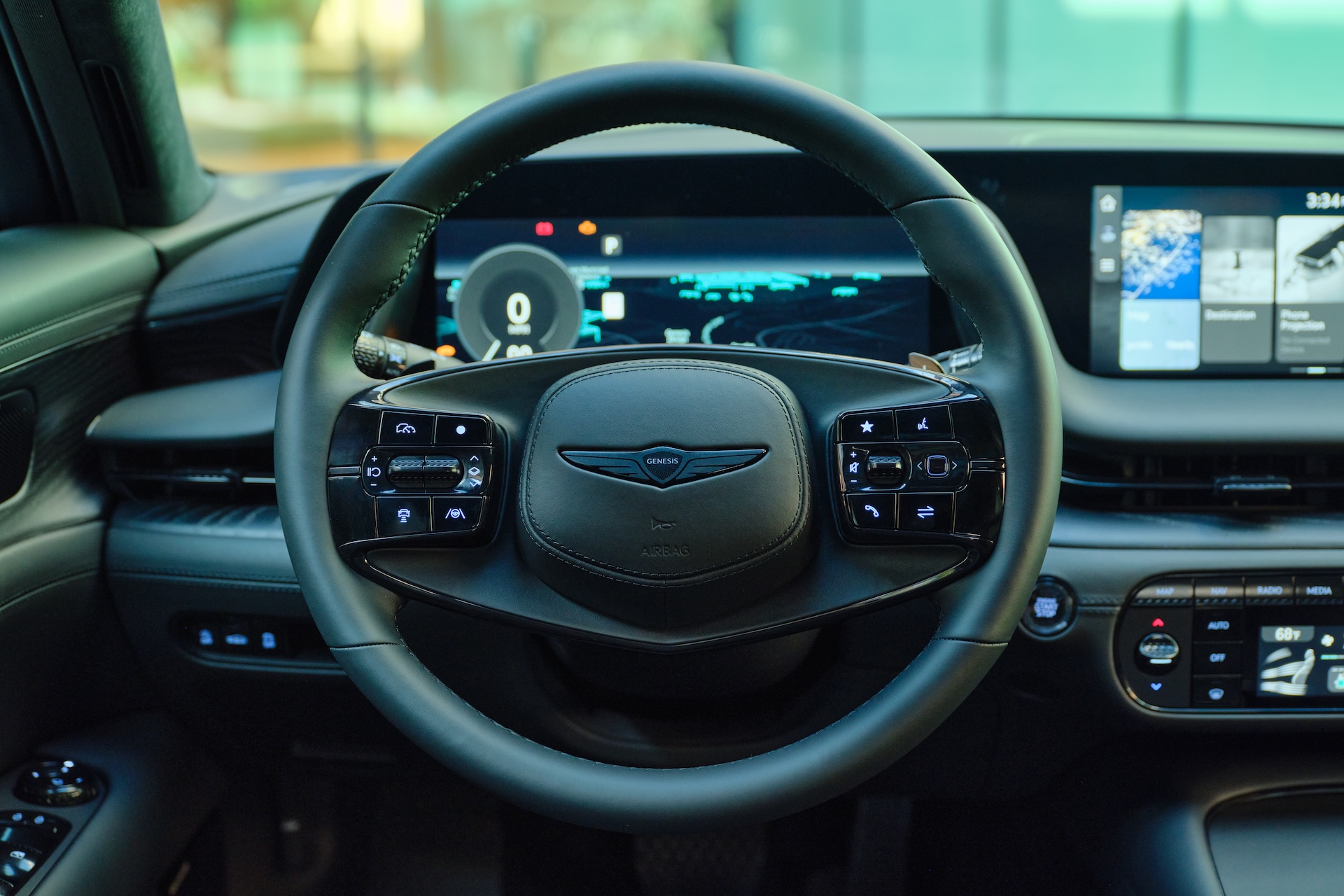
“What happened was, the Genesis cars that we initially brought in Europe, when we first developed them, they were not actually intended for the European market,” Donckerwolke told me. “So, we brought the cars to Europe, and then we had the guys at the German research and development center, the HMETC in Rüsselsheim, tuning the cars for improvement.
“But there were some things that we did not consider necessary until we actually used the cars [in the real world]. For instance, the car’s top speed was limited to 158 miles per hour, but I found out that at around 150 mph, the windshield wipers were not wiping exactly as they should have,” he added.
“The initial reaction to my feedback was: ‘Why would you want to drive in the rain at 150 mph?'”
“It’s something that you don’t really test at top speed, because it’s usually unnecessary. But I was the first one to comment on that, because I do a lot of Autobahn driving, and I’m always used to going the maximum speed,” he chuckled.
Donckerwolke did not specify which Genesis model he was in, nor whether it was a sedan, an SUV, or even one of those sweet wagons they have in Europe. However, most, if not all, Genesis models in the U.S. can reach 150 mph, with those equipped with the higher-output engines topping 170 mph. And while only a tiny fraction of consumers will ever dare drive at those speeds on a wet road, it’s still reassuring to know that the designer’s feedback was taken seriously.
“What ended up happening was, we substituted some parts, and we changed the profile of the wiper blades. We decided to implement an air blade for the wiper arms, and it was done. It was fixed.”
When I asked if he was happy with his wipers’ performance on his Autobahn runs now, he simply smiled and said, “Yes.”
Email the author at jerry@thedrive.com
Loading comments…
Comments couldn’t be loaded. Please refresh the page.