
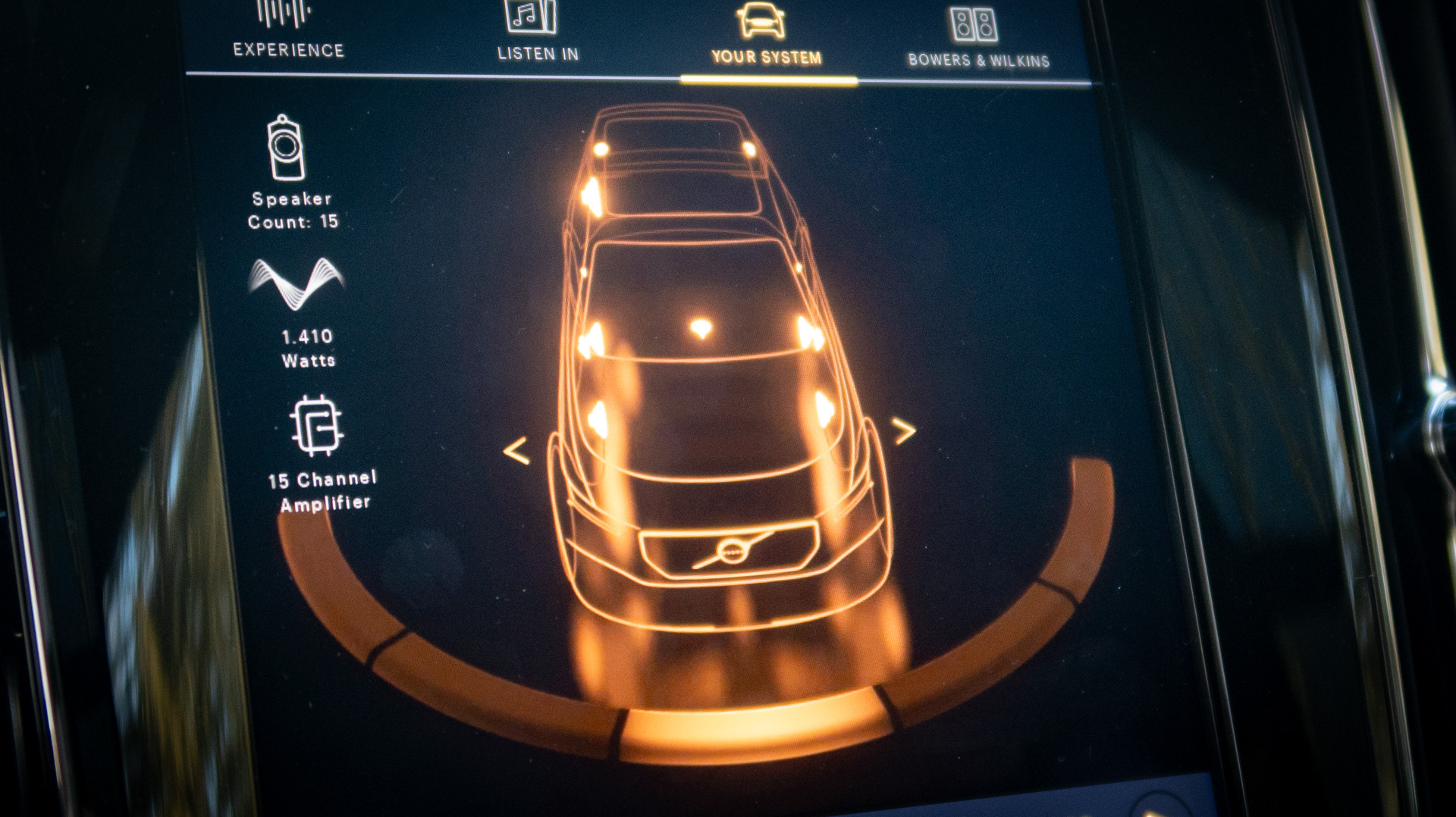
The Bowers & Wilkins Premium Sound system in the 2026 Volvo V60 Cross Country Ultra is the best OEM car audio I’ve ever heard. It drenches the cabin in music that’s uniquely both loud and clear—even when handicapped by a streaming Bluetooth connection. Volvo’s B&W setups are famous for acoustically mimicking specific music venues, and of course, you can fiddle with the equalizer yourself if you’re so inclined. The system also has adjustable “envelopment” and “intensity,” which you don’t normally see in a sound settings menu. Volvo’s people were kind enough to explain what exactly those terms mean and how they work in this car audio context.
If you get a V60 CC Plus ($54,000 base model), you can upgrade the car with a 14-speaker, 600-watt Harman Kardon Premium Sound System for $800. If you step up to a V60 CC Ultra (starts $5,300 higher), you get that H/K system plus a four-zone climate control system and fancy Orrefors crystal shift knob. From there, you can drop another $3,200 on the 15-speaker 1,410-watt Bowers & Wilkins Premium Sound option we got to sample here.
My take as a casual music appreciator, believe it or not, is that the big-money B&W is worth it. Especially since three grand tucked into a $60,000 car will barely make a mark on your monthly payment. As Volvo’s briefing puts it: “To enable extremely low and undistorted bass tones, an air-ventilated subwoofer uses innovative technology that allows it to pulse enormous amounts of air—without encroaching on load space.”

I’ve been lucky enough to experience many OEM car audio systems. This Volvo’s B&W kit stands out to me mostly because of how well it can belt out music at high volume without compromising richness or clarity—everything from the hype-stoking wail of “No More Tears” to the goofy-ass computer-generated Viking ballads that I’ve been rocking out to all winter—simply sounded cleaner and more powerful to me than they have in any other car.
True audiophiles tend to dismiss car stereos as a collective lost cause, due to the inescapable ambient noises of wind and tires. But to me, a car is one of the best places to spend time alone with music, whether it’s classic Ozzy Osbourne or guilty-pleasure parody tracks. It’s just fun to crank up the volume and kill some brain cells in the privacy of your car’s cabin on your way to wherever. And in fact, the word “stereo” only applies colloquially—there’s a lot more going on than just two speakers.

The dashboard speaker is a B&W signature. 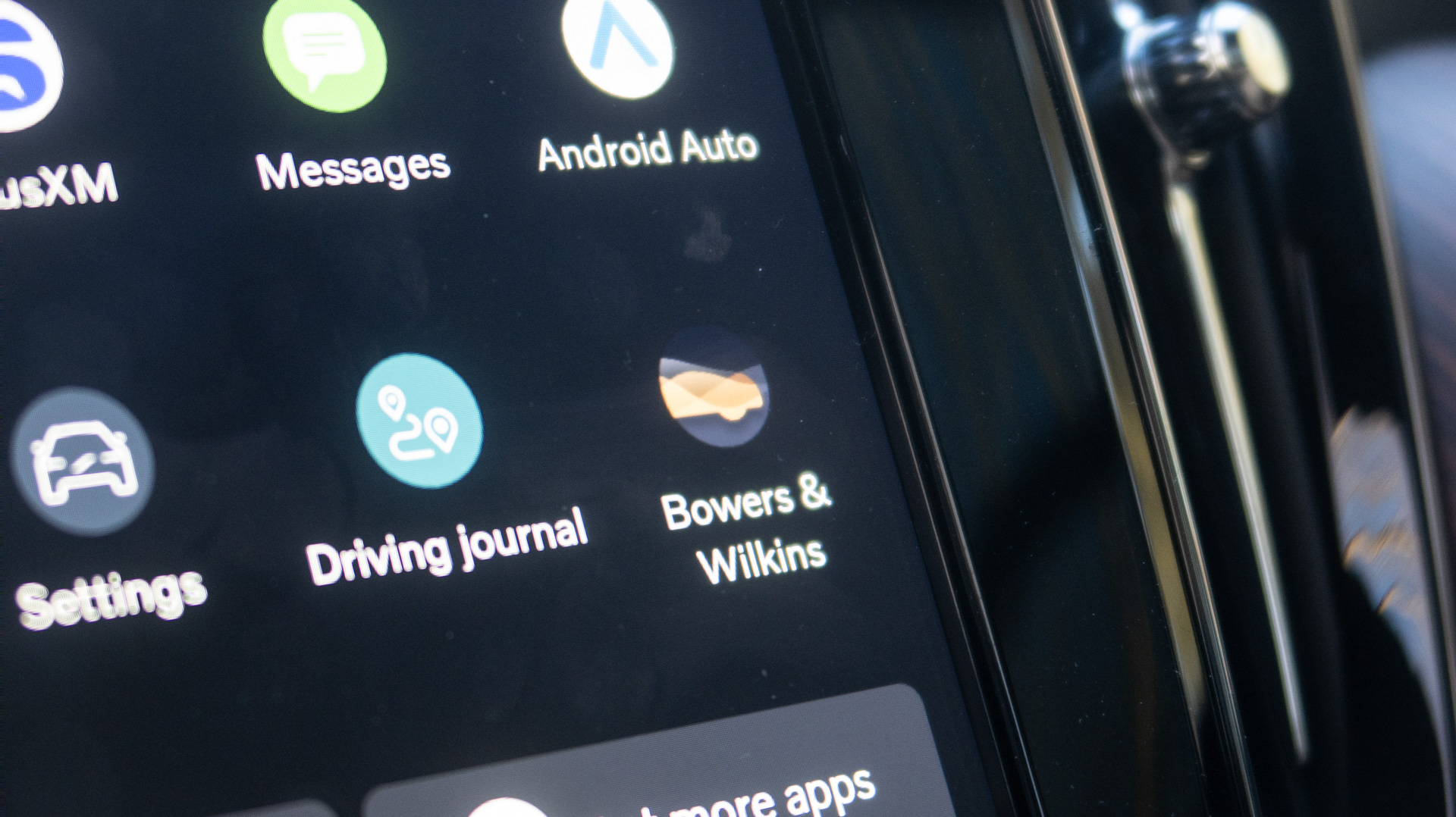
The stereo brand has its own app within Volvo’s infotainment. 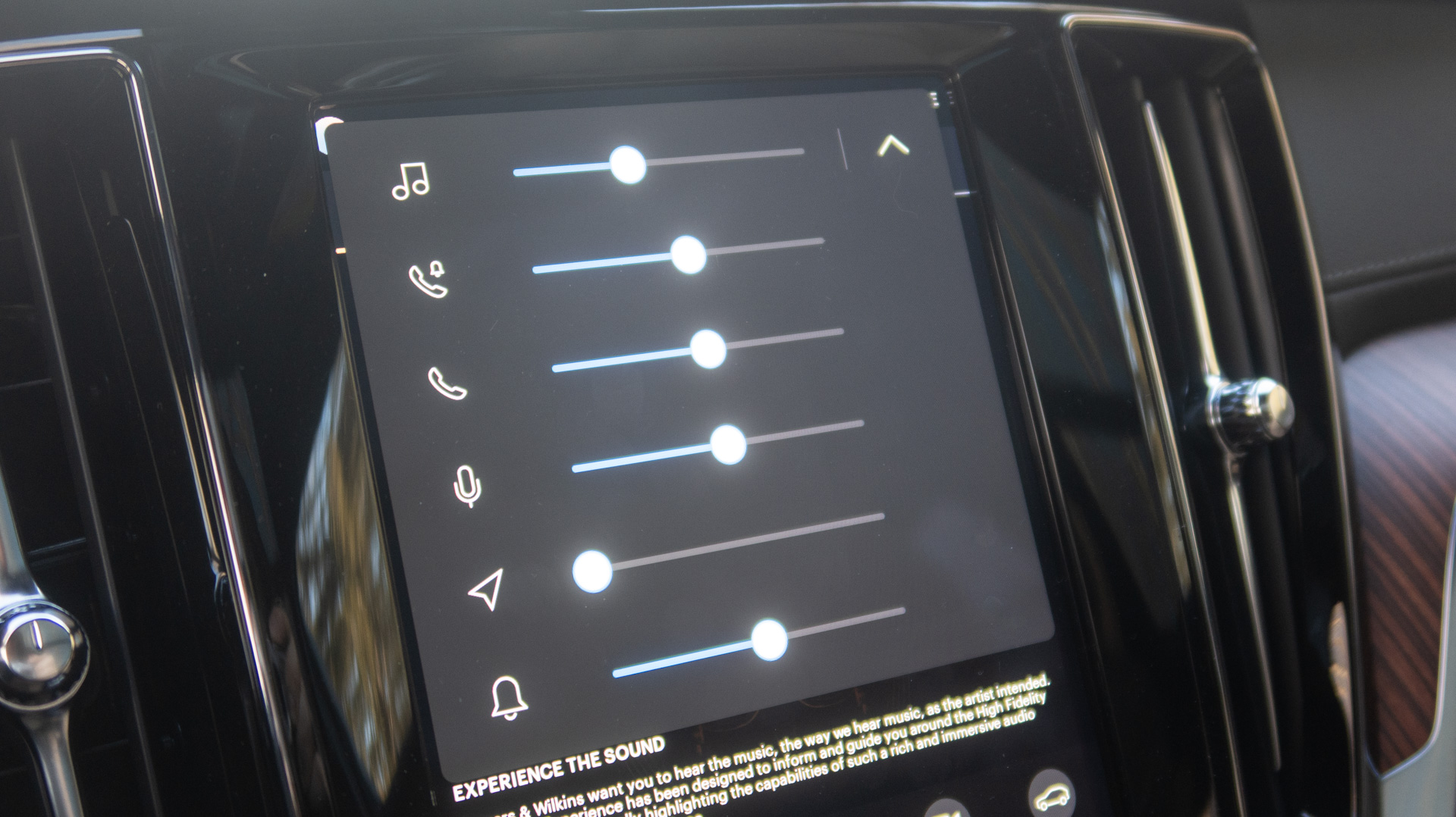
You can easily adjust volume on each individual function very easily. 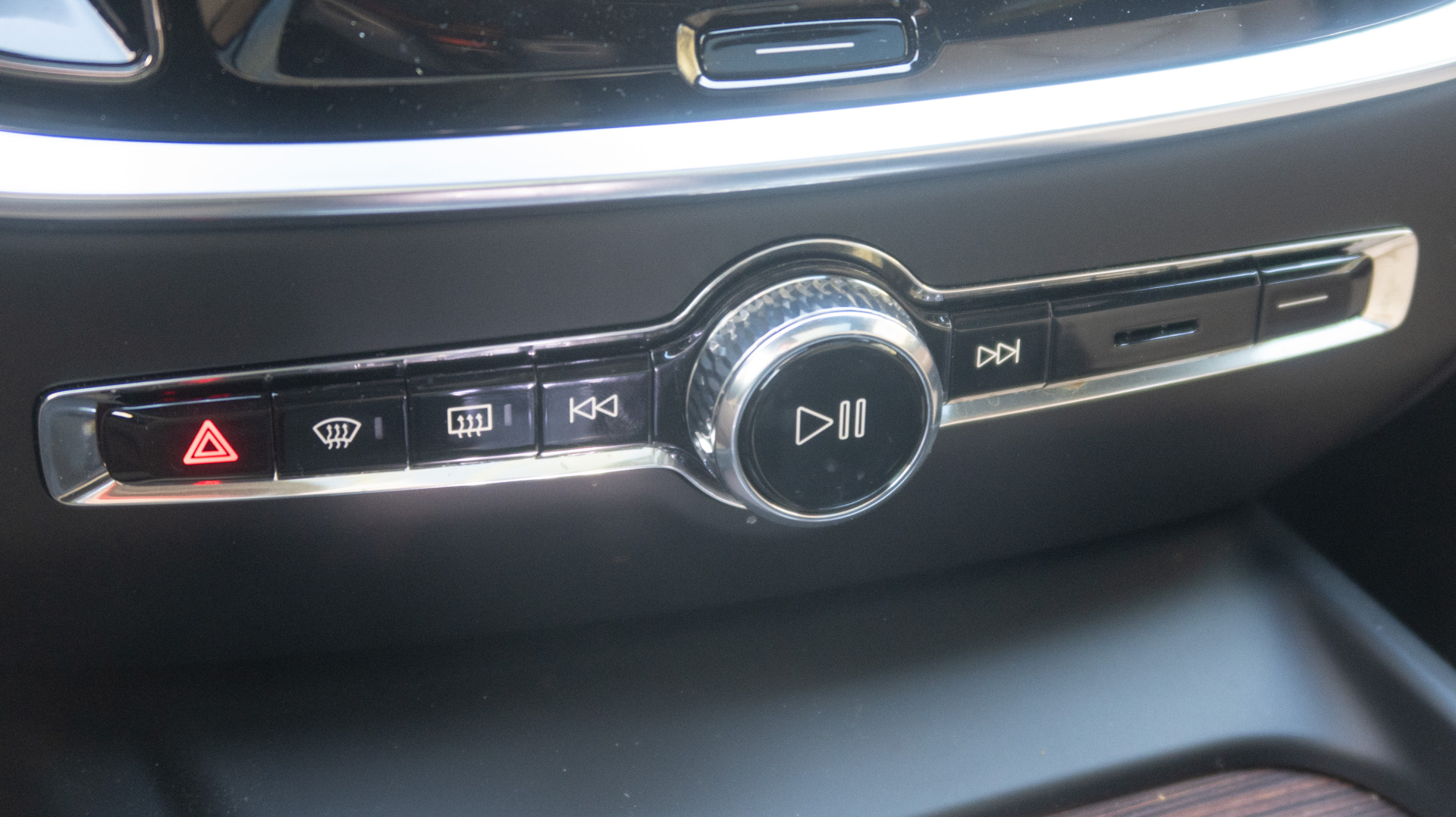
The volume knob and track controls are a literal centerpiece in the V60’s center console 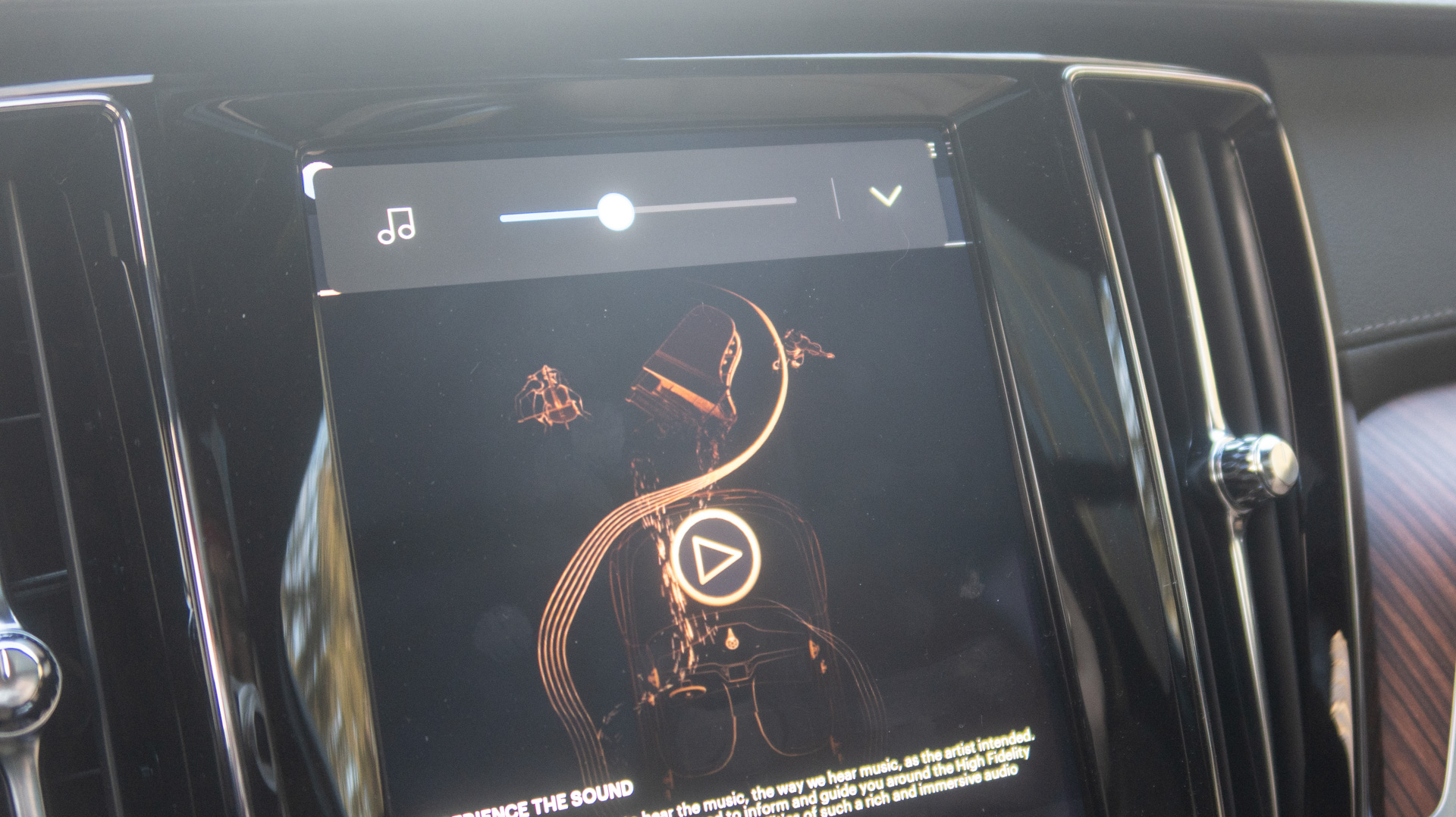
There are some funny B&W promotional clips baked into the car’s infotainment. You can use this to impress passengers, I guess. 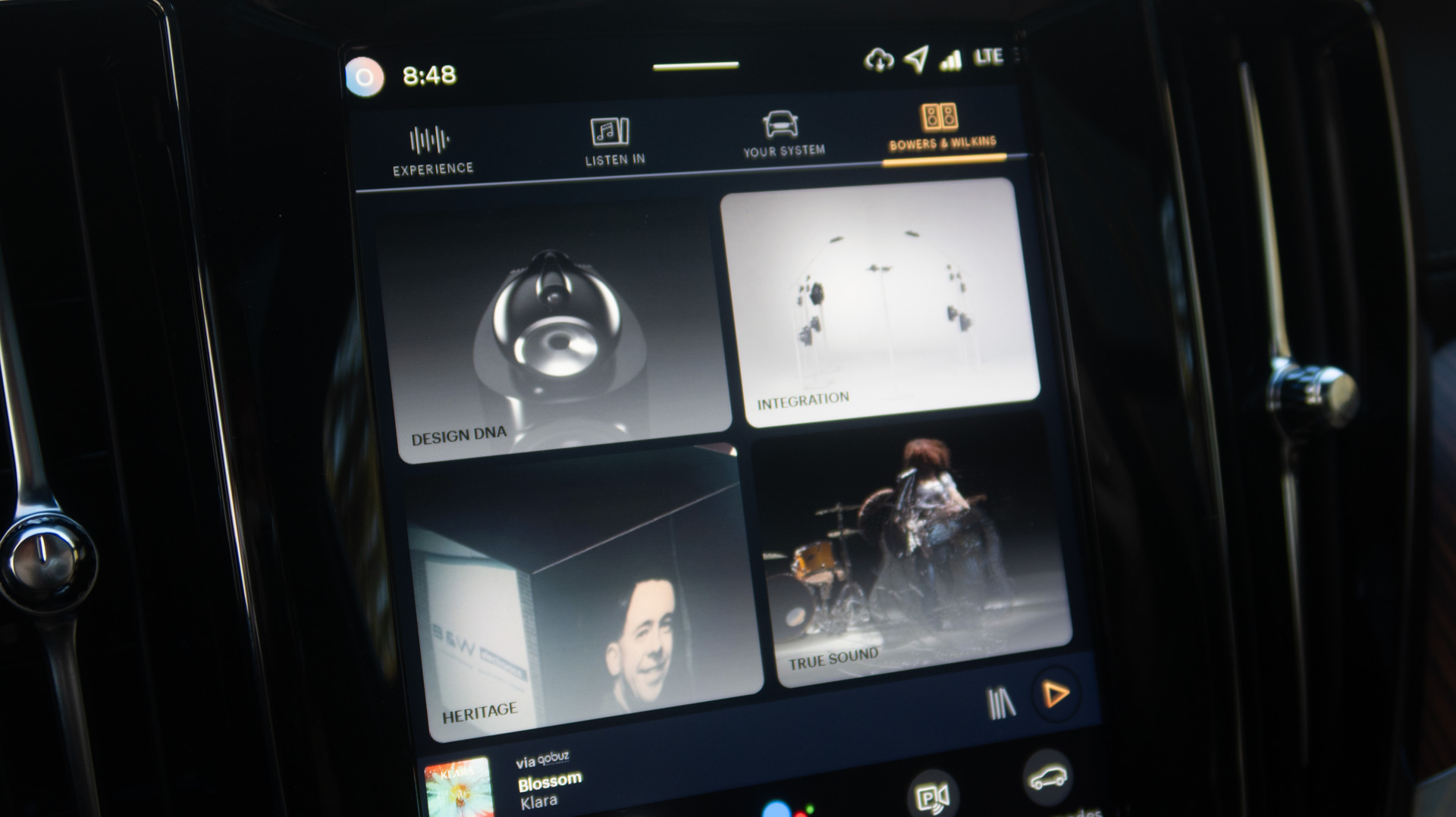
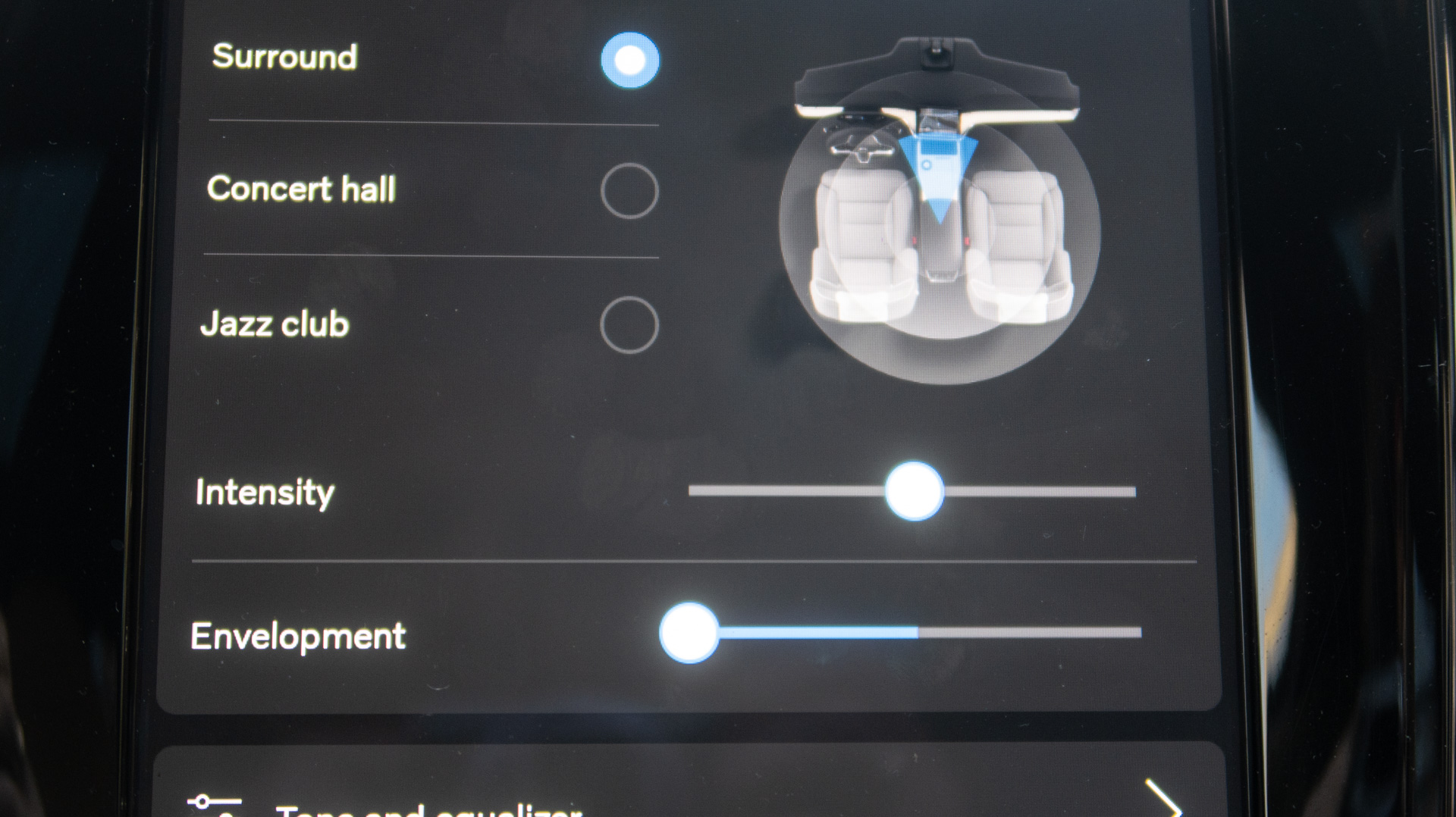
Two words that I feel describe the Volvo B&W’s sound particularly well are “intense” and “enveloping.” I’m sure you understand what those mean, but in the case of this B&W audio system, there is some specific science involved in their exact definition.
In addition to bass, treble, midrange, and other adjustments you can make to Volvo’s B&W system, within the Surround mode menu specifically, there are sliders for Intensity and Envelopment. As I played with these while listening to a variety of music genres, I realized they were aptly named. Adding Envelopment did, indeed, seem to create a more nuanced sensation of being surrounded by a song.
That got me thinking, how the heck is such a thing quantified inside the audio system’s brain? How exactly does the car adjust itself empirically to increase or lessen the somewhat abstract concepts of intensity and envelopment without physically moving the speakers?
I sent that question to a contact at Volvo, who passed it along to George Fryer, Automotive Engineering Manager, Bowers & Wilkins, and Jonatan Ewald, Attribute Leader, Audio Performance, Volvo Cars. Those gentlemen were kind enough to share explanations, which I will share with you here (lightly edited for punctuation and formatting):
Volvo Bowers & Wilkins Surround Mode Explained
George Fryer, B&W: “This mode utilises QuantumLogic Surround, an upmixing technology that transforms a stereo input into a multi-channel presentation. Using proprietary processing, the system identifies and separates spatial cues within the recording, which are then redistributed across the vehicle’s loudspeaker layout. This reconstruction is combined with vehicle-specific tuning to deliver a user-controlled, immersive listening experience.”
Jonatan Ewald, Volvo: “This mode utilises QuantumLogic Surround. This processing is looking at correlated content (part of the recording largely in phase, or with a fixed phase relationship) compared to decorrelated content (stochastic or with a more random phase relationship). In a concert recording, the direct sound from vocals and different instruments is largely correlated; it arrives at the listener or microphone location with a fixed phase and amplitude relationship.
The ambiance or reverberation of the room, on the other hand, is bouncing around, creating a magnitude of early and late reflections, building up a sound field that is more chaotic and noise-like in character.
Our surround processing separates the stochastic part of the signal from the correlated part, which effectively separates direct sound coming from the instruments from the room ambiance in the recording.
In the correlated part of the sound, we can then determine where each source (instrument) is located in the stereo field by comparing phase, amplitude, frequency, and time relationship in the two stereo channels and, in that way, create spatial “slices” of the stereo field.
Once we have performed that processing, we can manipulate the ambiance and spatial location of sources individually and position them anywhere in space by up-mixing them to our 7.1 surround sound architecture of the V60.”
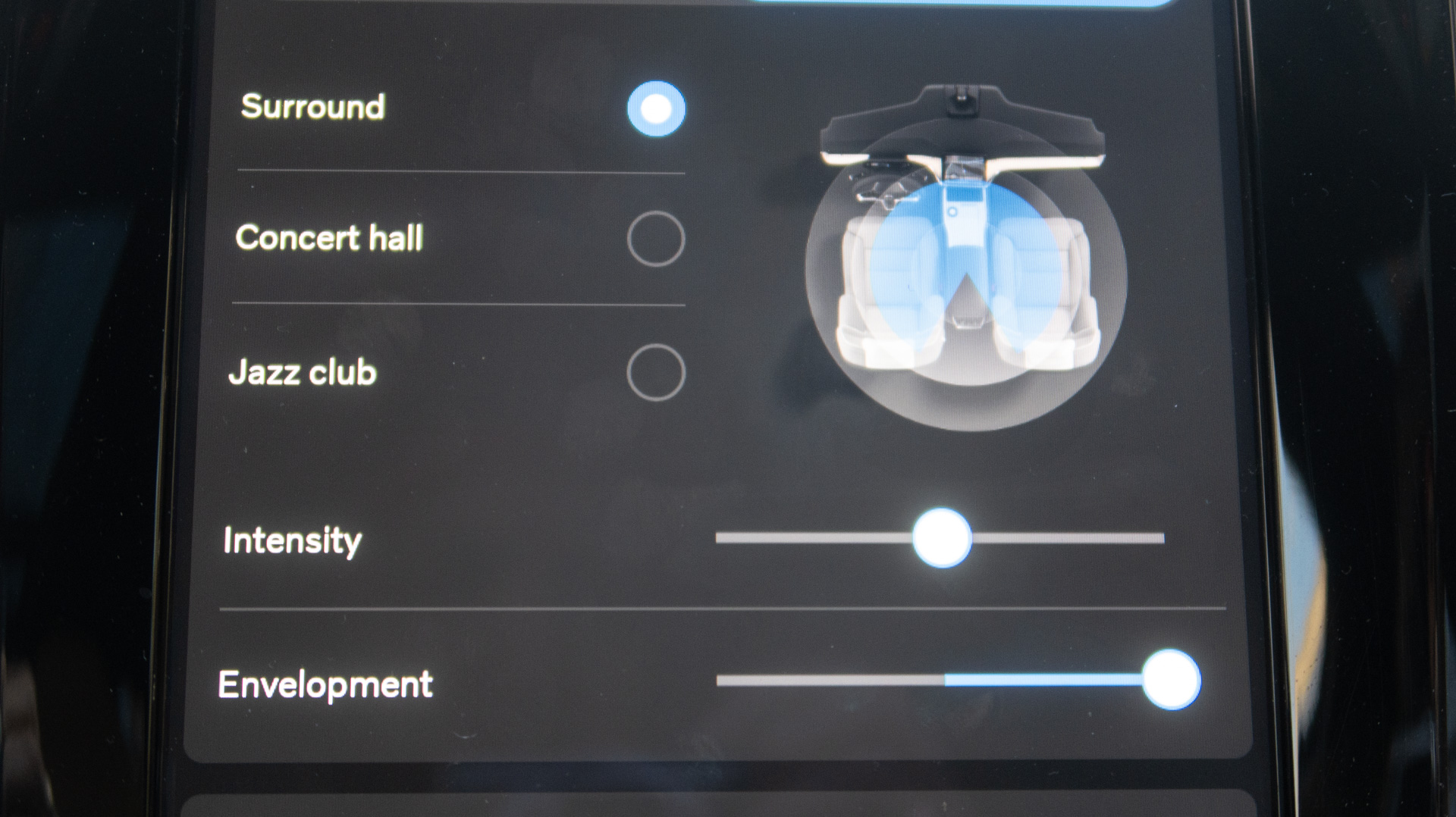
How Volvo’s Bowers & Wilkins Stereo Adjusts “Intensity” and “Envelopment”
George Fryer, B&W: “The system provides a range of calibrated surround presentation states by deriving spatial components from a stereo input and distributing them across the vehicle’s loudspeaker system. Adjustments to the envelopment control vary the balance and spatial placement of these derived signals, transitioning the soundstage from a more focused, forward-oriented presentation to a wider and more immersive listening experience. In the V60, these changes are achieved through predefined, vehicle-specific surround states that are smoothly interpolated in response to user input.
Intensity adjusts the perceived scale and spatial presence of the sound reproduction without changing overall playback level. This control operates on a similar principle, modifying the contribution of ambient and spatial content relative to the direct sound. By varying these relationships within calibrated limits, the system allows the listener to tailor the sense of impact and spaciousness while preserving tonal balance and overall system integrity.”
Jonatan Ewald, Volvo: “As per the previous question, we have an incoming signal that is 2 channels in stereo and we then up-mix that signal to surround playback with seven horizontal channels.
We then use advanced processing to do bass management and further up-mix these 7 channels to our individual loudspeakers in the vehicle.
For the question of how we manipulate the stereo content so that it makes full use of our 7.1 surround sound architecture, we do the following: Since we have separated the ambiance from the direct sound of the instruments, this means that we can manipulate the level of room ambiance in the recording separately from the direct sound.
If you pull the intensity fader down, you can reduce the ambiance and reverberation on the recording, which can give interesting results and let you hear things more clearly that were previously blurred by the ambiance. Or you can pull up the ambiance to feel more of the space and feel a sense of envelopment in the acoustic signature of the recording space.
The ambiance is also up-mixed to Surround so that it gives a more natural impression of the space where the recording was made.
The envelopment slider lets you push down the recording to mono in the centre or wrap the full orchestra all the way around you. This is done by first analysing where every instrument is located in the stereo field, and then you can think about it like creating pizza slices or perhaps the individual blades on a Japanese hand fan.
If the fan is open to 30 degrees, then you have the full stereo field of the recording represented within those 30 degrees in front of you. If you open the fan more, each individual blade will start sliding apart, and the instruments that were spatially located on that blade will follow as you open the fan fully and wrap the instruments around you. You can also push the fan together to make the instruments take up less space than the original stereo field.”

I found all that to be pretty fascinating. If you, too, are a huge nerd, I hope you did as well. Finally, since I thought it might come up in the comment section, we also got responses on the optimal file-type for audio appreciation:
George Fryer, B&W: “We typically use a variety of different sources when tuning, but WAV and FLAC have been found to be of highest fidelity.”
Jonatan Ewald, Volvo: “We support Tidal full quality lossless audio (please make sure to select this in your settings) as well as lossless audio over Apple CarPlay so that you can store lossless files on your phone or use your favourite CarPlay compatible app.
We always recommend to listen to lossless encoded audio such as FLAC, raw WAV files or using streaming services that support lossless audio playback. For the best possible experience, avoid Bluetooth since it introduces its own codecs that degrade the signal. Use CarPlay or the in-car apps to ensure that lossless audio from your phone and from streaming services also playback in full quality in the car.”
Got a tip? Drop us a note at tips@thedrive.com.
Loading comments…
Comments couldn’t be loaded. Please refresh the page.