
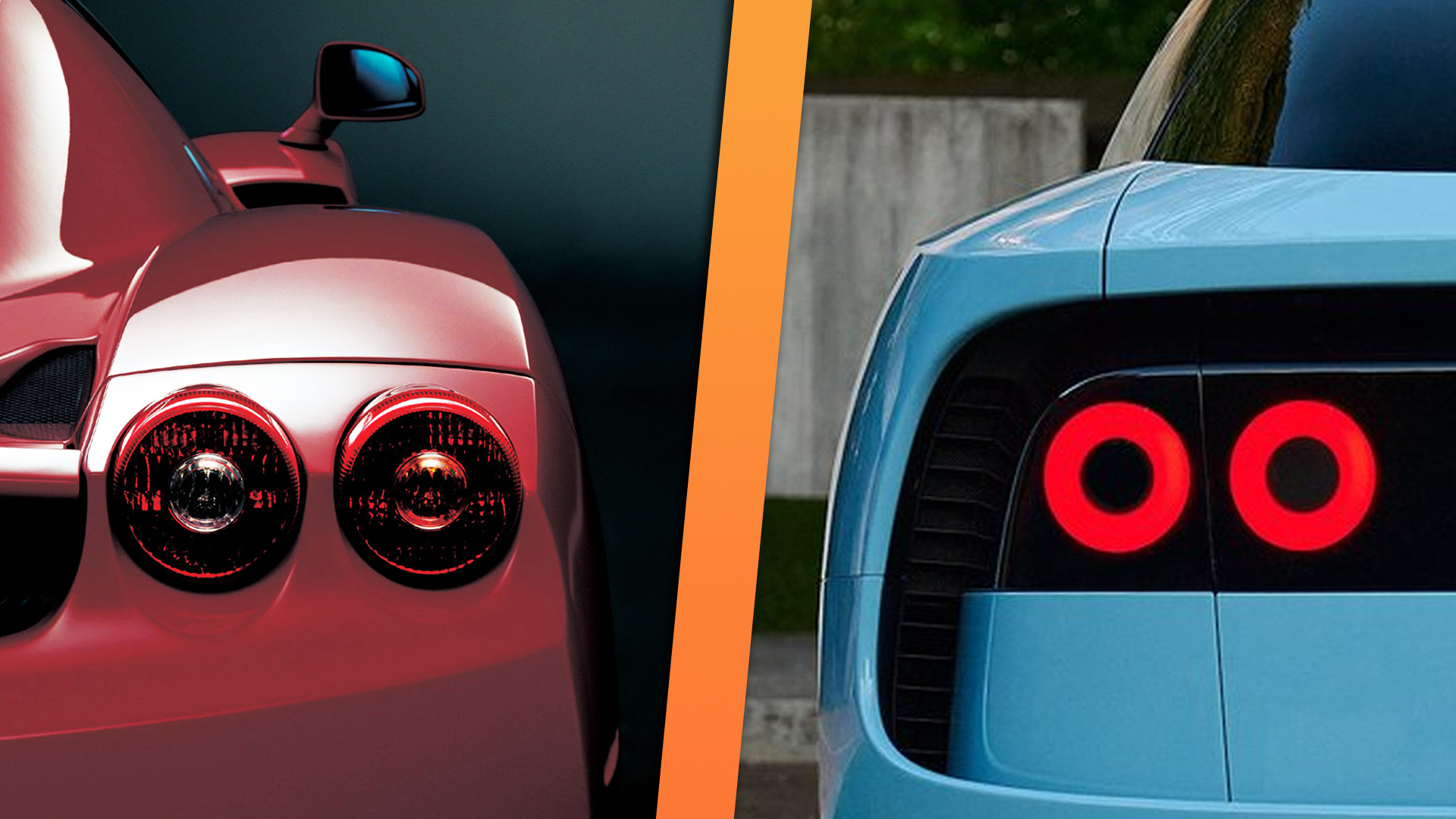
Pictures of the world’s first electric Ferrari, the Luce [“loo-che”], have now been out long enough for both initial reactions (the brand’s stock stumbled as the car was revealed) and a few counterpoint follow-ups (corporate-pilled influencers are writing long LinkedIn posts). Most of the commentary I’ve seen in automotive circles is along the lines of: “Enzo is rolling in his grave!” He’s not, though. If Ferrari’s founder were alive today and saw a Luce on the street, he probably wouldn’t even look twice at it. That is the actual tragedy of this pointless car. But really, it’s just a reflection of the state of our whole industry.
The Luce’s design is friendly, clean, tidy, inoffensive, and unremarkable. As a modern daily driver, it looks fine. But when your brand revolves around grand-entrance aesthetics and your new $600,000 supercar invites comparison to a Nissan Leaf, something’s not right. A few commentators are describing Luce’s look as “a big risk” or some kind of dramatic statement, but really, it’s the opposite. It’s a four-door daily driver—it’s the most mass-appealing product Ferrari could have possibly created. Sure, it’ll have enough horsepower to enter orbit and a price that ensures only oligarchs will be first owners. But every function is going to be electronically actuated, every display is simulated on a screen … just like every Honda and Hyundai. Well, OK, not just like—Ferrari did a nice job making its screens sit in cool housings. So herein lies the problem—as every car becomes a computer, everything that makes cars really feel special is inherently impossible to carry over.
There was some intrigue around the Luce after the cockpit was revealed, and I won’t deny I was drawn in myself. “The iPhone guy made a Ferrari;” I even did a TikTok about it. Jony Ive, who had a hand in designing a bunch of Apple products, and Marc Newson, who also did some Apple stuff and, even more relevantly, the Ford 021C concept, are being credited with a lot of the Luce’s presentation. So we can’t really be surprised that the Luce looks more like a piece of consumer electronics than a car. To the credit of everyone involved, the Luce does clearly make an effort to move away from the “monolithic black mirror” giant screen-centered cockpit by using a bunch of little screens instead. But even when the guys who designed the iPhone actively try to save tactile, mechanical knobs, the overarching reality of the modern EV package is still so fundamentally ensleekified that the car ends up feeling like an appliance anyway.
Here’s where we get to my headline—this Ferrari isn’t ugly. In fact, it’s a perfect contemporary vision of what a futuristic Ferrari should look like. It’s just that today’s sleek future-techy aesthetic is an austere, corporate copypasta sanitized to the point of lifelessness. The intro of Weeds comes to mind.
What exactly is today’s sleek future-techy aesthetic? Look at modern washing machines, lawn mowers, homes. Pretty much everything either looks like Call of Duty, EVE from Wall-E, or some combination of the two. (The Luce falls firmly in the motherly robot category.)
It’s not just about the aesthetic, or even the fact that it’s an EV, or a practical people-mover. It’s the combination of those things. And the realization that it’s not really an original idea—it’s a modern interpretation of something that already existed. And that can kind of be said for every car people get interested in lately, right? “New Bronco!” “New Defender!” There’s nothing new, just old ideas turned into what feels like an app-icon version.
What the Luce accentuates is how so many aspects of the consumer experience have gone this way. Compare pictures of a McDonald’s exterior from the recent past to today. The ones we grew up with were stacked with fun and whimsy; modern ones look like external hard drives.
Cars (and, honestly, all consumer experiences) are becoming so homogenized across our reality that it’s hard to get excited about anything. Every gauge cluster is just a design skin. Every vehicle is a coupe-SUV-everymobile. Everything looks like it’s being optimized for sales volume, which is inherently uncool.
What’s especially sad is that, you’d think with however many billions of human beings are connected to each other now, you’d get a huge range of variation among cars and designs of everything else. But, no, stuff stays sloshing along to sans-serif soft-edge mass-market shapes with competent but characterless underpinnings and an electronic isolation between you and all the vehicle’s functions. Everything’s optimized to minimize build cost and maximize recurring revenue.
It’s a little ironic that Ferrari, a brand that’s built on stand-out mystique, would adopt an iPhone-adjacent look. An iPhone, after all, is one of the most ubiquitous things ever; therefore, it is about as normcore as something can get. But this is how everything is being built now—focus-group approval and marketability uber alles.
I was on a much-needed vacation from computers last week, so I missed the initial chatter around the Luce’s release. But this week, I took a lap around the internet looking for somebody who was stoked about this car—and aside from a few comments reminding us that the driving experience could redeem it, pickings were slim.
The most astute assessment of Ferrari’s current situation that I did dig up is a Reddit thread in r/Ferrari, where a semi-anonymous redditor brilliantly articulates exactly why the Luce is what it is. More pointedly, they also spelled out why it’s going to have a hard time finding fans. As u/BrienneOfFuckinTarth put it:
So who actually are Ferrari trying to target with this thing?
Existing Customers (The Petrolheads) – The Petrolhead customers won’t sniff at this thing, simply because it’s a crossover and is an EV. They were already mostly lost by Elettrica.
Existing Customers (The Loyalists) – The Loyalists who were open to an EV Ferrari were, in my opinion, lost by the looks and the ridiculous price tag.
Silicon Valley Tech Bros – The Tech Bros I know will either just buy an ICE supercar, or will take pride in the fact that their Plaid or Taycan Turbo GT “has a Ferrari beat at a fraction of the price”. They care about statistics and numbers, and those cars have the Luce comfortably beat.
“Silent Wealth” – The whole point of silent wealth is that they don’t want to flaunt money. If they want an EV crossover they’d just buy a normal EV crossover.
Whoever that Redditor is, they’re absolutely right (and they had some other good observations, too).
What people who aren’t into cars don’t understand is: there’s a lot more to a great-feeling automobile than performance, or even exhaust note, or ride quality. There’s physical engagement with things like door handles, throttle cables, ignition keys, and toggle switches. The real weight of pedals pulling on cables. Shifter linkage. Gauges with depth and artistry. Thick plastics and thin A-pillars. Ferrari became an icon by doing all that stuff so spectacularly well that its products felt alive. And now that none of that matters, the brand is just … a black horse emblem.
So when I see comments like “legacy automakers need to adapt or die, all cars must become computers,” I have to respectfully shrug. If we really are heading for a near-future where all cars are super-fast transport pods with different emblems, the car-hobby as we know it will simply have to revolve around maintaining the vehicles that have already been built.
No kid is going to hang a poster of a Luce on their bedroom wall, and nobody’s going to be restoring one 30 years from now. I’m not trying to say “cars are over,” but, if you’re really into machines for their own sake, the shareholder-focused automakers of today are never going to build what you really want. For the general public that just wants to get around, transport pods have never been better. For the most tragic car dorks, stop worrying about saving up for a down payment on something new and start learning how to fix the cars that came out before smartphones.
Got a tip? Drop us a line at tips@thedrive.com.
Loading comments…
Comments couldn’t be loaded. Please refresh the page.