
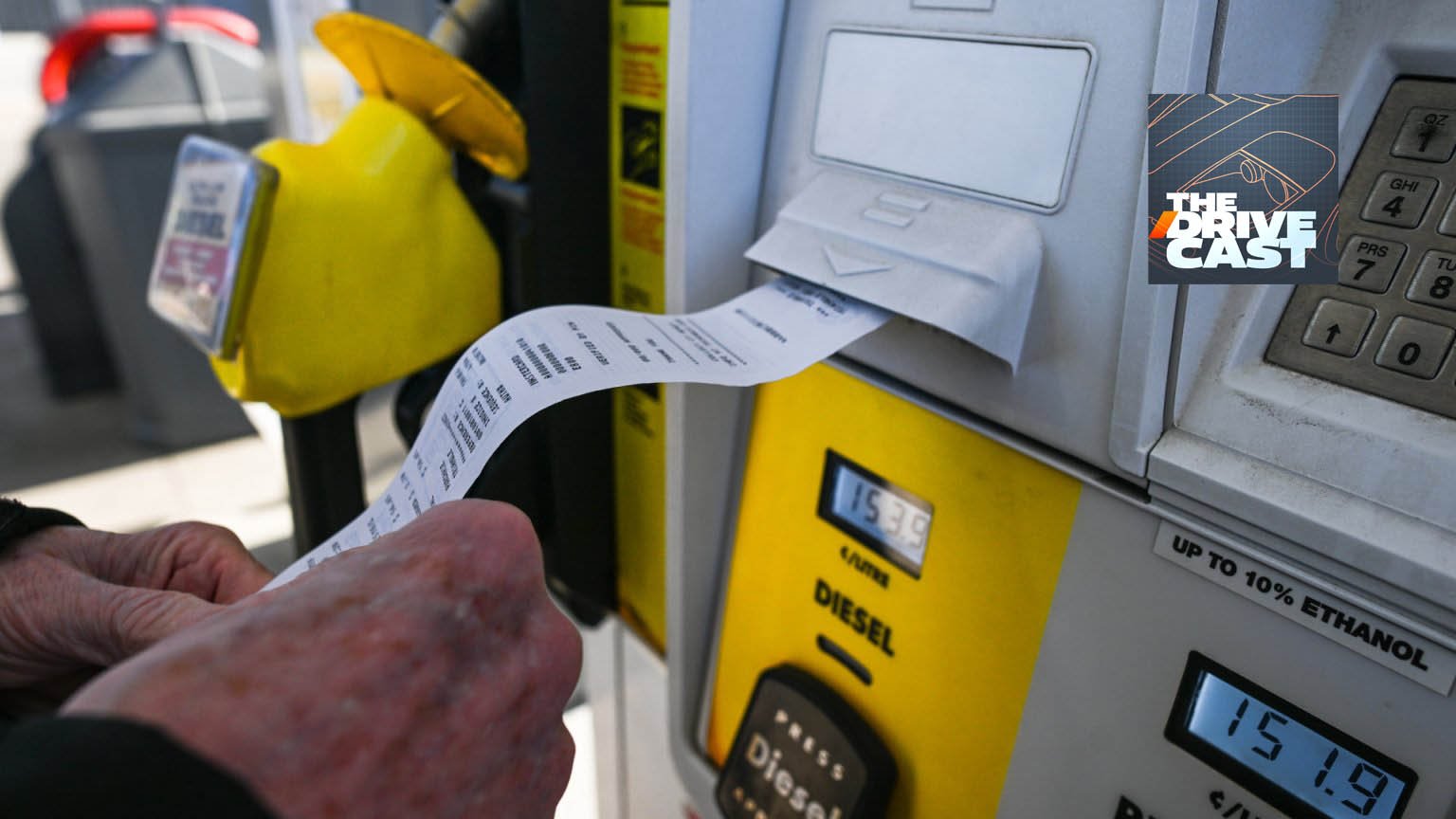
Analysts and economists are starting to sound the alarm over a different number than the price of a gallon of gasoline and this number has massive implications for the economy: the price of diesel.
One year ago, the average cost of a gallon of diesel fuel in America was $3.70. Today, at the time of this recording, it’s $5.60. That’s 50% higher, and some forecasts have it touching a record $6 a gallon by the end of the year. Not good.
America doesn’t actually run on Dunkin, it runs on diesel. Unlike gasoline, the Government can’t mess with the formulas of diesel to try and lower price, and it certainly can’t dilute diesel like it tried with gasoline earlier in the year.
Fact is, our economy runs on diesel fuel. It’s in the semi-trucks and freight trains hauling all your Amazon packages, the buses taking your kids to school, the tractors and combines harvesting your food, and even the tanker trucks carrying regular gas to your local station. Not to mention the millions of heavy duty pickup trucks used by fleet operators and tradesmen across basically every sector. The price of diesel is a cost that almost every business and municipality in America has to account for, directly or indirectly. So when it goes up by 50%… well, that pain can only be contained for so long.
There’s no easy fix—just as the kids are going back to school, farmers are hitting peak harvest time, and holiday shopping season is almost upon us. On the latest episode of The Drivecast we discuss the domino effect of the diesel price spike. How bad will it get, how far will the ripple effects reach, and is $5 a gallon just the new normal?
New here? The Drivecast is The Drive‘s weekly podcast that takes you behind-the-scenes on the largest controversies, stories, and characters shaping the automotive industry along with the way our roads look today. Powered by The Drive‘s inside access, original reporting, exclusives, and insights, The Drivecast aims to make everyone an insider.
Listen to The Drivecast via Spotify, Apple Podcasts, or Amazon Music. Love it? Like it? Want to help? Leave a five-star review on your platform of choice to help get The Drivecast in front of more people. Have a suggestion, tip, request, or feedback? Drop us a line at feedback@thedrive.com. I promise, we read every single email.
Full Transcript
Kyle: So, Caleb, let’s set the record straight here. How much diesel do you buy?
Caleb: Really, I should buy more than I currently do, because my 7.3 Ford Power Stroke is broken and has been for way too long.
Kyle: Ooh, sore subject.
Caleb: Yeah, you said we wouldn’t talk about that on this podcast. But no, for real, we have a Kubota tractor that we run often, and you fill that up 5 gallons at a time or so, so you don’t feel the pain nearly as bad. Still, doing it a few times a month, you definitely feel the pain. I don’t have it half as bad as over-the-road truckers or guys who are farming their fields and have got to go in harvest time. It could be worse, I feel for them for sure.
Joel: Just imagine if boats—wait, other people’s boats run on diesel. Thank goodness our boats don’t run on diesel. We run on 91 non-oxy premium, which is not cheap, but not diesel.
Caleb: Come on, baby.
Kyle: Nothing is cheap these days. Diesel prices—many people are used to seeing it on the gas station sign, but most people don’t pay attention to it because most people don’t drive diesel. It’s just another number that’s out there. In the past, it was often lower than regular gasoline at various points in time, and it’s one of those invisible costs that, as we said in the intro, affects literally everything in this country. Every kind of business, every kind of product, somewhere along the way involves being transported, made, or powered by diesel fuel. It is a really important thing that most people just look past. We’ve had plenty of other high prices to complain about; if you don’t actually use diesel yourself, it’s out of sight, out of mind—until it’s not. So, Caleb, just to sum it up, why has diesel gotten so expensive as the year’s gone on, and at a faster rate recently than regular gas?
Caleb: There are a few reasons, and at least two of them involve international armed conflicts. There’s the war between Russia and Ukraine, and also the closure, or at least serious restriction, of ship traffic through the Strait of Hormuz. While it’s maybe obvious why it would matter that the Strait of Hormuz traffic is super limited—obviously you can’t carry a whole lot of oil through there—the Russia-Ukraine conflict is a mess for a lot of reasons. In relation to this topic, Russia is actually the world’s second-largest exporter of refined fuel. There have been several successful Ukrainian drone attacks on Russian refineries that have totally knocked out their capacity. The crude oil supply actually isn’t that bad or too badly affected in terms of being a choke point on this whole process; it’s the refined fuel—what people can actually use on the other side of it—that has been an issue. Whenever we talk about the supply of diesel being low, it’s not because there’s less oil being pumped out of the ground or less being sent to the refineries; it’s that it just can’t make its way from the refineries out to the people. One more important point on this is that the global supply of diesel is affected by all of this. It’s not like, “Oh, I get my diesel from somewhere else.” There is tremendous demand for diesel across the world, not just in the United States—you could say maybe especially in the United States—but it doesn’t matter. Nobody is better off in this situation than the rest of us, so we’re all pulling from the same supply, and that supply is really low.
Joel: You got a little ahead of it there, because I was going to say, when you talked about the Strait of Hormuz and Russia and Ukraine, I live in Minnesota, Kyle lives here, why do those wars and conflicts over there affect the price at my pump for diesel? That was definitely on my mind.
Caleb: It’s exactly that. We are all going to the same place saying, “Can I have some more, sir?” Right now there just isn’t any of that; there’s not enough to go around. I couldn’t tell you off the top of my head what the price increases are elsewhere in the world. Here, we saw it’s nearly $2.00 a gallon more than it was at this point last year. Everybody is struggling with this, and we are starting to see the pain of that already—the knock-on effects of what happens when diesel price goes up and the rest of the economy has to respond—but I fear it’s just going to get worse from here.
Kyle: Yeah, and the U.S. hasn’t built a new refinery—this might sound crazy—since the ’70s. We have just expanded and invested in existing production facilities. I remember when Iran first started lobbing missiles at a bunch of facilities in the Middle East, it’s one thing to rebuild a pipeline, or pull off a diplomatic coup and reopen something like the Strait of Hormuz, but it takes time to build a refinery. You’re talking hundreds of millions or billions of dollars, and years-long construction. This is not like a switch that can be flipped, or backup refineries just waiting to come online. The stat from Goldman Sachs was telling—take what those guys say with a grain of salt, sure—but right now global refinery capacity outages are currently 60% higher than usual at this time of year compared to the seasonal average. That is really what’s going to put the ongoing squeeze on consumers eventually into next year. This is not something that, once the Strait of Hormuz opens, suddenly all this oil gets released and everything goes back to normal in due time. This is a much bigger issue with no easy fix and a lot more complex factors at play that we’re going to be feeling for many months.
Caleb: Exactly. Here recently there was a Reuters report that said Russia’s fuel export ban is likely to continue throughout September. Don’t be surprised if that gets re-upped for the next month, and the next month, and the next month. This has already been renewed several times at this point, so it’s a slow process. There are physical limitations on what you can do in order to make these facilities, build them back up, and get them fully operational. We are all feeling the pain from that.
Joel: If you think America runs on Dunkin’, you’re just a sucker for marketing, honestly, because it really runs on diesel. In theory, it takes fewer steps to produce diesel than gasoline, but regulations and taxes drive the price up even when there aren’t global conflicts, drone strikes, and shipping choke points. Caleb, talk to us about the modern realities of the situation in terms of diesel alone.
Caleb: Sure. Think about everything that you could buy at the grocery store—it was delivered there on a diesel truck, very likely. Sure, you talk about last-mile delivery maybe taking place with EVs depending on where you live, but diesel was very much involved in getting the goods to where you are. That’s just the reality of it. We might have the benefit that we’re not all truckers or farmers, but all those extra costs get passed down to us. I hear the argument a lot, especially from old farmers around here where I live in the Ozarks. They say, “It’s not even that hard to make diesel, why should it be this much more expensive than gas? I could probably make this tractor run on peanut oil, whatever.” Hey, maybe they could, right? But you have to take into consideration, especially for on-road use, you’ve got to use ultra-low-sulfur diesel that is taxed, right? There’s absolutely no chance that that’s going to get removed just to make it lighter on people’s wallets. I did a little bit of napkin math, so take this for what it’s worth, but we have the price of diesel almost $2.00 more per gallon than it was a year ago. Take into consideration a semi-truck; a lot of them have dual 100-gallon tanks, okay? Per fill-up, that is an additional $388. If you’re going from empty to full, that’s an extra $388 per fill-up. You can be generous and say a loaded semi gets 8 miles per gallon—lots of them don’t get that, all right—and factor in how many miles they can go in a day based on the time they’re allowed, they’re probably stopping for fuel twice in a week. I know this is all rough math, but if you’re filling up with fuel eight times in a month—not crazy to think for a semi—that would total $9,040 in diesel fuel alone. That is $3,100 more than it would have cost in August of last year. You can’t escape that.
Kyle: And that is one truck. That is one truck. So you can imagine a fleet company that has even 100 trucks.
Caleb: Oh, yeah.
Kyle: That is $300,000 more per month that needs to come from somewhere. There are lots of areas like this, as we discussed: trains, farm equipment, construction equipment, even pickup trucks. But semis are hauling the majority of goods in America, especially to the final destination, the final place where it’s sold or picked up. It’s kind of like the situation we had when the tariffs were first introduced at the beginning of last year. There’s all this freak-out and panic over what this means, how costs are going to go up, and how it’s going to get passed down to consumers. Then, for a while, nothing really happens because companies, especially bigger companies, are operating on longer timeframes. They’re projecting costs a couple of quarters in advance, so they’re figuring out ways in the short term to absorb that while they simultaneously figure out how to pass it on to consumers and get that money back from somewhere, either by cutting costs or raising prices. With this diesel thing, we’re in that staggered window where prices have spiked a lot this summer, and if they remain at this level, it’s going to take maybe a couple of months, but it’s not going to take that long for people to start to feel the increase in prices as all these companies charge more to ship all of the goods in America. Then the companies that make those goods need to charge more because they’re paying more for shipping, and we end up in this vicious cycle where suddenly the cost of diesel is almost like an inflationary force. It is really not a good picture.
Joel: I want to be clear, we’re not a political outlet and we’re not getting into politics, but we’re literally running into an election season. We’ve got a war going on that’s affecting this, we have the cost of goods—you talk about the cost of eggs—it’s not just diesel, it’s everything, right? So it’s interesting to see how this all plays in the political sector and whether it affects the outcome of all these things this fall, right? Because whether it’s flock cameras or diesel prices, everybody loves a lightning rod they can latch onto.
Caleb: Yeah, for sure. At my house, my kids eat so many blueberries, strawberries, and salads. We’re having to pay a lot more for our Cyclospora outbreaks; it’s really starting to impact us.
Kyle: That diarrhea does not come cheap, that’s for sure. But anyway, I’m curious—I live in Los Angeles, Joel lives in Minneapolis, and Caleb, you live in Missouri. Prices are so high out here anyway that people are feeling it, but I haven’t heard anyone talking about the price of diesel out here. I would assume, Joel, it’s probably the same for you. But Caleb, you mentioned your friends and acquaintances and the farmers wondering why they can’t just make cheaper diesel. Is this something that people who use diesel vehicles or equipment every day are now talking about in the same way that high gas prices are talked about by everybody? Has it really been picked up like that?
Caleb: Oh yeah, unquestionably so. Fortunately where I live, the average gallon of diesel price is lower than the national average. So whereas at the time of recording that’s more like $5.60 a gallon, we’re closer to $5.10 a gallon.
Kyle: Big savings.
Caleb: Big savings, big savings, everybody. Come to Missouri, get your fuel. But that’s still a huge leap from where it was. We’ve seen lots of fluctuation over time, of course. I started driving 12 years ago, and at that point it was pretty common to pay about $4.00 a gallon. Then that was unthinkable, it was wild, this is crazy. I, yet again, had a 7.3 Power Stroke during those days; that one ran, this one that I have now does not. You had dual tanks, man, you could spend a whole lot on diesel. I’m personally glad that my 7.3 is not up and running right now, because filling up two tanks at $5.10 a gallon, even though that’s a lot lower than the nationwide average, man, I just wouldn’t. Being real honest with you, in my case it’s largely optional; we have a gas truck that we’re able to pull with. I would just park that sucker, so maybe it’s doing me a favor by having never-ending electrical gremlins.
Kyle: Thank you, Ford.
Caleb: Thanks to the dude that tuned this thing up before I bought it. It is so massively screwed on just the dumbest issues. It’s not a Ford problem; we can blame Ford for a lot, but the 7.3 Power Stroke was one of their gifts to man, and man screwed this one up.
Kyle: As he often does. The other thing we should mention is that although the average price of diesel in America is extremely high right now, it is actually not the record. The record came in 2022 right after Russia invaded Ukraine—again, Russia and Ukraine, big factor. That was a peak of $5.82 a gallon. Obviously, inflation has happened a lot since then, so the inflation-adjusted costs, we’re still a fair ways off of what it was at the beginning of 2022. But that was very time-limited, and everyone knew why it was happening, and there weren’t all these compounding crises around the world making it difficult for everyone to adjust. So if you look at the line graph, there’s a big spike right when it happens, and then over the next two years it drops back down, not to where it was exactly, but close-ish to where it was right after the big COVID disruptions and right before Russia invaded Ukraine. So we are not quite in unprecedented territory yet, but we’re getting close, and this time there’s not this one thing that happened that everyone can figure out how to work around and suddenly everything goes back to relative normality. We are in a very weird and unpredictable time. It’s not looking good.
Caleb: Yeah, we’re all worn out on that saying “the new normal.” I hope that’s not the case forever with this, but certainly in the interim, this is the new normal.
Joel: I think our senior editor, Adam Ismail, is always saying, “What I wouldn’t give for some precedented times.” I think that applies here.
Caleb: Yeah, I’d agree.
Kyle: I’m tired of living through history. Another ripple effect that we touched on briefly in the intro is on school districts and local governments. School districts operate fleets of school buses; by and large, those also run on diesel, although some run on natural gas. A medium-sized school district with a normal fleet of buses could be looking at hundreds of thousands of dollars in additional costs over the coming months. That is another big problem; it’s not like they have a ton of money to begin with, and I think we’ve all seen what happens when districts have to make tough choices: teachers get laid off, teachers don’t get raises, class sizes rise, and then there’s a whole ripple effect from all of those things within the schools. So, Joel, I hope you’ve got your seatbelt on, that’s all I’ll say.
Joel: Yeah, I mean, we didn’t get a note from the school district saying fuel is going to be more expensive this year so you owe us more money, but I’ve gotten a lot of other emails about my kids going back to school. Some people in this house are excited, some people are not; it’s a very emotional time.
Caleb: Where I live it’s rural, and all of the towns around, the kids from each of these towns go to one high school for the entire county. It’s no stretch to say that they’re going 60 miles in terms of starting at one place and ending there at the last stop. There are lots of side roads that they’ve got to go down. It’s the same story here. Whenever you’ve got that much distance to cover, you’re doing it in the morning, you’re doing it in the evening. Yeah, it is not looking too good. I tell you, it might be enough to stop the bleacher construction for the football field at our local high school, and I don’t know what our kids will ever do about their education if the bleachers can’t be completed.
Joel: Meanwhile, in the state of Minnesota, we’ve got the State Fair going on, and I guarantee you no diesel prices are stopping anybody from making their trip to the State Fair. I’m just saying, you’ve got to get the corn dog and the fried pickles.
Kyle: Well, that’s kind of everything in a nutshell here, because drivers around the country have spent the last six months adjusting to these higher prices. They’ve remade their household budgets, or they’ve gone into credit card debt, or they’ve just—that has mostly been accounted for, even if it’s not a sustainable thing, at least people have adapted. But the price of diesel, because the way that people will feel it is so widespread and in so many different areas that really vary depending on where you live and your situation in life and if you have kids and whatnot, it’s not this thing where suddenly the price goes up, you see it on the sign, and you’re like, “Okay, now I know how much I have to spend on gas this month.” You have no idea of knowing how much prices are going to rise, which prices are going to rise, and when. It all just trickles down when it does. So, yeah, people may say, “I’m still going to go to the State Fair even if I drive a diesel truck,” but that’s just one area where the cost of diesel impacts their life. All those other areas, it’s just going to have to be wait-and-see and then try to adapt. Again, this is happening just as people are starting to get into the holiday shopping season, and people have already reconfigured their household budgets so they can buy their kids’ Christmas presents or Hanukkah presents, and suddenly those costs may also go up. We’re just trying to express that this is something that most people have no idea of how it’s going to impact them, if they even know that it will at all—but it will.
Joel: I think that’s it, right? Hank going to the Minnesota State Fair, he’s going to feel the pain when he has to fill up to drive to the State Fair, and he’s still going to buy fried pickles or whatever. But Mom and Dad buying Halloween candy, they’re not going to know why the Twix and the Reese’s are more expensive. They’re just going to say, “Well, eggs cost more, so this costs more,” and they’re not going to realize it might be because of diesel fuel, right? The reality of the situation is that it’s going to affect everything. Goods and services are going to cost more money, especially as we head into the holiday season, and this time it’s because of fuel.
Caleb: Yeah, and you’re not going to see any big tax cuts on diesel to make it more affordable on people. Think of—we can use this hypothetical again, right? We’re talking about a state fair. Let’s say that taxes just get totally stripped on diesel so that way it’s cheaper to fill up at the pump. Well, what happens whenever you have an event like that? There’s a million and one semi-trucks, heavy-duty pickups pulling trailers that love to just totally obliterate interstate highways, bridges, anything that they come across, right? Heavier vehicles take a heavier toll on infrastructure. Then suddenly they’re going to say, “Hey, where’s the money at that we would normally use to fix this?” That would never happen, that would never happen, that’s the point that I’m getting at. The hypothetical seems unlikely because it is incredibly unlikely. Don’t count on the Feds doing some kind of switcheroo like they have and diluting regular gasoline with ethanol. The same tricks don’t apply here, folks.
Kyle: Yeah, and also another place where the same tricks don’t apply, or the same expectations don’t apply: when gas prices rose at the beginning of the year, you saw an immediate spike the next month in hybrid car sales in America, and EV sales, too. This is, again, after the whole tax credit kerfuffle and the price of those went up by $7,500 by default, and everyone predicted, “Well, that’s it for EV adoption for the next 10 years.” Sales did drop, but then there are always people in the market for a new car, so when they are deciding on that and suddenly there’s a geopolitical catastrophe and gas prices go up by two bucks, it’s pretty easy for someone to adapt and say, “Okay, well, I’m just going to buy a hybrid next time,” and then they get to enjoy those savings. So there’s basically one practical electric semi-truck on sale that you can buy in America, and that’s the Tesla Semi. Other than that, it’s not like any of these fleet operators can just suddenly, next month’s purchase order, “I’m going to buy a bunch of electric semis instead, and then we can reap those savings elsewhere.” All these heavy-duty pickup truck operators—heavy-duty electric trucks are not a thing. There is no backstop to help with the demand destruction, as the economists put it, to just get the demand to a place where the supply can actually catch up. It just doesn’t work like that with vehicles in America, especially. We’re used to people seeing high gas prices and changing their purchase decisions on new cars accordingly; that can’t happen for a number of reasons with the price of diesel.
Caleb: Exactly. I’ll tell you this: a lot of people who are buying diesel trucks for leisure aren’t about to admit they can’t afford one, they’ll just get a bigger loan.
Joel: That’s the perfect place to end it. Let’s not even get into start talking about truck loans.
Caleb: See that? I told you everybody, I own a diesel, I am one of you. It’s just the fact of the matter. Nobody is going to skip out on a diesel and tell somebody else it’s because they can’t afford the price to fill it up. Come on, boys.
Kyle: Someone help Caleb with his budget, his family is dying. Too much diesel, too much diesel.
Caleb: Too much diesel, too much diesel.
Loading comments…
Comments couldn’t be loaded. Please refresh the page.