
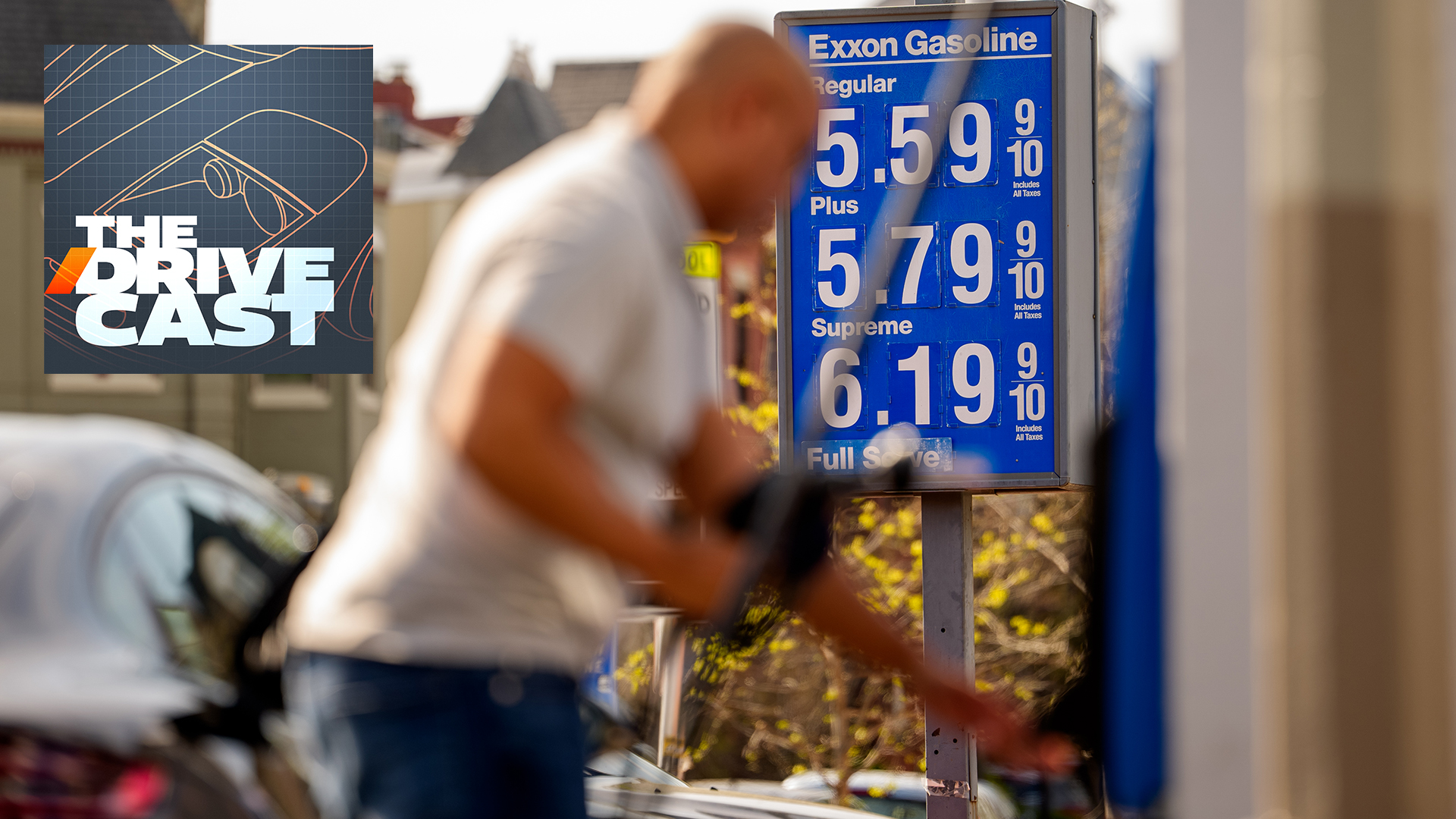
Gas prices just hit an average of $4 a gallon in the US, and man, people are not happy. The longer the war with Iran drags on, the longer the vital Strait of Hormuz stays closed, and the longer that 20% of the global supply of oil is cut off from the world’s markets. But hey, the EPA has a plan to lower prices: stretch America’s fuel supply by diluting more of it with cheaper ethanol. What could go wrong?
Well, depending on how old or well-maintained your car is, and where you live, the answer is not nothing. That’s what we’re digging into on this week’s episode of The Drivecast.
This is a really contentious topic, so let’s lay out some facts. Outside of specialized blends, most gasoline in America is already diluted with 10% ethanol (an alcohol made from corn) as a baseline, called E10—so every gallon of gas you buy is actually 90% gas and 10% ethanol by liquid volume. We do this because ethanol is an oxygenator that helps gas burn cleaner and raises the octane rating. We used to use lead, but… that didn’t work out.
In some states, especially in the Midwest, you can buy what’s called E15 gas, which is 15% ethanol and 85% gasoline, labeled as 88 octane at the pump. It’s cheaper too, because you’re literally buying less gas and more corn juice per gallon, but air-quality rules restrict its sale in the summer because it creates more smog than E10.
And that’s what the EPA is focused on: waiving those rules to allow oil companies to keep making E15 gas longer into the spring and summer than they normally would ahead of the typical June cutoff. Theoretically, there will be more of this cheaper ethanol-rich blend available for longer. Thing is, though, E15/88 octane is only sold at a fraction of gas stations nationwide. Increasing the supply won’t really do anything to lower the price of regular 87, 89, 91, and 93 octane gas in the short term.
But even if you assume it will, because more people are choosing E15/88 so demand for the other grades goes down, that brings up the bigger problem. Ethanol is also a solvent that can eat away at delicate rubber seals and plastics in older engines, potentially causing major damage, which is one of the reasons why it’s usually capped at 10%. The EPA even says you shouldn’t use it in cars made before 2001, though that important note is missing from the agency’s triumphant press release on the matter. Even in newer cars, E15 will lower MPGs because it’s less energy-dense than gas.
So yeah. Don’t hold your breath for this to work.
New here? The Drivecast is The Drive‘s weekly podcast taking you behind-the-scenes with the biggest stories, controversies, and characters shaping the automotive industry and the way our roads look today. Powered by The Drive’s inside access, the show takes you through our original reporting, shares our exclusive insights, and expands on those stories in ways that aren’t possible with just one article.
You can listen to a new episode of The Drivecast every Wednesday on Spotify, Apple Podcasts, Amazon Music, or wherever you get your podcasts. Like what you hear? Hit us with a five-star review to help get The Drivecast in front of more people and keep the show going. Have a suggestion, request, or feedback? Drop us a line at feedback@thedrive.com. We read every email.
Full Transcript
Joel Feder: Man, have you seen those gas prices? And by man, I mean Kyle, who lives in LA where everything costs an arm, a leg, and half of your firstborn.
Kyle Cheromcha: Don’t remind me. I actually saw $8 a gallon on a gas sign the other day. It is hard to miss that. Makes you stop and stare in not a good way. Yeah, it’s really painful out here.
Joel: Andrew, what’s it cost out by you in your neck of the woods?
Andrew Collins: Yeah, in rural New York, we’re finally cresting the $5 barrier for 93 octane, which is rare for here. Usually hangs out in the $3 neighborhood at best, but it’s been a scary few weeks for sure.
Kyle: I have very little sympathy for that. None of this is satisfying. It all sucks, but there is something… heartwarming maybe about watching the rest of the country freak out about $5 a gallon gas while we’ve been paying well over that in California for years now. I feel like Bruce Willis in Die Hard, welcome to the party pal. That’s where I’m at right now.
Joel: Yeah, but you don’t understand. I live where we have snow and negative 40 with the wind chill. I’m not supposed to have to pay for that sunshine tax. I’m pretty sure you pay extra to live where you don’t have snow.
Kyle: There are benefits and a lot of reasons why everything’s expensive in California, but that’s not the point of today’s podcast. The point is to talk about ethanol. So Andrew, just give me a quick primer. What is ethanol?
Andrew: Yeah, ethanol is a kind of alcohol that’s made from corn. It is added to gasoline as an oxygenator. So it raises the octane rating. The number you see at the pump, regular, mid-grade, premium. It helps the fuel burn cleaner. And we used to use lead, which turned out to be toxic. And then we used something called MTBE, which polluted groundwater. Not so good. Ethanol is today’s diluter of choice because it’s abundantly available and it’s made of corn, which we grow a lot of here in America.
Kyle: Well, that sounds good to me. What’s the problem then?
Andrew: So downsides of ethanol, it’s less energy dense than gasoline. So the more ethanol you put into fuel, performance and efficiency goes down. And you can also damage cars with older engines and more primitive technology.
Joel: I will say, while there’s downsides, there are upsides. A lot of supercars and hypercars you see doing the tough speed runs like the SSC Tuatara and all that, they’re running on ethanol, basically E85. And that’s because while it is less energy dense, it has a higher octane rating, it has a superior cooling effect. It’s more oxygen rich in terms of its composition, which all of this enables a company like SSC to then tune the engine to be a more aggressive tune to put out more power.
And so the same engine that says—and I’m making these engine numbers up by the way—but let’s say it puts out 1,000 or 1,200 horsepower on 91 premium. You could put out, I don’t know, 1,700 or 1,800 horsepower on E85 just by recalibrating that tune. It’s all controlled by the ECU and the controls unit systems for the engine and it reads the octane rating and the fuel that’s in the system.
Andrew: And then of course you’ve got GM’s flex fuel engines, which similarly, they’re meant to run E85. And that was cooked up for efficiency, at least for cost efficiency. That was cooked up when gasoline was going to be really expensive. And so they figured out, why don’t we run more ethanol? So they’re tuned engines for that. And now in 2026, that idea is starting to look a lot better.
Kyle: That I think is the confusing part of this for a lot of people because you just said we have E85 fuel in this country. Well, in some states at least. You see that next to 87, 89, 91, 93 is the octane ratings for regular fuel up to premium. And so people are maybe used to seeing E85 on the pump and thinking, okay, well, there’s ethanol-based fuel. That’s not a big deal. But the octane rating of E85 fuel is actually more like 100 or 105. So all this is, it just speaks to the lack of knowledge that a lot of people have on gasoline. The consumer education is just not there.
Andrew: And for the common person, the ethanol content of fuel is almost never on anybody’s radar. I mean, except for E85, which is labeled, everything else is just kind of baked in and people never think about it. In the US, every octane gas is E10 at 10% ethanol. That’s the standard. That’s normal. From October to May, typically, oil companies are allowed to sell E15, 15% ethanol because it’s cheaper. Basically, they’re cutting gas with corn juice to save money. And that kind of brings us to this waiver we’re talking about where the EPA is extending that by a month pretty much to allow more of what is sometimes called winter gas creep into the summer a little bit.
Kyle: Yeah. I mean, 10 to 15% might not sound like much, but that’s 50% more ethanol going into your gallon of gas. And like you said, no one thinks about this stuff because this blend is done at the refineries and the fuel that reaches your gas pump is just the fuel that you can buy. No one thinks about this and the way they think about octane ratings, to the extent that people think about octane ratings at all. So what is really going on with this waiver? You mentioned that it’s usually summer versus winter gas. What’s the difference there? Why is ethanol not usually sold in the summer? And again, what is the EPA really trying to accomplish here?
Andrew: What the EPA is trying to accomplish is cheaper, regular gas pump prices at the pump, and which theoretically should be visible. E15 can be as much as like 25 cents a gallon cheaper than E10, which is not insignificant if you’re pumping fuel. And the reason you hear about summer and winter gas, ethanol evaporates more quickly in the heat, which leads to more smog. That’s why we don’t want it in this conditions typically. But some corn producing states have waivers to sell it year round and then some don’t sell it ever.
So because of the typical June cutoff, oil companies start winding down production of E15 in May. People think gas prices usually go up in the summer because demand is higher, but this is actually a factor too. Every gallon of gas actually has more gas in it. It’s less watered down basically. And with gas prices being so high and the global supply being hit by war, the EPA is announcing this waiver, basically allowing oil companies to make this E15 longer into May. And then there’s another critical point of this called eliminating boutique fuels, which we can talk about in a second too.
Kyle: So basically more ethanol equals cheaper gas. I think most people hear that and think, okay, great. Sounds good. So why is this a problem? Why is this something people need to know about?
Andrew: So more ethanol means cheaper gas, but it also comes at a cost, a few different costs really. So because it’s less energy dense, you need to move more volume of it through your vehicle to keep it running. And there are mixed results on what that number actually is. The EPA says you should expect about a 1.5% drop in fuel economy, switch from an E10 to an E15, but Cars.com and Car and Driver have tested this and they claim it’s more like 4 to 5%.
Joel: And there are variables in all this, by the way. So certain engines, turbocharged, supercharged versus naturally aspirated, and then your weather, right? So certain engines are just more efficient in sunny, warm California than cold Minnesota. And then there’s also the fact that you’re going to go more often because you are getting worse fuel economy and fill up. So yeah, you’re saving at the pump when you’re filling up, but you’re consuming more fuel. I don’t know where the real math lies, but it’s kind of like soup to nuts. Are you really saving money? Are you?
Kyle: I think people would probably hear, oh, 5% efficiency loss, single digit percentages, is that really going to add up? I mean, the answer is yes, especially over hundreds and hundreds of miles. If you’re driving a thousand miles and you have 5% less efficiency, that’s 50 miles that you’re losing out of that, right? So that’s not nothing.
Andrew: So the thing that really caught my eye about this, in addition to the range problem, there’s the wear problem. Because this fuel has more oxygen in it, it’s also kind of forcing your engine to run leaner, which you never want. Obviously lean is when there’s too much air and not enough fuel mixing in your engine. So if you have a high performance engine in your car, especially high compression, turbo, a lot of stuff that our readers might be using, they’re burning higher ethanol content, and that car’s ECU is going to detect more oxygen and then it’s going to think it has lean condition and then it’s going to spray in even more fuel to prevent knock and pinging.
On top of that is not every ECU is going to be perfectly right. The EPA says they did six million miles of testing. And based on that, they found that cars built after 2001 do not really have issues with E15. However, it’s a pretty vague result they got there. So even if a modern car can run it, you’re still asking a lot more of your car’s engine and your car’s brain when it’s burning a much leaner fuel mix.
Joel: Moreover, to the point, what’s a modern car? The average car on the road today is somewhere between 11 and 12 years old. I haven’t looked in a minute, but let’s call it 11 and a half years old. What is a modern car? If that’s the average and we’re on a bell curve, there’s a lot of cars on the road that are a lot older than 11 years.
Kyle: Millions, really. So what’s the issue with cars before 2001? They’re just dumber, therefore it causes more issues or what else is going on?
Andrew: They’re not only dumber, but it’s also materials. Not only is ethanol an alcohol, but it’s also a solvent. So it can eat seals. It can even damage types of aluminum, believe it or not. And this is especially a factor on very old vehicles and small engines. Anything with a carburetor, anything with old rubber, primitive rubber, ethanol can leave like a varnish behind and gum up carburetors very easily. It is not good for your old machines.
Joel: I would actually even argue to the point that it’s just not good period because it goes bad, right? It’s not shelf stable. So for a car you might not drive every day, you might not drive very often. Your power equipment for your home, like a two-stroke gas blower, a lawnmower, that kind of gasoline is not shelf stable as long as gasoline doesn’t have ethanol in it, which is known as non-oxy.
Andrew: I was going to say that’s definitely one of the biggest consumer takeaways from this, be triple careful when you’re picking fuel for your mowers and boats and go-karts, especially right about… March is usually when that stuff comes out and those engines will not run well with E15 or you really got to be careful.
Kyle: Right. I mean, we’re talking, if you’re filling up with one tank of extra ethanol gas and your car is not used to it, or even if you have one of these pre-2001 cars where it could cause a serious problem, one tank is probably not going to do it unless you have a seal that’s like on its last legs. But with a small two stroke engine in a lawnmower or a motorcycle or a boat, the damage can come a lot quicker because of the way those engines operate. And as Joel said, the shelf stability of this fuel is not as good. And so if you fill up your container at the beginning of the summer season to then just fill up your lawnmower every few weeks or so, by the time July rolls around, especially if you’re in a hot place, that fuel is not going to be good. It’s going to be degraded significantly and you could have some big problems. I mean, a lawnmower is not as big as a car, but you’ll still have some problems.
So when it comes to highway versus regular driving, is there anything extra to be concerned about there?
Andrew: I think highway driving is going to give you fewer problems in general, including in this issue, just because a vehicle running at a consistent, steady state, higher pace is happier in general in every sense of the word than one that’s constantly changing throttle position, constantly changing speed. So if you’re doing a lot of highway cruising, yeah, this is less of a concern. I’ll be honest about that.
Kyle: So let’s talk about where this is actually going to be sold, because not every state sells E15, but those that do, there’s a little extra trick at the gas pump that consumers need to be aware about. That is the fact that this E15 gas is going to be labeled with an 88 octane rating. And so you will see on the pump, 87, 88, 89, 91, 93, depending on which states, not every state has 93. Thank you, California.
But the 88 is better than 87 in terms of octane rating. So you might look at that and think like, “Oh, I’m going to give my car a little treat,” as a lot of people do by putting in a higher fuel grade that it doesn’t require. But from everything we’re saying here, going from 87 to 88 just for the heck of it and maybe it’s cheaper, that could be bad. That could end poorly for you.
Andrew: There is a fuel called unleaded 88, and that is commonly how you’ll see E15 advertised. You almost never see ethanol content as its own label on a fuel pump, but that is what that means when you see unleaded 88. And that is because, as Joel mentioned earlier, the ethanol content does boost the octane rating. And so octane rating’s a whole other conversation that’s about resisting knock and ping, but yes, that’s how you’re going to see it when it’s at the pump.
Kyle: Yeah. And Joel, before we started recording, you were sharing a pretty telling story about why you shouldn’t just go with the cheapest gas, which a lot of people know, but a lot of people don’t know. A lot of people just say, “Hey, gas is gas, right? My car still runs when I put in 87, even though it requires 93”. Whatever. What’s the risk here?
Joel: Gas is gas, but gas octane ratings, the number at the pump to what Andrew was saying, 87, 88, 89, 91, 93, and 101, that’s race gas, by the way. Octane ratings matter because it’s actually how your engine is tuned from the factory to run in terms of timing and compression. And if you run a lower octane rating than your car is requesting, not good. So let’s say you have a BMW or an Audi and it’s asking for 91 and you put in 87, regular gas, non-premium gas. What’s going to happen is your car is going to run and it will probably run fine, but there’s a real big emphasis here on probably.
First off, it’s not going to run a peak performance. What’s going to happen is there’s an electronic control unit, an ECU, and a bunch of sensors that are basically reading the fuel mix and saying, “Okay, engine, we don’t have peak performance. We don’t have the top shelf gas that we want. So we need to retard the timing. We need to slow the timing, change our compression, and we need to burn at a different rate.” It’s a different temperature, and it’s not going to burn as hot. And what’s going to happen is it’s going to theoretically modify everything around that. It will not perform the same way.
But it should still work, until it doesn’t, because you will not know if that sensor, your ECU, is not working correctly, if it’s not reading correctly. And should it not be reading correctly, and this is of course a catastrophic example, but something could happen. And why I know this is because back in let’s call it 2011, another outlet had a journalist that had a second generation Cadillac SRX. It had a 2.8 liter turbo V6 in it, actually a Saab motor from GM, and it wanted premium gas and the journalist did not put premium gas in it. And again, it should be fine.
Should be, probably, might be, until it wasn’t, because the ECU and the sensor failed and it did not change the compression and the timing and it blew a hole in the side of the engine. That is what we call catastrophic failure. So that lesson was very graphic and very much embedded itself in me. And so my wife’s 5.7 V8 Hemi in her Grand Cherokee takes 89, which is very specific by the way. It’s kind of like a blend of 87 and 91 and a lot of gas stations do not have 89. When we bought this car, I explained this whole thing to my wife and the possibility of the rare but catastrophic failure. And I’m like, “So if there’s a gas station that doesn’t happen to have 89, please let’s use 91 because an extra 30 cents per gallon or whatever is cheap insurance against the rare possibility of catastrophic engine failure.”
Kyle: That’s a preventative surcharge right there. And that story you just told, that was a new car.
Joel: It was a brand new car. It probably had 5,000 miles on it.
Kyle: And one that was within, obviously we’re talking about octane and not ethanol content, but one that is recent enough that if you’re just kind of glossing over these details, you might see the EPA’s announcement and think, “Well, my car’s from 2011, so no problem.” Any of this stuff can happen no matter how old or new your car is. The risk is much smaller with a new car, of course, but engines are very complex machines and there’s a lot of interdependent and interworking parts and systems that all need to be in close to perfect condition for the whole thing to work. And one small slip in one area can lead to compensation in another area, and then you introduce sub-octane gas that the engine’s not designed for and suddenly it all goes boom. That is a rare case, but it’s possible.
And that’s the point I think we’re trying to make here, that this one octane difference might not seem like a big deal, but that can be a big deal. And the bigger deal is that that one octane difference between 87 and 88 or 89 and 88 adds a lot more ethanol in the gas that can really, really have a detrimental effect on your engine.
Regardless, what alot of people care about is, will this actually work? Will this actually work to lower prices? Andrew, what do you think?
Andrew: I know. Short answer, yes, 88 octane is cheaper. That is a fact. It’s less-
Kyle: If you live somewhere where it’s available.
Andrew: Yes. Yeah, right. Exactly. That’s a very good point. Yeah, this isn’t going to make everybody’s prices go down. It will make regular gas cheaper for a select few people. Whether or not it will actually help consumers is very difficult to math out because as we said, it reduces your efficiency a little bit. I think probably the biggest benefactor of this is the oil companies that their refinement game just got a whole lot easier. Prior to this going out, these companies have to make different types of fuel for different regions. And now they’re talking about moving to a national gasoline pool. So everything would be the same. Removes a lot of the workflow from fuel refining. Now, will that turn into consumer savings or are they just going to pocket that? That remains to be seen.
Kyle: To that point, it was actually in October of last year that California finally legalized E15 gas to be sold year round. And it was done in response to higher gas prices, again, which we’ve been dealing with out here for many, many years. Hasn’t helped. Prices here are still the highest in the nation. It’s not available in most stations yet. We don’t have the refinery capacity for it. And that just speaks to this broader point that this could help if you live in a place where E15 gas is already available and it could increase the supply and be sold for longer. Great. But if you don’t, it’s not like this stuff’s going to magically appear at your local gas station.
And to the point of mileage, if you drive all around looking for E15 gas, 88 octane, you’re going to spend the same. The cost savings will be completely canceled out because your car is less efficient and you’re driving more to find it. And all this is just a swirl of math that really doesn’t change the big picture for drivers.
Joel: Look, the bottom line is, is that if we have more ethanol in our gasoline, you’re going to fill up more often. You maybe, maybe pay less of the pump, maybe, but you’re not going to be as efficient. You’re going to get less miles per gallon, be less fuel efficient, going to be at the pump more often. Whether you pay less at the pump or not, if you’re filling up more often, I’m not sure, depending on how much you’re losing in efficiency, I’m not sure you’re saving money.
And also, by the way, I’m not entirely sure that this is necessary. How much oil are we not getting in from the war? I mean, all of this is just… I think the basic summarization I would say is midterms are coming and people are getting scared and the headlines on the news are not so good. If you want to just summarize this, headlines bad, midterm’s coming, we have a problem.
Kyle: I mean, there’s what is it, I think it’s 20% of the world’s oil supply goes through the Strait of Hormuz and that’s not open, doesn’t seem like it’s going to be opening anytime soon, although we’re recording this on Monday. We’ll see what happens in the next two days by the time this is posted. But yeah, we are also one of the largest oil producing countries in the world. You would think that we would be able to manage our own supply in a time like this, or we have the strategic petroleum reserve and just unlock all those barrels, let it flow. There are lots of complex reasons and complex factors that go into gas price at the pump, and the greed of oil companies is just one of them. Supply is just one of them.
I just don’t see this making a big difference in the end. Like you said, this is going to make a good headline, “Oh, gas prices are suddenly 20% cheaper in certain places for certain kinds of gas”. But by and large, most people are not going to see any savings. And if you do fill it up, I would say keep an eye on your MPGs. Your car’s MPG calculator is not always accurate. The real way to do that is to measure how much fuel you put in at the pump and then measure exactly how many miles you drive until it reaches a certain point and just kind of math out literally how many miles you’re getting per gallons of gas in your tank. It’s going to go down. If you put in E15, if you put in 88, it’s going to go down. The question is just how much, and that depends on where you live, the climate, your driving style, your driving habits, the efficiency of the car to begin with. All this will depend, but really seriously, keep an eye out, look at it, and then email us and tell us what you’re seeing because we’re really curious too.
Joel: To that point, by the way, if you really do want to take the time to do this, and Andrew’s laughing because I’m not entirely sure anyone will, but to do that, you actually really need to actually use the same pump. I don’t mean the same gas station. I mean the same pump because different pumps and different gas stations actually have different calibrations to the handles of the actual gas filler and it actually calibrates with your car. It has to do with the back pressure when you’re filling your tank up. So if you want to do this and you go to two different gas stations, it actually might put a different amount of gas into the car depending on which gas station you go to. Now, I don’t mean a huge variable. We’re not talking about multiple gallons, but when you’re working with 6.2 gallons and 6.5 gallons or 7.1 gallons, and then you start mapping how far are you driving, it really messes with your calculations because we’re talking a difference between 21 miles per now and 22.2 miles per gallon. You’re going to look at that and be like, “Well, that’s a big difference”. Point is, it’s more complicated than you think.
Kyle: And you know what? If you are one of those people who likes to top off your tank and you think, “Oh, topping it off, that’ll get me that extra 5% back”. Don’t, just don’t do that. It doesn’t matter what kind of gas you’re putting in your car, don’t top off your tank. Let it click off automatically and drive away like an adult.
Joel: Well, actually, did you know that fuel expands with the vapors? And so if you like top of your tank and you go all the way up the fuel filler neck, and then you go put your car in your house, that gasoline, the vapors can expand, and then all of a sudden you lose gas because it expands. It kind of comes out over the fuel filler neck of there’s a little runoff and then it comes out and then trickles and then it vaporizes. You think you’re being smart, but I promise you, it clicks. We want to go one click, you want to go two clicks, live on the edge. It’s fine. Do a click or two, but just stop.
Kyle: There’s no outsmarting capitalism.
Joel: You’re going to spend the money, boys and girls. You’re going to spend the money, ethanol, gasoline. It doesn’t matter. You’re going to burn it.
Got a tip? Send us a note: tips@thedrive.com
Loading comments…
Comments couldn’t be loaded. Please refresh the page.