
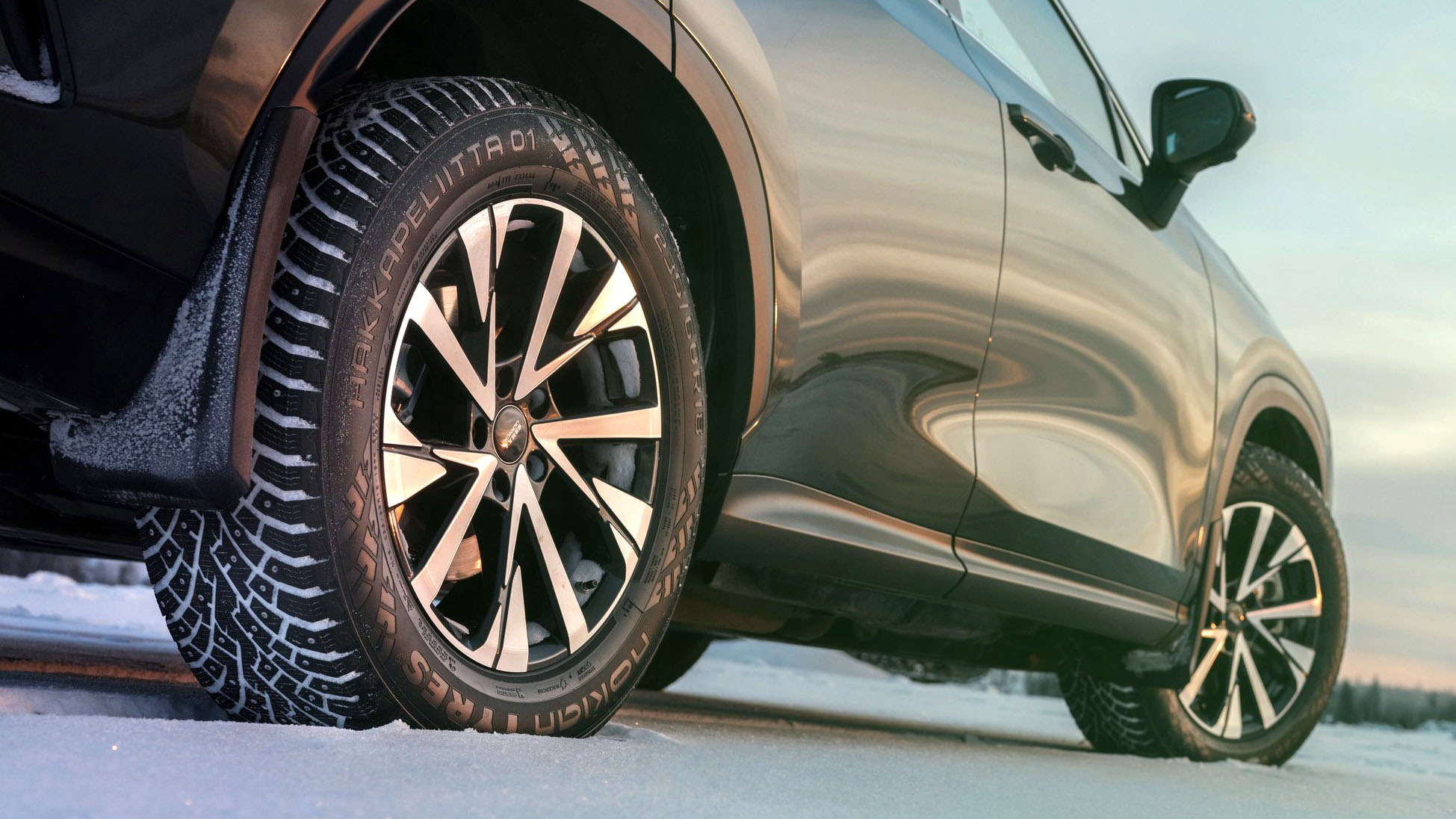
Studded tires are unmatched in snow and ice, but it’s their very capability in such conditions that makes them brutal on dry roads. For a while, companies have been trying to figure out how to deliver tires with true metal studs that can only be deployed on a part-time basis, when the driver wants, but none have made it to market. Winter tire experts Nokian may have actually just pulled it off, as the company has announced a new product—the Hakkapeliitta 01—that automatically deploys and retracts studs depending on temperature.
When the road surface is warm enough, the studs, which themselves have been redesigned specifically for this tire, sit back beneath the surface of the rubber. As the road surface gets colder—like, tire-in-contact-with-ice cold—they push out. Nokian says it’s been working on this technology since 2014, around the time it debuted a concept tire that deployed studs with the press of a button. Other startups had attempted to deliver such products, but they never arrived.
It’s unclear why Nokian moved away from the push-button system—perhaps the tech required to enable communication with the tire was too expensive or complicated. Regardless, it came around to a mechanism that reacts naturally to the changing environment, no sensors or electronics required.
The key is what the company calls an “adaptive base compound.” This is the material that the studs sit in, and it’s sensitive to temperature—becoming rock-solid when cold, and softer and more pliable when warm.

Nokian Tyres Hakkapeliitta 01: This is how we did it
Nokian said this was the most difficult component to develop, but the results seem promising. In one particular demonstration, timestamped above, samples of this compound are struck with a hammer that has a stud mounted to its head. This stud more or less bounces off a sample that has been cooled to -5°C/23°F, but sinks into another that has been kept at 5°C/41°F.
Nokian estimates the Hakkapeliitta 01 cuts down on road wear by “up to 30% compared to its predecessor,” though it’s unclear under what conditions—that is, to say, with the studs in or out. Ice grip is estimated to be 10% better and wet grip 5% better, while dampening road noise, another unfortunate byproduct of studded tires, by a decibel.
Part of the impetus for this innovation is the increasingly fickle weather brought on by climate change. Sudden freezing and thawing cycles mean that drivers in locations that see a lot of snow and ice come winter can’t necessarily count on leaving studded tires on season-long anymore. We’ll have to see how well the Hakkapeliitta 01 meets the challenge when it goes on sale this fall, right ahead of snow season, in North America and Nordic countries. Pricing has not yet been announced.
Got a tip? Reach out to tips@thedrive.com
Loading comments…
Comments couldn’t be loaded. Please refresh the page.