
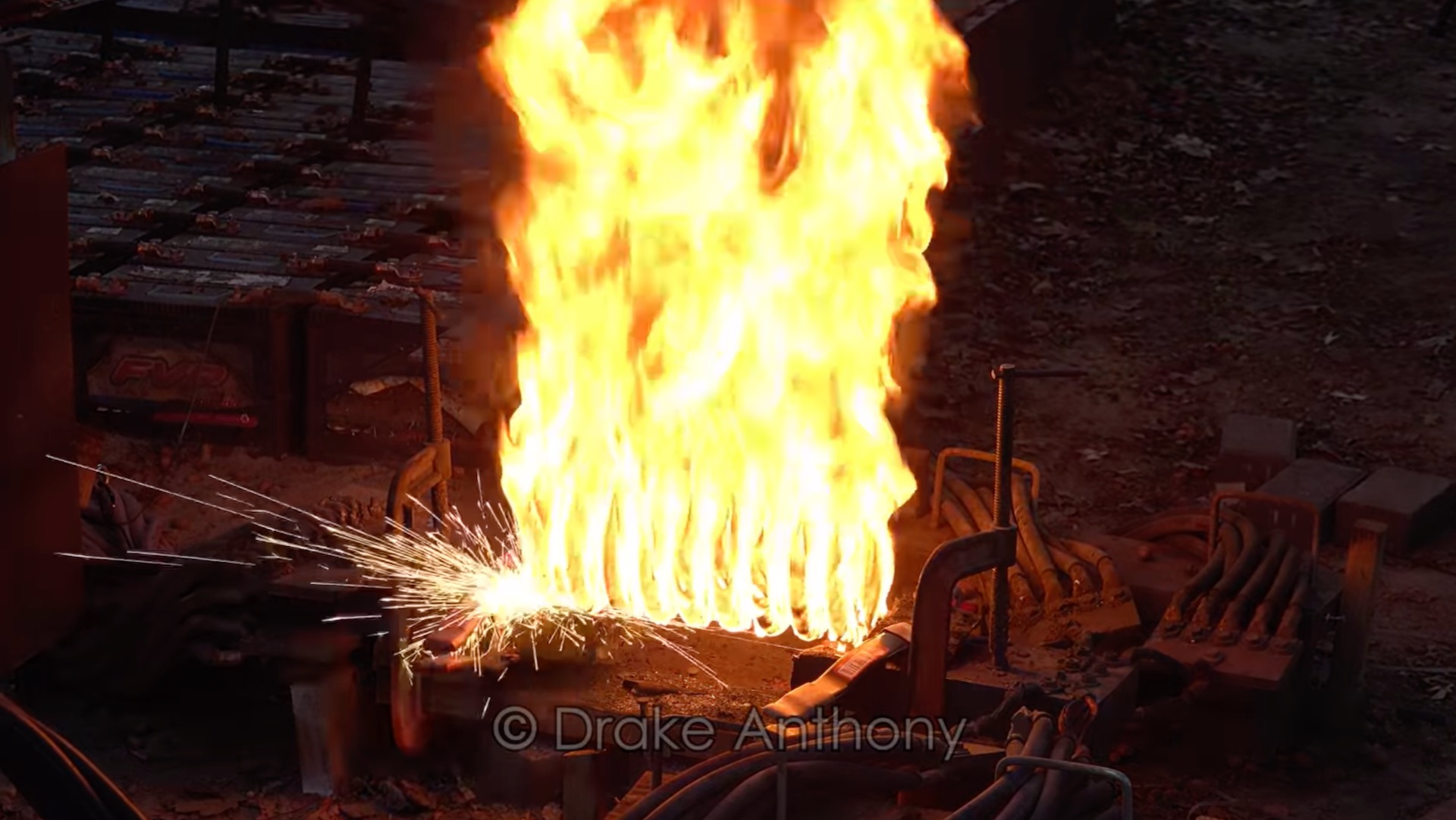
What do you do with 400 lead-acid car batteries? Wire them together and zap things with their combined current, obviously. That’s what Drake Anthony, who goes by styropyro on YouTube, did. The result was a two-hour video showing how various items react to devastating amounts of electricity.
One part worth focusing on comes up at the 1:16:20 mark. That’s when a steel suspension spring is hooked up to the battery array of death. It glows bright orange and bursts into flames before eventually disintegrating. Everything else was either destroyed instantly, or handled the current well enough that there was no noticeable effect. A chain came close, briefly glowing like it had been touched by Ghost Rider.
The key difference between the spring and those other items was its length, which allowed it to act as a resistor. The current flowing through it dropped from 8,000 amps to 1,000 amps by the time it melted, slowing down the reaction enough to produce those cool visual effects. That a piece of steel capable of holding up one corner of a car’s body can be made to glow and spontaneously combust is also a reminder that this falls firmly into the “don’t try this at home” category.

400 car batteries wired together!!
Lead-acid car batteries were chosen because they can produce a lot of current for sustained periods. The 400-battery setup weighs 28,000 pounds and discharges its current through a custom switch and connectors made with over 1,000 pounds of copper plates. All that copper is needed to handle the current, which also produces strong magnetic fields that had to be dealt with through the precise arrangement of the cables harnessing power from the array.
It sounds like a lot of work for some unorthodox pyrotechnics, but also a better use of these batteries than tossing them in the ocean. The entire video is well worth a watch if you have the time. It’s not really automotive at all, but you’re guaranteed to learn something from Anthony’s crazy experiment. Let’s all be grateful that he’s experienced enough to create something like this so none of us have to. I get the feeling it would have gone a lot worse if it
Got a tip? Send it in: tips@thedrive.com
Loading comments…
Comments couldn’t be loaded. Please refresh the page.