
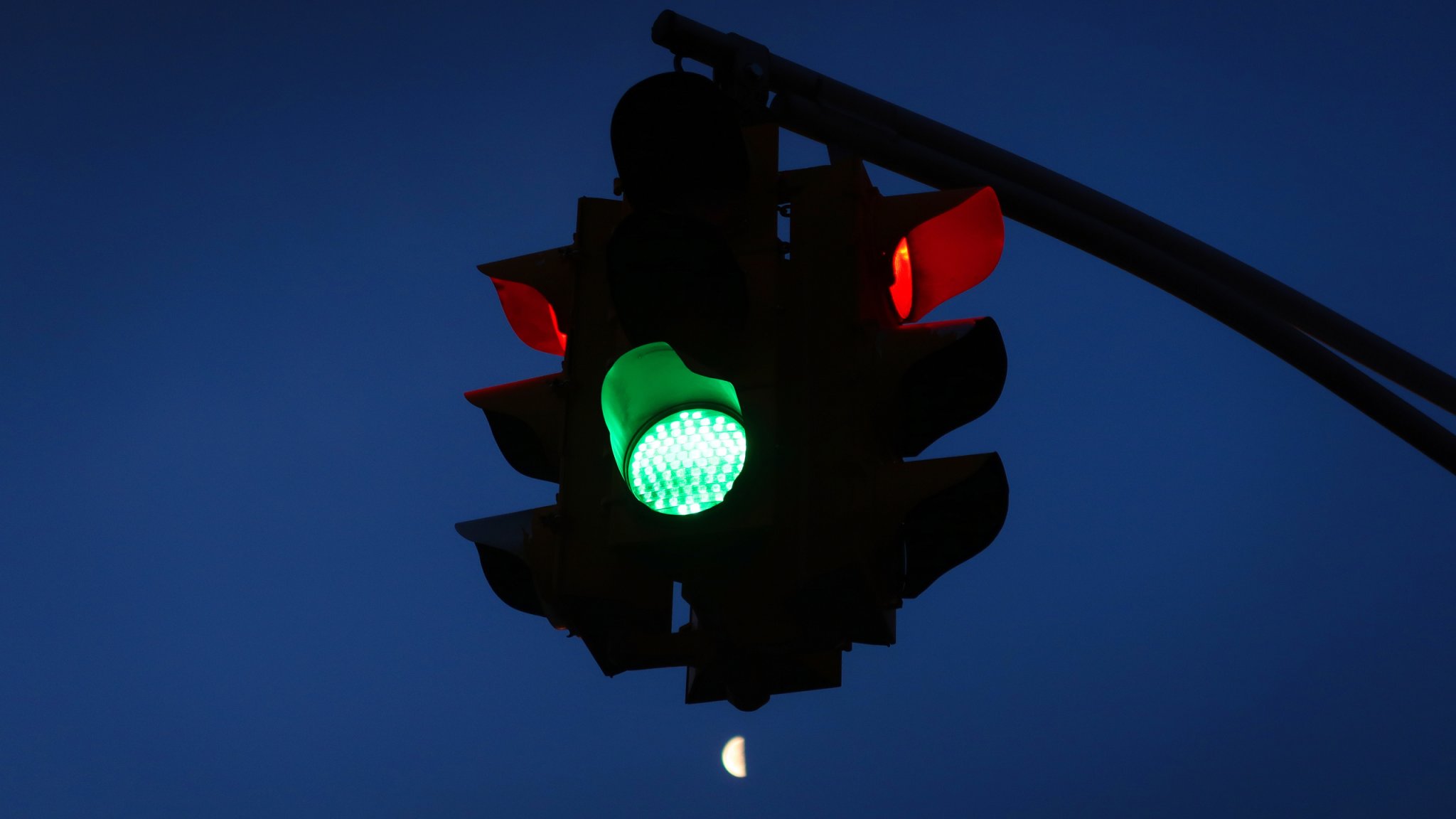
When most people think of “timed” traffic lights, what they picture is something rooted in the “green wave” effect—where traffic lights along a major thoroughfare are synchronized such that they turn green for traffic that is flowing at the prescribed speed. Hit one green light, in other words, and you’ll hit them all. But now there’s a new strategy in town. It’s called “rest in red,” and in cities where the approach has been pioneered, it’s both promoting better flow and moderating driver speeds, resulting in fewer accidents.
Essentially, rather than encouraging drivers to speed up by presenting an endless succession of green lights, this strategy makes red the default state for lights on a busy road. When traffic approaches the red light, the cycle triggers. Traffic moving faster than the limit will approach the light while it’s still red, forcing it to slow or stop for the light before it changes, while traffic moving at the limit will be met with a perfectly-timed green.
Drive the limit, in other words, and you’re rewarded with a constant rhythm of green lights. Drive too fast and you’ll end up encountering more reds. It doesn’t take long for drivers to learn the cadence and adjust their pace, according to Jennifer Turner, the director of municipal development for Albuquerque, New Mexico, which is one of the municipalities trialing the approach.
“If you come to Albuquerque right now and you’re driving that corridor, you will learn pretty quickly that if you are speeding, you stop,” she told the Associated Press.
Critics and skeptics worry that the approach will encourage more red-light running and other illegal activity, but the trial results so far speak for themselves.
In Portland, Oregon, a “rest in red” trial lowered average speeds from 39 mph to 30 mph (the speed limit). A pilot program in North Carolina saw a 43% reduction in total crashes after “rest in red” was implemented 24/7—an outcome that makes sense, a traffic analyst told the AP. The strategy seems to work best when implemented on roads that are designed to accommodate a great deal of traffic during the day, but are virtually empty at night.
Similar trials have been conducted in Long Beach, California, and Boulder, Colorado. The California study also briefly incorporated warning signs for speeders, alerting them to what was happening. That test began in 2012 and the results do not appear to be published online, however the city of Los Angeles was still utilizing “rest in red” strategies as recently as 2017.
Got a story tip? Let us know at tips@thedrive.com!
Loading comments…
Comments couldn’t be loaded. Please refresh the page.