
On Wednesday, we reported on a service bulletin that was allegedly sent to Toyota service departments with instructions on rationing motor oil stocks due to an impending shortage. On Thursday, a tipster sent us a copy of a similar bulletin drafted by Nissan in anticipation of a similar supply crunch—and an accompanying price hike for service departments.
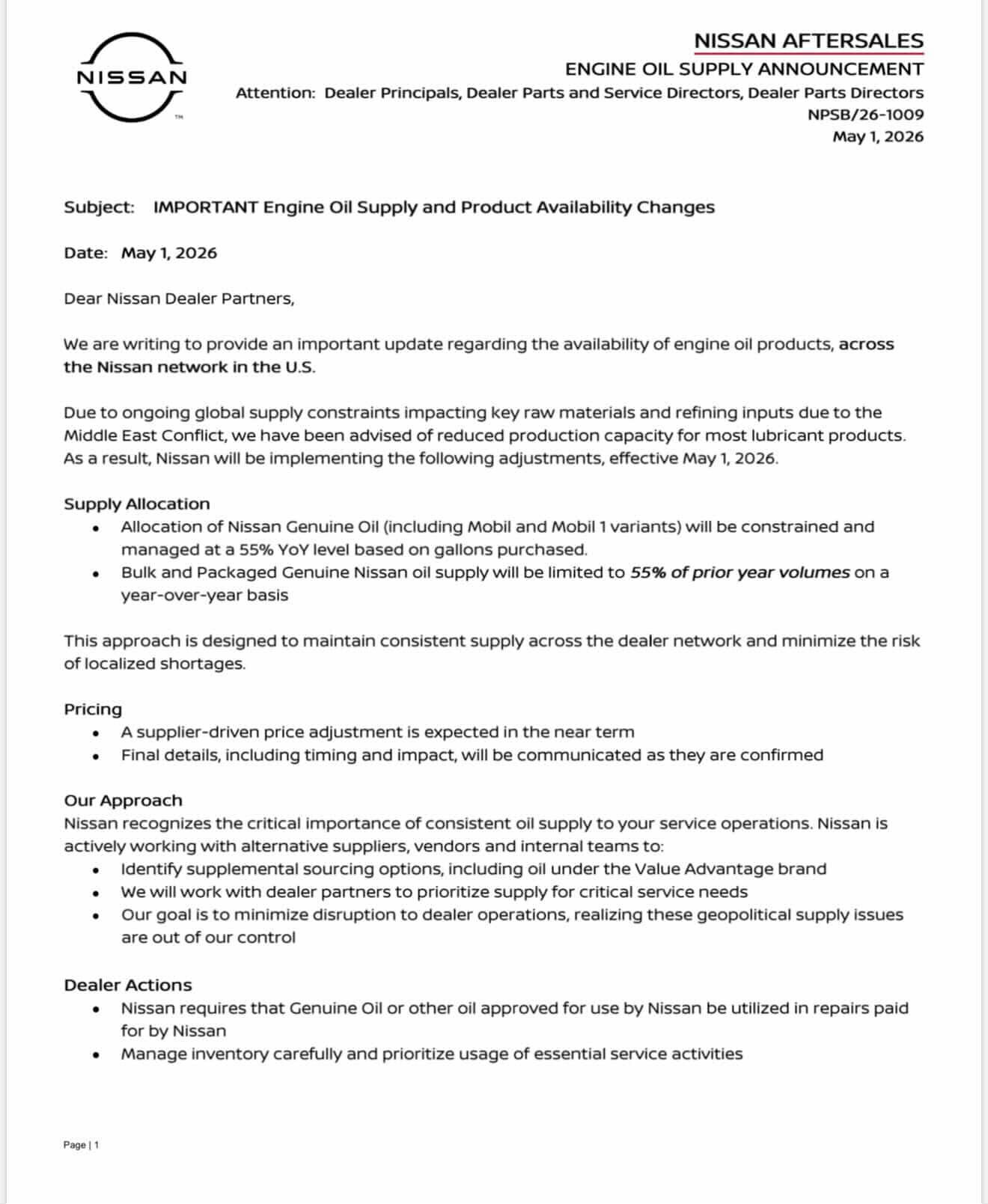
A Nissan spokesperson confirmed the authenticity of the bulletin to The Drive, noting that while the bulletin is real, it has not actually been distributed to Nissan’s dealer network.
“Nissan is closely monitoring current oil supply constraints in coordination with our supplier partners,” the spokesperson said in an emailed statement. “We remain fully committed to supporting our dealers and maintaining a high level of service for our customers.”
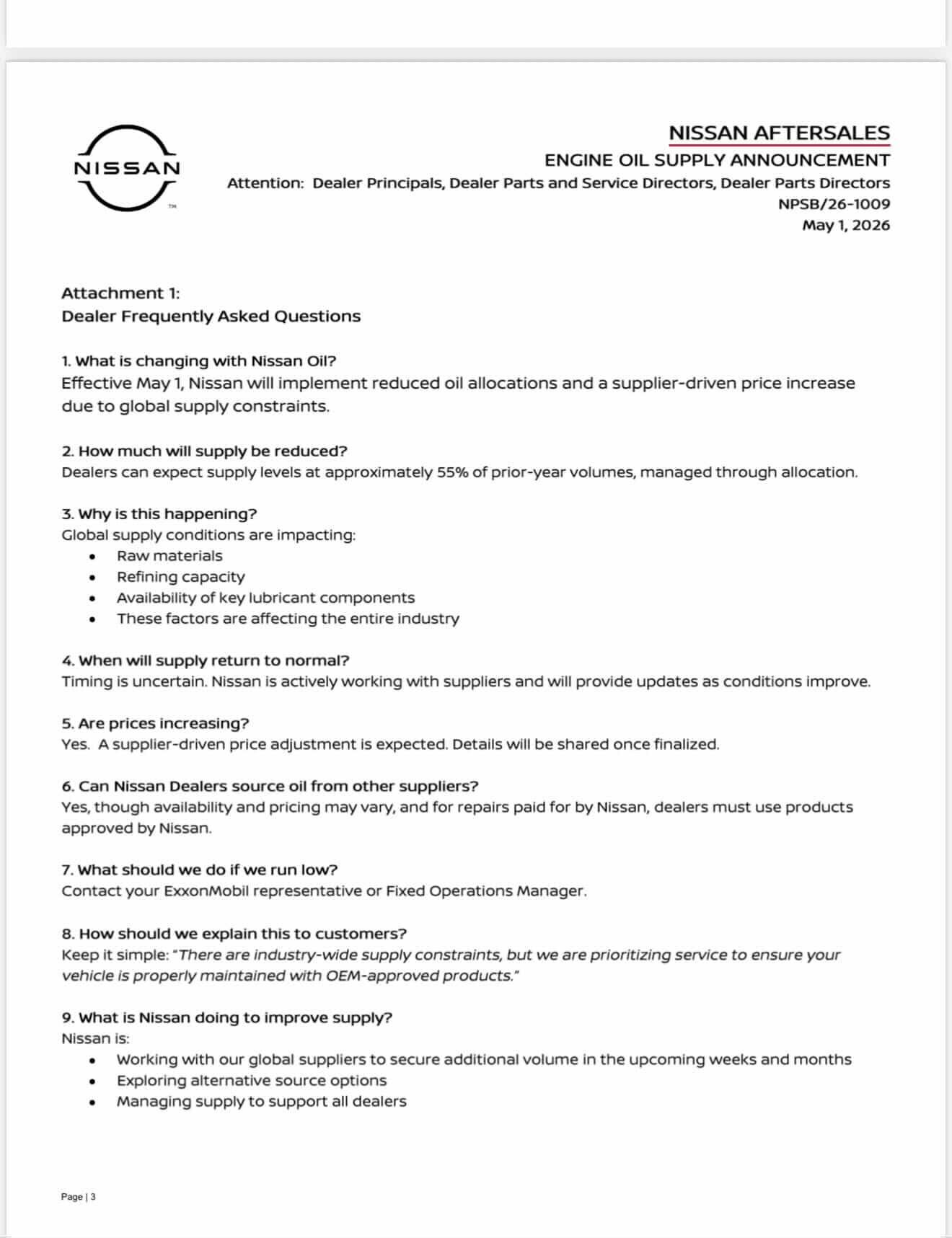
The bulletin itself is a single page, but includes a draft of customer talking points. Notably, the “why” section points out that the supply shortage is affecting all automakers, not just Nissan.
“We are writing to provide an important update regarding the availability of engine oil products across the Nissan network in the U.S.,” the bulletin says.
“Due to ongoing global supply constraints impacting key raw materials and refining inputs due to the Middle East Conflict, we have been advised of reduced production capacity for most lubricant products. As a result, Nissan will be implementing the following adjustments, effective May 1, 2026.”
“– Allocation of Nissan Genuine Oil (including Mobil and Mobil 1 variants) will be constrained and managed at a 55% YoY level based on gallons purchased.
“– Bulk and Packaged Genuine Nissan oil supply will be limited to 55% of prior year volumes on a year-over-year basis.” (All emphasis original.)
The bulletin also mentions a “supplier-driven price adjustment” of an unknown amount, but points out that dealers are not required to pay Nissan’s supplier-side rate for bulk oil; they can source it from wherever they like. However, any authorized service must be performed with a Nissan-approved (though not necessarily Nissan-sourced) lubricant.
Because the May 1st deadline has already come and gone without Nissan distributing the memo, it stands to reason that things haven’t gotten dire just yet. Still, even the potential for a 45% cut in supply compared to a year ago is eye-opening.
These days, many engines require a synthetic or at least partially synthetic (blended) motor oil. Given that the current geopolitical kerfuffle largely concerns old-fashioned, dinosaur-derived crude, it may seem odd at first glance that this shortage would impact motor oils. So, what’s the catch? In a word, base stock.
Yes, that’s two words, though occasionally you’ll see it as one. Whether you call it basestock or base stock, it’s pretty much what it sounds like. Here’s the short version, straight from a little mom-and-pop oil outfit called ExxonMobil:
“Base stocks are the key building blocks of lubricants and greases. A base stock is a single lubricant component produced by a single manufacturer,” the company says. “ExxonMobil produces and supplies them, and oil marketers or formulators mix them to make the finished products.”
In other words, if motor oil is a soup, the base stock is the broth. And as it turns out, “synthetic” base stock isn’t always synthesized. Depending on where you buy it, your “synthetic” oil may not actually be all that synthetic. It simply has to meet whatever criteria allow it to qualify where that formulation is being sold. Again, ExxonMobil explains:
“There is no generally accepted definition of a synthetic base stock, or synthetic base oil. In the U.S., the government considers “synthetic” to be a marketing term characterizing the formulated lubricant while in Germany, synthetic base stocks are defined by law to be polyalphaolefins or esters.”
“Many oil marketers consider lubricants formulated with significant concentrations of Group IV and/or Group III base stocks as synthetic. Most Group III base stocks are refined from crude oil streams.” (Emphasis added.)
The logical solution would be for motor oil producers to switch back to a synthetic base stock, but while that may help address the shortage, it might not save us any money. If old-fashioned dino oil was being cleaned up to use as a “synthetic” base already, chances are it was cheaper than anything man-made. That doesn’t bode well for summer road trip plans. If you’re due for a oil change, you may not want to wait.
Update 5/14/2026, 8:20pm ET: This story has been updated to include a revised statement from Nissan and clarify the nature of the bulletin itself.
Got a news tip? Let us know at tips@thedrive.com!
Loading comments…
Comments couldn’t be loaded. Please refresh the page.