
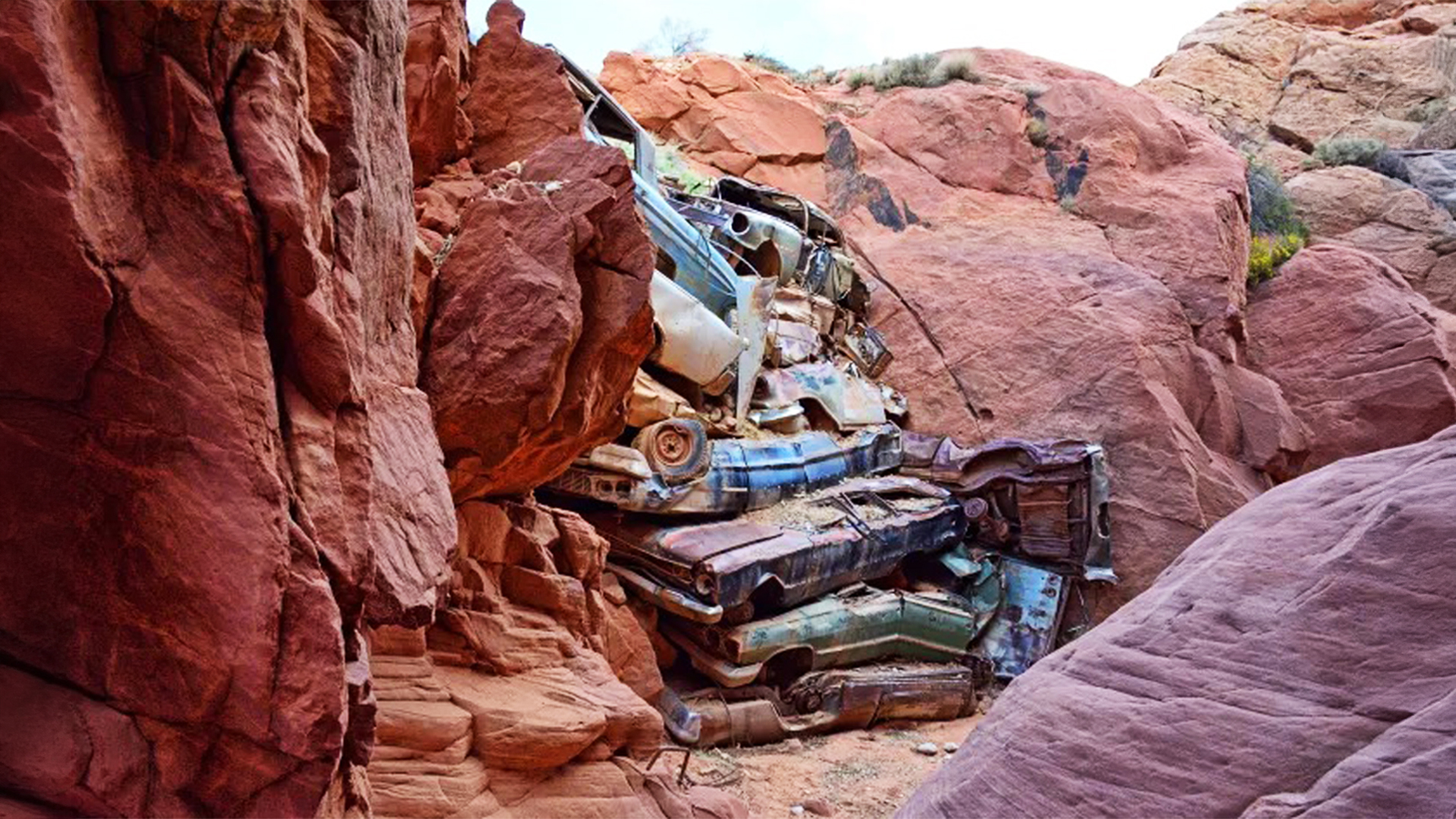
Right off Highway 89 in Utah near mile marker 25, just above the border with Arizona and about 80 miles east of Zion National Park, lies an oddity: the ruins of Detroit metal in various hues, piled from the canyon floor up to the road itself. These scrapped cars have been here for around six decades, but today they look completely out of place in the desert. There’s a good reason for their existence—or, at least, there was.
This area is known as Catstair Canyon, and the junked car wall, the Catstair Riprap. “Riprap,” for those of us not well versed in waterway studies, is any sort of material deposited along banks to protect the adjoining land from erosion. You can do this with rocks or concrete, of course, but in the middle of the 20th century, some experts favored using junked car bodies filled with gravel and tied to a slope.
Strange as it may seem now to see a stack of ruined Bel Airs, Contintentals, and Corvairs tall enough to climb (though we’d recommend exercising caution, as the explorer in the video below does) this practice was actually somewhat common at the time.

Catstair Canyon
On the banks of the Loup River outside Columbus, Nebraska, for example, you’ll find rows of cars lining the river, spaced out about a car width between them, stretching almost as far as the eye can see. Though it looks very different than the Catstair Canyon installation, the goal was the same: disrupt the flow of water and protect those riverbanks from being eaten away at over time. For Catstair, the concern was rainwater rushing in those troughs.
Did it work? Well, yes, but at an obvious cost. “It was part of a long habit of treating rivers as little more than sewers and riverboat highways,” David L. Bristow of the Nebraska State Historical Society wrote in a 2022 article. “For many years a town’s riverfront was predictably its poorest, ugliest, and most industrialized area.”
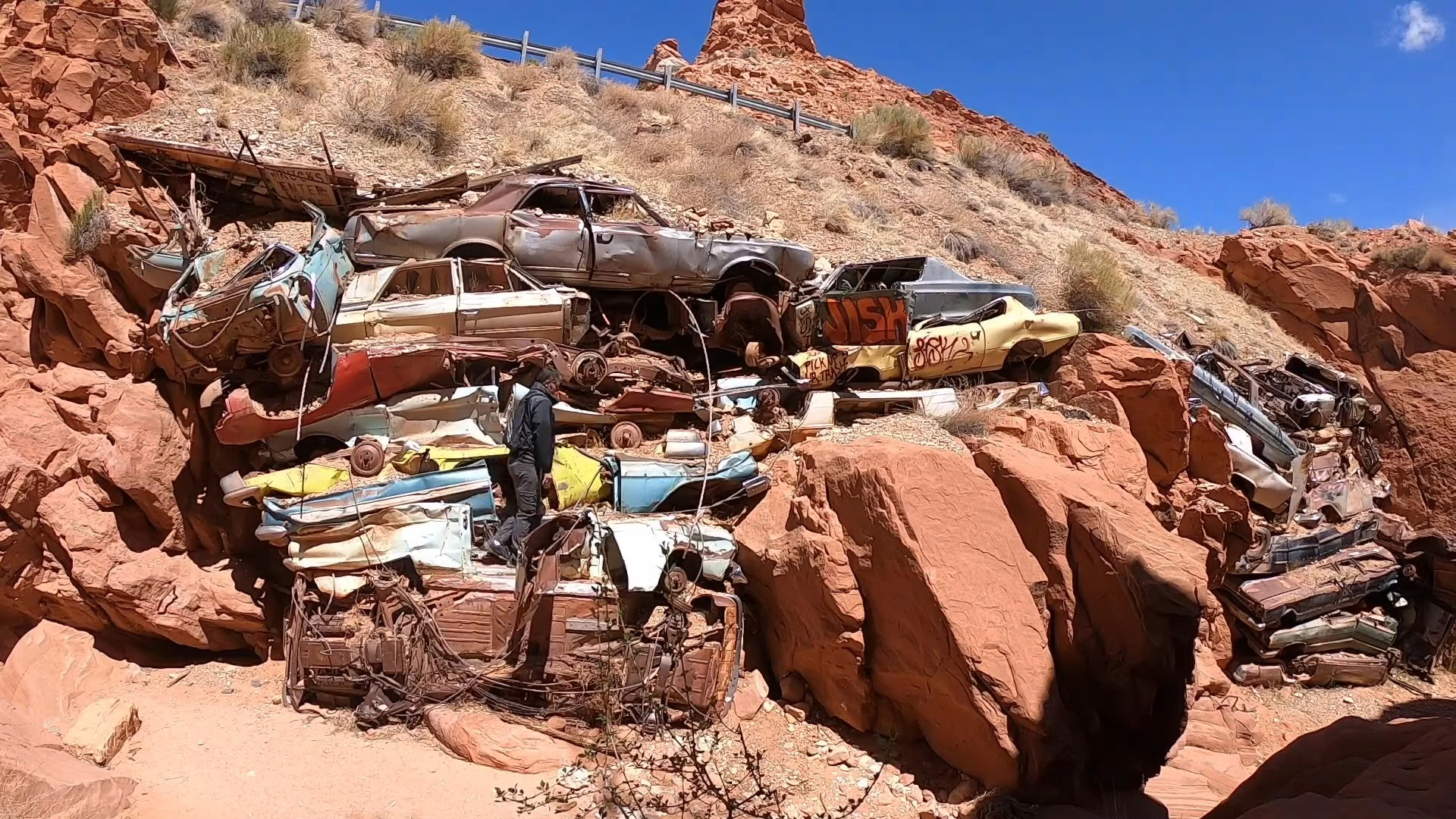
By the early ’70s, the act of using cars as riprap was beginning to fall out of favor, per Hot Rod Magazine’s Steven Rupp, due to the Clean Water Act of 1972 and the onset of new construction technology and techniques. Of course, even though the practice stopped, the junk isn’t going anywhere.
You can hike to the Catstair Riprap from small dirt parking areas located to the east and west of the attraction itself. The west lot is much closer than the east lot and its path is much easier, too, so it’s best to aim for that one. Continue walking past the cars from that side, and you’ll meet a 10-foot drop and a much more challenging journey, per My Zion Vacation.
Have you seen Catstair Canyon in person? Comment below and share pics if you got ’em!
Loading comments…
Comments couldn’t be loaded. Please refresh the page.