

Remember the scene in Ford v Ferrari where Matt Damon, playing Carroll Shelby, watches his team strip all the heavy computer equipment out of the GT40 and Ford’s engineer asks what are they doing, “making your car faster,” Damon said. Something similar, though different and more modern, took place with Ford’s latest endeavor: The GTD.
In Palm Springs at the launch of the 2025 Ford Mustang GTD Chief Program Engineer Greg Goodall told The Drive the team was 3D printing and engineering parts on the fly at the Nürburgring to make the car faster and shorten lap times. The real-time development during testing at the ‘Ring then was fed back to the team for further development and analysis.
Goodall said in a traditional vehicle development program there’s a point at which engineering and design just gets cut off and the ideas have to stop. “We gotta get ready for production, guys,” is that moment in time. The GTD is not and was not a normal program.
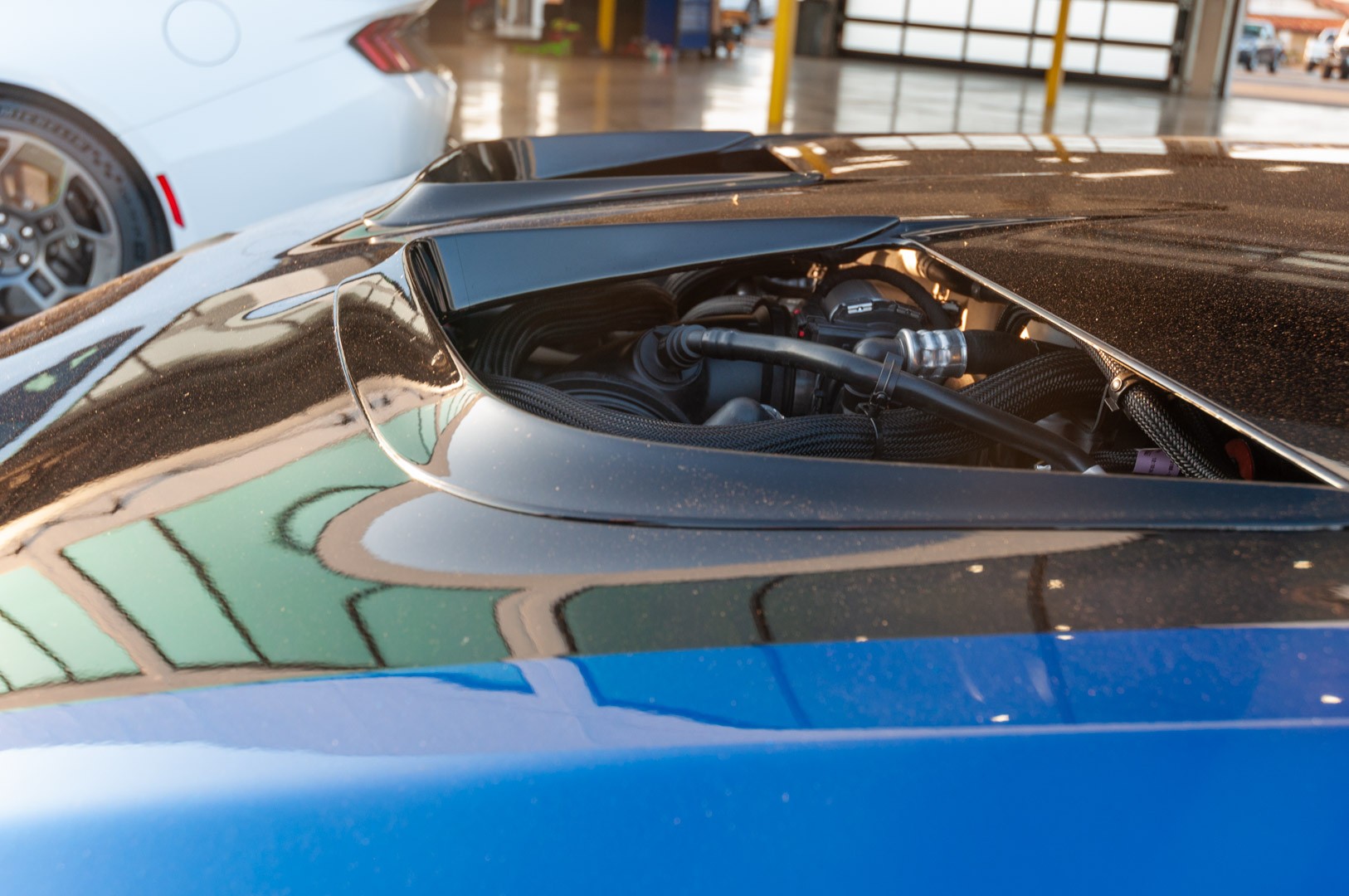
The specific part is called the “hood flicks” around the vents on the hood. “They are like little raised ski slopes on there,” Goodall said.
Goodall said Mustang GTD Vehicle Dynamics Technical Specialist Steve Thompson called from the Nürburgring and said, “Hey, this isn’t in the design, we 3D-printed some parts we’ve been testing out here. It’s worth X amount of time (Goodall wouldn’t divulge the actual number) on the ‘Ring. We want this. Can you figure out how to make that happen?”
Between Goodall’s and Design Manager Anthony Colard’s teams within a week or two a design was figured out that provided the downforce Thompson was seeking. The design ended up being drag neutral, but provided the downforce and extra time on the ‘Ring. Colard said the team did about 20 coefficient drag runs to get the design right, and it took seven or eight iterations.
Before the “hood flicks” were installed there was a smoother raised lip that sat lower, which is actually still beneath the new design, with the new part now bonded to the hood.
The Mustang GTD team went to the ‘Ring three times before going in August 2024 for the first controlled runs with the track just to themselves. And then the team went back to the ‘Ring a few more times in 2024 and 2025 before setting the current lap time of 6:52.072 in April 2025.
The “hood flicks” didn’t come along into the picture until May 2024 while Ford was performing some final testing during industry pool days. The first official sub 7-minute lap attempt took place in August where the Mustang GTD became the first American car to run a sub 7-minute lap with a time of 6:57.685.
Without the “hood flicks,” running a sub 7-minute lap around the ‘Ring would’ve been “very tight,” Goodall said.
Got a tip about an engineering success story? We want to hear from you. Shoot us a note at tips@thedrive.com.
Loading comments…
Comments couldn’t be loaded. Please refresh the page.