
Are independent mechanics about to get locked out of wrenching on new vehicles? Should you be allowed and able to choose who fixes the car that you own? Should you be able to work on your own car?
The quiet battle brewing over the right to repair could decide the answer to these questions all within the walls of congress without you ever getting a say. The fight has been brewing for over a decade, and now it’s back in spotlight. Ford CEO Jim Farley made a comment about the topic that should make every car owner uncomfortable.
Farley’s comment that modern cars are too complex and his argument that it’s a safety issue for you to work on your own car is just one piece of the puzzle. The larger question, and the real danger, is what happens if automakers win this fight that you didn’t even realize existed. The feds are involved and President Trump is now urging the EPA to clarify what repairs are legal, but the current administration’s latest move only takes aim at emissions equipment. It also is a memo and by no means changing the current situation. This isn’t a new topic and has been on the docket for years with bipartisan coalitions introducing bills, U.S. Senators calling out automotive executives for opposing right to repair, and even the feds telling automakers to ignore right to repair laws in certain states. The issue can affect things as simple as changing brake pads on your car. And cars being more connected and complicated than ever isn’t helping things.
On the latest episode of The Drivecast we discuss the right to repair, how we got here, why it’s back in the news, what’s happening, what it means for you, and what you can do about it.
First day here? The Drivecast is The Drive‘s weekly podcast that takes you behind-the-scenes on the largest controveries, stories, and characters shaping the automotive industry along with the way our roads look today. Powered by The Drive‘s inside access, original reporting, exclusives, and insights, The Drivecast aims to make everyone an insider.
Listen to The Drivecast via Spotify, Apple Podcasts, or Amazon Music. Love it? Like it? Want to help? Leave a five-star review on your platform of choice to help get The Drivecast in front of more people. Have a suggestion, tip, request, or feedback? Drop us a line at feedback@thedrive.com. I promise, we read every single email.
Full Transcript
Joel: Today’s topic, right to repair. And you know, let’s just get into it. First off, start with the basics, Andrew. What is right to repair for people that don’t know?
Andrew: Yes, so I’m going to start with the kind of broad conceptual definition because slightly different ways of phrasing it have made their way into various pieces of legislation. Broadly speaking, right to repair is talking about the consumer’s right to basically understand and diagnose their own car. I mean, we typically talk about it in terms of cars, especially since this is a car site, but it absolutely also applies to home electronics, tools, technology. I mean everything, it applies to everything. And one of the most important things that I really want listeners to understand and everyone to understand is that this is not just about you and me tinkering on our old 90s vehicles in our shops. It’s about independent mechanics existing, basically, and being able to fix your late-model car. I mean if OEMs own every aspect of vehicle diagnosis, then they’re going to be the only game in town when it comes to servicing them. And I don’t think anybody any consumer wants that.
Joel: Well, I mean it overlays about modern cars and whether it’s gatekeeping itself for a mechanic. And I’m sure we’re going to touch on that today. You know, I remember there’s a shop here, we’re not going to start naming names, but there was a shop here who had to make a life decision of we’re going to spend X number of dollars so that we can basically license and have access to one of the German automakers’ tech systems so that they can actually work on modern cars from this German automaker. And eventually, they were like, “That ROI is not there for us. We can do oil changes and all basic stuff without that, so we’re going to not invest in that,” which means that certain things for that German car, if you owned it, you couldn’t go to this third party. You would have to literally go to the dealership, which actually that part of it is something we’re going to talk about. But it’s gatekeeping. So given that context, Andrew, and the broad conceptual definition we just went through, how do we get where we are today with talking about Jim Farley and obviously President Trump, but it goes even before that, right? This has been the news on and off for years.
Andrew: Yeah, absolutely. So I’ll give you kind of the run-up before we talk about what’s happening right now. I mean, we could go back to the dawn of industrial economics, really, but we’ve only got an hour here, so we’ll fast forward to let’s start with 2013. This is kind of the first time that people really heard the phrase right to repair in the news. My home state of Massachusetts passed a law that basically said all vehicles built after a certain year had to have had to be diagnosable with non-proprietary technology, kind of trying to avoid the situation you were just describing. And standardizations did exist before then, you know, we had things like OBD-II, which is where all cars made after ’96 had to be scannable with a certain kind of computer. But that Massachusetts ruling was really when when the American public first started hearing about this right to repair term, 2013. Okay, so then shortly after that, 2014, aftermarket and auto industry groups got together and joined a voluntary agreement that kind of codified the same thing, again, voluntary, codified the same concept, but their concession to OEMs was they would back off trying to push right to repair on a state level and try to do it federally. So we’re this is 2014, okay, this is now a long time ago, and automotive technology has changed a lot. I mean the Tesla Model S was still brand new basically back then, right? So critically, that kind of voluntary agreement doesn’t mention anything about vehicle data and telemetry, and this is going to become very important soon in this part of the story. So now we get to why this legislation is kind of on people’s minds again, and why we just saw executives from Ford and GM meeting with the President at the White House. So now there’s something being debated called the REPAIR Act, and that stands for Right to Equitable and Professional Auto Industry Repair, okay? That’s being tucked in to something called Build America 250 Act. This is also known as the Surface Transportation Reauthorization Act or, commonly known as, the highway bill. This is currently being actively debated. Now, stay with me here. So very recently, there was language in the REPAIR Act that covered that data and telemetry stuff. So this see data telemetry this is very important because modern cars collect a lot of data, they use a lot of data. The data that lives inside their car computer brains becomes important to diagnosing them. OEMs want to keep that for themselves. Independent mechanics are like, “Hey, I need this. I need to be we need it to be able to diagnose modern cars,” which I think I agree with, personally. So the reason this is being debated again now, and I’m talking now, like as you’re listening to this, this is currently happening, language was removed about data and telemetry to go back to this 2014 era kind of language to get it into this highway bill that is in front of in Congress now. So you’ve got people on small-bizz advocates who are trying to get that reversed. As a matter of fact, an organization called the NFIB, which is the National Federation of Independent Business, that’s actually the largest small business association in the U.S., they sent a letter to Congress basically pleading to reinstate that language about data making sure that like an independent mechanic should be able to access vehicle data, basically. And there are some other spurs to come off of it, but basically that’s where we’re at right now is there’s two the two sides to the coin are you’ve got consumers and independent mechanics and small operations on one side, and then big corporations and shareholders on the other. It’s really that simple.
Joel: Tale as old as time.
Andrew: Exactly, yeah.
Joel: But now in modern times. And as you were saying something about all this stuff, you mentioned 2014 and all that, I was just thinking what happened around that era was the the the first real electric car that we all would know came into real mass production, right? The Model S, right? So it came in around 2012, 2013, and then it started picking up and then after that came the Model 3 and the Model Y. We had the second-gen Leaf, and now we have really truly connected cars. But even a RAV4 is a connected car now, right? We just did the story about that guy ripping out the Bluetooth and the GPS and the sat radio just so his car couldn’t be tracked, which is the podcast we did last week about being cars being tracked via license plate readers and signals from the the numbers on all of your smart devices. We live in a connected world. So now it’s in the news again, thanks to President Trump and Ford CEO Jim Farley. Take us behind the scenes on what the latest is on this.
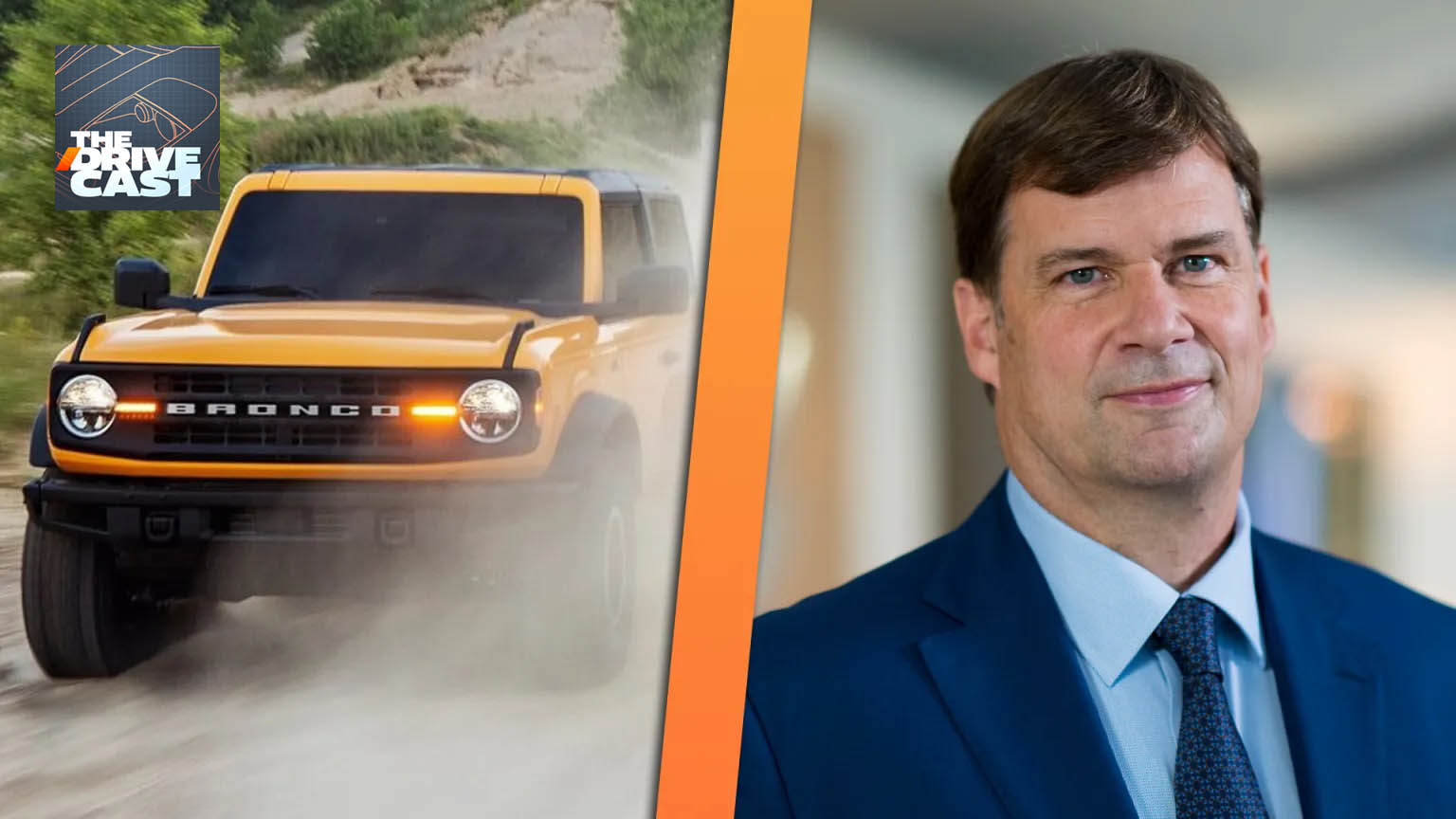
Andrew: So basically there was a meeting with Mr. Farley and one of the GM execs, maybe Mary Barra, might have been someone else, in the White House, and they all they left and there were some follow-up questions, you know, of course, people wanted to know what like many things that come out of the White House, it was quite murky about what was actually decided. And someone from the Detroit Free Press caught Jim Farley at another event and they asked him point blank, “So you don’t want people repairing your own vehicles?” And you can watch the video on on Freep’s website. He kind of does these like Homelander eyes and is like, “Well, you know, no, it’s it’s a safety issue. Oh, you know, I can work on my old Bronco but I wouldn’t want to work on a new Bronco.” And as I was listening to that, I was thinking like, what a weird car to pick. Like if he had said Ford GT or like even Mustang Mach-E, I might have been like, yeah, okay, I guess. But a freaking Bronco, man, that’s like caveman technology. But I mean, I will concede there are some stuff, you know, there’s ADAS, there is some stuff that I wouldn’t want to touch as a private citizen, but certainly independent mechanics would want to be able to mess with that. And his comment, you can just watch the body language and the very careful way he phrased it. He was trying to make it about safety. And this is what you’re going to hear auto execs talking about this for the next as long as this is being debated. In the coming weeks and months, it’s they’re going to say oh, it’s not safe for people to work on their own cars. But like I said earlier, this isn’t about people working on their own cars. It’s about these companies hoarding all this data and information from us. When they sell you a car, you it should be your car to tinker with as you see fit. And so all this to bring it back to, of course, I wrote that up on the site and I will I will say I feel a little bit bad about using Mr. Farley’s name because it’s really not a Jim Farley issue or even a Ford issue. It’s an industry-wide issue. He just happened to be the guy who had the juicy quote and people really resonated with people because it is infuriating. You know, I’m sorry for Mr. Farley if he had any annoying meetings with his PR staff, I’m sure he did after that. But yeah, it’s an industry-wide issue and, you know, we’re going to keep seeing it.
Joel: You know, the couple things you said that are interesting is and I’m just going to try and go in order, I don’t remember everything, but like one, it was interesting that Farley would choose, like you said, the Bronco versus like a Mach-E, right? Like or a Lightning. Like if he had picked an electric car, we probably wouldn’t have batted an eye because like, you know, high-voltage batteries and whatever, but like picked a car that you can unbolt the doors. So in the defense of Mr. Farley, right? Okay. Even a Bronco, even a Bronco. So and let’s just side-step the ADAS stuff. By the way, ADAS is like adaptive safety equipment, right? So forward automatic emergency braking, automatic headlights, you have forward collision warnings, etc. If you let’s just side-step that, which by the way, that stuff is really important and if you take some of those sensors out, they need to be recalibrated. So like when you if you crash a car and you go to a repair shop, you need to either A, go to a certified repair shop or B, a shop that can bring in a certified person or take it to the dealership to calibrate that stuff, otherwise it really could like screw your car up if you were to be in traffic and it thought it was going to be in an accident, you weren’t going to be in an accident, then it then it hit the brakes or whatever. But that’s not the point. So like even a Bronco, the days of like when you would modify a car, probably even not truly in my lifetime because like electronic control systems came in play in the ’90s. My my E34 M5, which was a 1991 car, had electronically controlled powertrain through a first-generation board, okay? And we can talk about that another time, whatever. But so a modern car, like a Bronco, the powertrain’s running off electronics, right? So you used to cam the crap out of a car or you would modify all these other elements to the actual engine. Now, you plug in a computer and you just give it a a software code that’s employs a new tune that modifies the turbo or the boost or any of this other stuff, and suddenly you have more power, right? Yes, you can still increase like the size of the turbo and the boost pressure and all those things, that’s mechanical, arguably. But you can literally plug in one of those Summit tuners. Ford approves this, by the way. It’s like a $1,300 option on the Ranger the 2.3 turbo-four that’s on the Ranger and the Bronco. And suddenly you have more power. Like you just push a button. And that takes software and code, which is what that powertrain’s running on. Now, if you uploaded a bad piece of code, you can brick your car. You it would just not start. Like that car runs off electronics when you push a button, that’s how the car starts. So I mean, and I’m not trying to defend him, it’s just like there are so many electronics running through every piece and every element of the modern car at this point, that you got to ask yourself, I mean, I don’t know how to code. Like like I couldn’t do it. I wouldn’t know if a piece of code I’m putting in the car is bad. Would you?
Andrew: It’s actually not as hard as you might think. Not to contradict, but I mean, you know, I had an eighth-generation Honda Civic and, you know, that was home-coded. I mean it’s basically, I had a fuel map that was running off a piece of software called Hondata and I had to talk to it with a laptop and I would email the car’s information to a to a professional who knew how to read it. He would give me settings, I would input the settings, and we would go back and forth emailing each other. And we could refine, you know, things like throttle response and even power delivery. But all this to so I’m agreeing with you in one sense that
Joel: But you just said the same thing. You had to email the dude who was the expert or whatever. You had to still rely on someone, someone that knew how to code and make the tunes for you. And yes, it was collaborative or whatever, but like I guess actually, if I wanted to argue your point, I could just go to Claude and say I need a code but then again, what if I load a bad code and like I misfire my engine or I whatever, right? Yeah.
Andrew: But we’re kind of straying from right to repair here. I mean you’re talking stuff like modding and I mean that’s been around for a while and it’s even, again it’s not really about the home tinkerer. It’s about the whole OEM owning this information and walling it behind their their garden. I mean yeah, of course, in the broad sense of should just anybody be dicking around with their car in their driveway? No, I mean absolutely not, you know, they are dangerous pieces of equipment and you do need to be careful with them and treat them with respect, absolutely. But the the safety comment really disappears when you’re talking about independent pro mechanics, that’s who I’m the most nervous about losing access to this this information and, you know, I’m already feeling this frustration with my freaking lawnmower. I’ve got a Cub Cadet zero-turn electric lawnmower that I bought some new blades for and I bought them directly from the manufacturer and I went to put them on and I couldn’t find the spec anywhere, the torque spec. I mean this is a blade that’s going to be spinning on a very powerful motor, and they said, “No, you need to have it installed by a certified Cub Cadet person.” And I’m like, “Well, I live in a rural area, I I don’t have a way of executing that, and so I basically had to convince the customer service person. I was like, ‘Look, I’m going to bolt this blade to this motor and it’s the blood is on your hands if the spec is wrong.'” And they ultimately did give it to me. But I can’t I don’t want to count on that for like all my future stuff. So yeah, I guess that does bring it back to the driveway tinkering.
Joel: I mean, I suppose what if they gate keep an oil change? I mean that wouldn’t be a thing for an EV, but like, you know, in our Grand Cherokee, when you change the oil, there’s the oil maintenance minder on on the gauge cluster, right? And to change that, you’ve got to go through this this touch your nose, wiggle your finger, whatever. I never remember the sequence. I have to go to YouTube and look it up every time because you got to put it into run, tap the brake three times, hit the gas, blah blah blah, and then turn the car off again and then you turn it on and then it does it. And I’m like, all right, this is insanity, right? Yeah, I mean it it they’re so complicated, truly.
Andrew: Yeah, yeah, they are, yes. And and I’m not, I’m not disagreeing that modern cars are complex and heavily computerized, absolutely. And you know, another thing is like you were talking about stuff like the modern Hummer and I mean with CAN bus another layer of complication is everything is so interconnected within the car. On some vehicles like you were talking about a light bulb can brick the vehicle because it does it’s getting the wrong signal from the taillights so it won’t activate some ancillary system that you wouldn’t think is connected, but yeah, the days of like just having an old spool of wiring connecting ignition to a starter, that’s over. It’s all interconnected now, for sure.
Joel: Well, I mean that’s an interesting topic, right, because you went to the Rivian R1 Gen 2 launch and you saw where they took from 17 ECUs to 7 ECUs and made a zonal architecture and it’s a northwest southwest northeast thing. They took all this wiring out, which takes weight and complexity out. But also now, the entire car systems are running on seven ECUs, seven computers, right? And like if one of those ECUs goes out, you’re not going to, to your point about the, you know, the headlights are running on one wire and this wire and whatever, like those days are gone. They’re stripping as much out of these cars as they can and trying to have everything do everything. It saves weight, it saves cost for them.
Andrew: Yeah, the Rivian one’s an interesting example, I like electric vehicles in general, honestly, because I really like them. I loved the EV Sierra, I like the Rivian, I honestly am enjoying the Hummer much to my own surprise, quite a bit. Electric propulsion is awesome. I really like it and I love the idea that of Rivian, you know, reducing their wire usage and simplifying.
Joel: Feel a but coming on.
Andrew: Oh yeah, no, no, well, the but is I just want to still be able to get the specs to fix it if like I’m in a Rivian and the motor fails in 10 years, I want to be able to not necessarily, if Rivian goes out of business, I want the aftermarket to be able to build the part, right? I want things to to keep going on. This is, I mean, this is another thing that is connected to right to repair very much so is if a company like let’s use Honda for example
Joel: Fisker, Fisker, Fisker, use Fisker.
Andrew: Yeah, okay, perfect example, right, let’s use a real example, yeah, Fisker. You know, all their stuff is locked down and once the company goes away, it’s like, well, now these cars are giant paperweights. It’s, well, if the aftermarket was able to step in and supply things, that might not be the case, but yeah, so right to repair’s really going to affect your ability to keep a car for a long time. Once you get past 15 years, you know, I just have this problem trying to find a freaking windshield cowl for my 2003 beamer, BMW doesn’t make it anymore, they’re not interested in building it, so you got to go to the aftermarket. And if right to repair doesn’t pass, that won’t happen anymore. You won’t there won’t be an aftermarket. This is what’s at stake.
Joel: It’s interesting, too, because so that 300ZX that’s in our garage, Nissan doesn’t make a lot of parts for that car anymore. It’s very annoying. And during our interview with Ponz, he’s the VP of Nissan North America and he was on the Drivecast a couple months ago, he he announced, we broke the news, that they’re going, he’s got a guy in place that over the next, I don’t remember what it was, 12, 16 months, they’re going to literally spin up a program that is going to bring parts that are for defunct cars back into production and support the aftermarket and blah blah blah. And I was like, cool, I may need like a blue dashboard or whatever, right? Like I was like, bring me some blue plastic clips, man. I need some plastic clips. But the point is, to your point, that so that car is 30 25 years old, 30 years old, 25 years old, 1990, I math is hard. But and the average car on the road today is I don’t remember what, 12 and a half, ish years, something like that. Something like that, 11 to 12, yeah. Yeah, so to your point about 15, and and we’re actually coming up we’re coming up on that with the original OG Model S, right? So the Model S launched in I mean, I think really low volume in 2012, but like 2013 was like when we really started getting numbers. Like 2012 was low. But that puts us at like 13, 14 years old on the original OG Model S’s, and they are still out there with a lot of them with original battery packs and impressive range for what they are at this point, they’ve held up much better than we ever anticipated. Maybe not so much for their digital gauge clusters that were bleeding, but that’s because they didn’t use automotive spec parts. Nobody believed they were going to be a real company at that point. They improved that car as the car went on and time went on. Point is, you’re probably not replacing that digital cluster in the Model S yourself, right? Like you’re not. Or or maybe you are a headlight? Like I don’t know how complicated it is, but we are getting to that point now where certain early EVs are hitting the 13, 14, 12-year mark, right? That average age of car on the road. It’ll be interesting to see how this plays out as whether it’s an independent mechanic or a do-it-yourselfer or what what is going to happen to these cars as the first Model 3s start really aging out, right?
Andrew: Yeah, I don’t know. There’s probably uh some total EV uh nerds that would love to get into that, but I don’t I mean, I would like to see them still mobilizing, I mean, why the heck not? If the if they still work, then keep them running.
Joel: Well, and a battery pack’s probably a lot less expensive than a new car.
Andrew: Right, exactly. Yeah, I know, that’s it’s a throwaway culture, man, it’s in everything.
Joel: We do live in a throwaway culture, right? Like how old do you really live with your iPhone? I don’t think I’ve kept an iPhone ever past three years, three and a half years, you know? It starts feeling slow, and the battery isn’t as good anymore, like then you get a new one, you’re like, “Wow, the camera is so amazing.” Exactly. You know, we live in a throwaway culture.
Andrew: Yeah, it’s it’s uh deeply unfortunate. It’s funny, I mean, it was to bring it back to the Hummer I’m driving. I mean it’s got carbon fiber wheels, and I’m thinking to myself, I mean, they’re super cool, but if you if you scratch them off-road, I mean, you’re not that’s not repairable, I don’t think.
Joel: Nobody’s taking the carbon fiber wheels on the Hummer EV off-road. Stop it. They’re going to Starbucks. Yeah, I guess, but I don’t know.
Andrew: I was just looking at that and then like the body’s all aluminum and it’s really cool, but it’s like, man, this is going to be hard to fix. I guess, you know, as I’m saying this, I’m like, I mean, it’s a Hummer, so it is supposed to be like a supercar, effectively. So I’m like, all right, well, that I guess that can be hard to fix. But It’s funny for as throwaway as our society and even the automotive scene is becoming.
Joel: Like if you look at the cars and and I want to say that we grew up with, but I really think actually even really goes up beyond our age range of like cars built before our time, you know, cars didn’t last then. And someone’s going to email email, someone’s going to email me and be like, “You know, back in my day, these cars lasted forever and we had the push thing for the headlight.” I was like, yeah, but guy, they rusted. They rusted out, they did not have the paint protection they had single-stage paint once we even got like We are in an era where cars don’t rust as quickly, cars literally start when it’s negative 10 below every time, even diesels, right? That didn’t exist when I was a kid. You didn’t always know your car was going to start when it was 20 below zero. And that’s how it is today. So I think that I think we forget about this and the modern conveniences, and cars do last a lot longer than they ever did.
Andrew: Yeah, that’s it’s totally true.
Joel: Despite the throwaway culture.
Andrew: Despite the throwaway culture. Yeah, I know, that’s it’s uh They they may be on their fourth owner, but they last longer than ever.
Andrew: I’ll just take a quick, since, you know, since this is an enthusiast site, I mean, I always think personally that like ’95 to ’05 is kind of like peak automotive technology. It’s like early traction control, it’s like things were easy enough to work on and computerized enough to be reliable, but still simple enough to be basically maintainable. That’s my that’s my little soapbox.
Joel: I would actually mostly agree with that, and I would also add like a point in because I grew up and and I’m sure people that have listened to every episode have a pretty good understanding of my background and automotive from Datsun Nissan to to Mopar to the Germans, specifically Audi with a little BMW and Mercedes in there. Um so I will always tell you when we talk about specifically let’s say Audi, right? I will say Audi’s peak era peak era was late ’90s and very early 2000s. So it’s like the B5 A4, C5 A6, D2 A8, and I will also emphasize that in 2001 was the model year that Audi introduced electronic stability control. So there’s certain things in history you look at that were like really modern marvels that maybe enthusiasts were like, “Why do I got to wear a seatbelt? Why do I need that? I know how to drive,” but they were really impactful and important. And I would say like seatbelts were one of them, airbags were one of them, ABS and traction control, and then legitimately, the more modern in my lifetime and your lifetime, the ABS but then electronic stability control was a life-changing thing for people. And then after that, I would say automatic emergency braking, right? Like these are things that legitimately save lives. I don’t care the hill you’re going to die on of like, “I know how to drive, blah blah blah, blah blah.” Yeah, guy, it saves lives. It does. It I don’t care, you know, we had a 2000 Audi and then we had a 2001 Audi. And the 2001 Audi had the ESP, electronic stability control. And my dad drove it and was like, “I might need to trade in my car.” Like legitimately was that life-changing that it was because because it’s not that he didn’t know how to drive, we live in Minnesota in the winter and we run Hakkapeliittas, but like the difference between ESP and no ESP is dramatic when you’re driving around with your kids.
Andrew: Oh yeah, oh, absolutely. Oh yeah, I guess I should interject like I definitely am I mean, I understand that like my 1975 International Scout is objectively terrible in so many ways, like.
Joel: It’s a death trap.
Andrew: Yeah, exactly. Oh, absolutely. Oh, yeah, so I’m not going to say like we need to go back to ’70s technology, that is not at all what I’m trying to say here, just for the record.
Joel: No, you’re just arguing that we shouldn’t it gatekeeping, and I agree with that. Gatekeeping. This goes way beyond automotive. Right, there are so many court cases in different countries. Let’s just use Apple and the iPhone and the app system the App Store and the ecosystem and sideloading apps and all that, same thing, different fruit. Ironic Apple fruit. But like legitimate it’s it’s literally just gatekeeping. That’s what it comes down to, and the idea that someone that is a qualified mechanic can’t work on a Bronco, crazy, right? Uh even even Rivian have Rivian certified uh repair centers for now, they do it for collision, they don’t have their own in-house collision, but they have their own they have their own service service, right? So like, you know, I don’t want to get into because I don’t know for sure whether you could third-party independently work on a Rivian itself. I know you can for body repairs. But I mean, again, gatekeeping. Like the can third-party mechanics work on Teslas? This is it’s a real issue as we go forward, truly. As cars are more software-defined than ever, this is an issue that we’re no longer talking about brakes. We’re talking about can you Do you remember changing out head units when we were teenagers?
Andrew: Of course, yeah, of course, yeah.
Joel: Yeah, like you just changing out a head unit. Forget doing that these days. Have you been to Crutchfield.com in any recent years? Right, no no no, that that era is long over. It’s all it’s all interconnected now, for sure. Remember when you used to walk into Best Buy, you could see all the stereos on the wall and I used to look at that. Yeah, yeah, Sony Explods speakers.
Andrew: I had the uh the eight-bit dolphins in my 1989 RX-7, the like animated dolphins.
Joel: I didn’t have the dolphins, I wasn’t that cool. I had a Pioneer head unit in my XJ, but I was not cool enough for the dolphins.
Andrew: Yeah, well, that’s uh I would say there’s still time, but there is definitely not. I don’t know where you’d even find that.
Joel: I don’t know where you’d even find that. Anyway, so final thought final thoughts on where you think we’re going and what what And by the way, if you’re a consumer and you wanted to be an advocate or or fight, like, you know, what would you tell somebody?
Andrew: I would say definitely look into this Build America 250 Act, and specifically dive into the REPAIR Act. That’s just REPAIR in all caps. If you Google REPAIR Act, you’ll you’ll find what you’re looking for. And again, that stands for Right to Equitable and Professional Auto Industry Repair. There are a lot of groups uh consumer advocate groups rallying, trying to make things happen. We are going to be covering this a lot more on The Drive, trust. After I posted that story about Mr. Farley’s comments, I got so many emails, including some from political consultants and people at SEMA, true experts in the industry, and I will absolutely be following up on that and talking to them and getting their perspectives and bringing that uh bringing that to TheDrive.com in the near future, for sure.
Joel: Yeah, I mean you can obviously when you do research this, email your your congressman, senator, anything like that. This is a national issue at this point, right? I mean the President was weighing in.
Andrew: 100%, yeah, 100%, yeah.
Joel: And I will I will also close as a call out like we ran a story, this is I think last year, about a and we got a tip, it was a tip from someone, about like the Hyundai Ioniq 5 N and how it was being gate kept from being able to change your own brakes. This is a track car, right? And we ran this whole story about it and then we talked to Hyundai, we we we investigated it, we reported two different stories about that topic. So if you know of an issue, there’s something being gate kept from being able to be repaired, worked on, etc., definitely hit us up, tips@thedrive.com. We will definitely investigate, look into it, and report on it, you know? Uh we we appreciate the tips. A lot of stories come in that way. So I think that’s about it.
Loading comments…
Comments couldn’t be loaded. Please refresh the page.