
Almost two decades ago General Motors was on the verge of launching a revolutionary new engine that could have rewritten the history of pickup trucks. It didn’t happen.
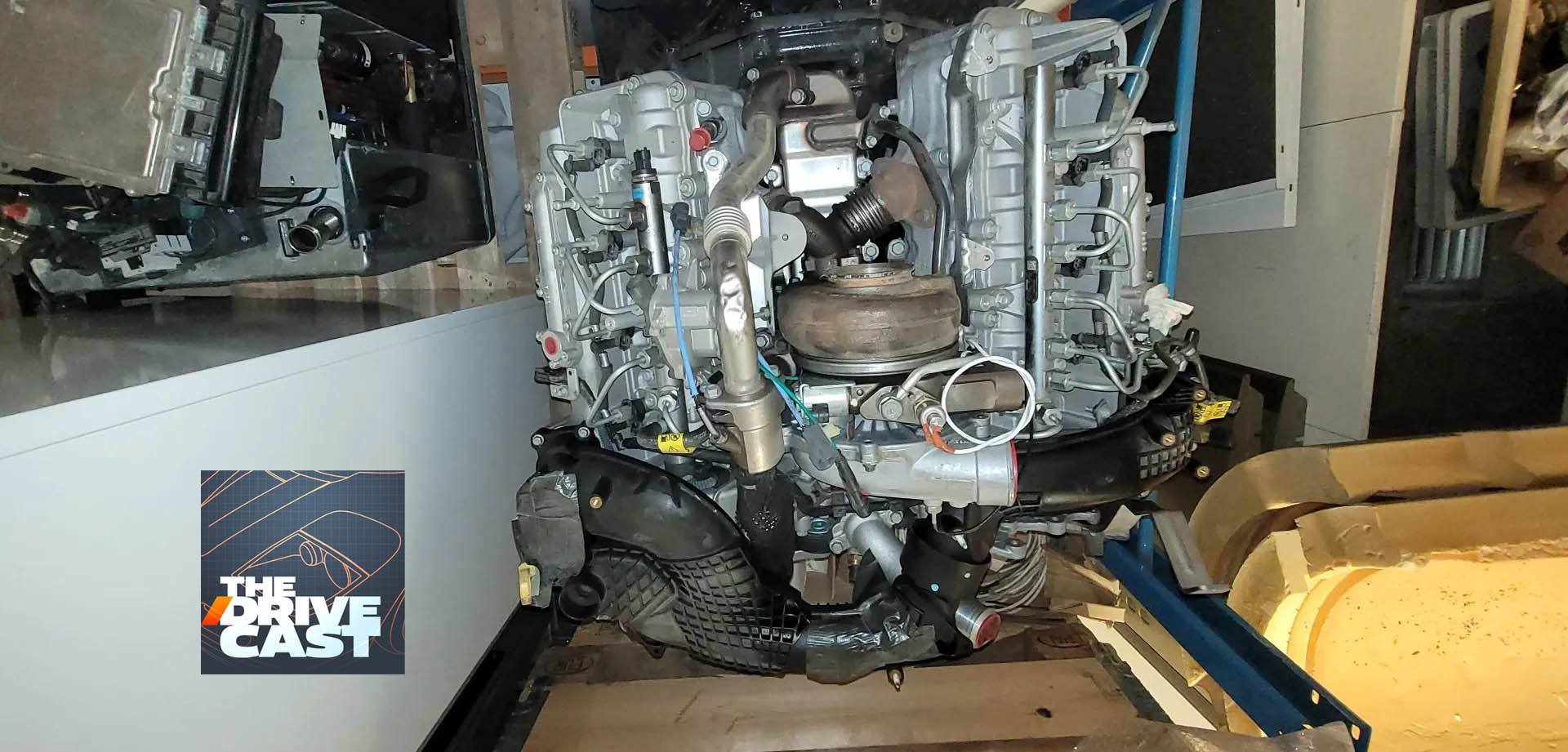
The 4.5-liter turbodiesel V8, known as the Baby Duramax, was nearly ready to roll, was even shown in a Suburban as a concept at a SEMA show one year, and was set to rewrite the rule book while setting a new bar in the half-ton truck segment. Then the crash of 2008 hit, GM filed for bankruptcy, and the Baby Duramax was shelved. GM said the prototypes were all crushed, but at least one engine made it out of GM’s hands, somehow. It’s now in Sweden.
This isn’t an over exaggeration. The Baby Duramax was going to have more torque than any other engine offered in a half-ton at the time, deliver better fuel economy than competitor’s engines that had less power, and featured technology that didn’t show up in sports cars for another 10 years. It was an engineering marvel that now seems as if it was simply ahead of its time. What could have been, or rather, could be, given at least one prototype is out in the wild. Are there more? How many? Where are they?
On the latest episode of The Drivecast, we discuss the Baby Duramax, code named LMK, what it was, what it could have been, and the prototype that made it out into the wild.
Know something about the LMK Baby Duramax? Send us a line at tips@thedrive.com.
First time here? The Drivecast is The Drive’s weekly podcast that takes you behind-the-scenes on the largest controversies, stories, and characters shaping the automotive industry along with the way our roads look today. Powered by The Drive’s inside access, original reporting, exclusives, and insights, The Drivecast aims to make everyone an insider.
Listen to The Drivecast via Spotify, Apple Podcasts, or Amazon Music. Love it? Like it? Want to help? Leave a five-star review on your platform of choice to help get The Drivecast in front of more people. Have a suggestion, tip, request, or feedback? Drop us a line at feedback@thedrive.com. I promise, we read every single email.
Full Transcript
Caleb: All right, Joel. I’m excited to finally talk about this on a podcast. This, consumed so much of my life there for a little bit as I was doing this reporting, trying to uncover, you know, the current story with the lost Duramax. And, here we are, and it’s kind of ironic because you just spent the last week in a Silverado EV Trail Boss. Quite a different rig there, don’t you think?
Joel: Yeah, no. I mean, look, we live in such a different timeline than the 2008 and the LMK and all that stuff. It’s true. I just had a Chevrolet Silverado EV Trail Boss and, you know, this is… It’s an electric truck, right? With a massive battery pack, and it’s heavy, and it has all the torque—775 pound-feet of torque—and all of the horsepower—725 horsepower. On 35s, and off-road this and whatever. It’s a rolling oxymoron. Like, it is a rolling contradiction, and we’ll do a review on that and everything like that. But it is ironic timing that we are talking about the baby Duramax and what could have been, given we are in such a different timeline. And history would have probably been changed in the the truck segment, which we’re about to talk about. So, before we get into everything, Caleb, walk us through what we’re even talking about. The background here, what happened, and the history itself, prior to us finding the engine itself that escaped the crusher. What are we even talking about?
Caleb: Yeah, sure. So, the 4.5-liter Duramax, that was a project that, really got wound up there in the mid-2000s, toward the end of that decade. It was a really special project that was destined to do something new in the half-ton truck space, which at the time, you know, of course it was competitive. It was the Big Three, you know, Chevy, well, we’ll just say GM, Ram, and Ford. But if you look back to those days, the half-ton segment wasn’t particularly great at the time. I mean, maybe I’m alone in thinking that. You had Ford with the 5.4-liter Triton, which people still love to hate all these years later. And, so GM was thinking at least two steps ahead by saying, “You know what? We could develop a diesel engine to put in these 1500-series trucks.” And, that would really throw people for a loop. It would perform far better than what you were seeing, you know, from the small-block gas V8s. And so, they set to work to do that. They wanted one that would fit anywhere that a small-block V8 would, but they wanted it to achieve better fuel economy while also making 520 pound-feet of torque. And so, that’s what they did. They developed this engine. They went through all of the hard work to to make it happen. It had a hot-V turbocharger, which if you’re, you know, more familiar with sports cars, you’ll know that was in the Mercedes-AMG GT, the Cadillac CT6-V Blackwing, which we all talk about, rare as hen’s teeth, something that you don’t see very often. GM actually did that with this Duramax diesel about 10 years before that. So, what I’m getting at is this was really a special piece of engineering, not just for the time, you know, 2006, 2007s is whenever it really started to take off, but even still today, I believe would be seen as special. And, that torque number is still unmatched by modern light-duty diesel engines. So, all that’s just to say it was going to be something great, but then, as 2008, 2009 came along, GM’s Chapter 11 bankruptcy took it down with it. And so, all that we had were stories about this engine. Never any first-hand accounts in terms of, “I reviewed this, you know, engine and this is the way it performed.” I was able to get some of that by interviewing people that saw it up close. So, the first one being Gail Banks. Pretty special.
Joel: And and before we get into more about the engine itself, just just a couple pieces of context that Caleb said there that I want people to understand the the scope of this because it’s not just the trucks, right? You said something really key in there, Caleb, that this was going to drop in and fit anywhere that Chevy’s essentially a small-block V8 was going to fit, right? That means this would have fit in basically an Escalade, and this would have fit in a Tahoe, and a Suburban, and a Yukon, this would have fit in a whole host of vehicles, and it would have opened the doors to a again, a totally different timeline than we live in today or we well, ironically we are kind of living in it today and we’ll get into that. But two decades before we are today. And there was nothing at the time that was like this, right? There was no small baby V8 turbodiesel or any turbodiesels at the time, in any of these trucks or or SUVs at the time. And to your point, the hot-V setup, that is again associated today with sports cars. You know, M5s have this and AMGs have this and and Audis are running this. But these are all RS-badged cars and AMGs and and M cars. These are hot sports cars. These are not pickup trucks. Right. Also, when you’re in a pickup truck, the duty cycle and use case of a pickup is vastly different than a sports car, right? A sports car, there you know, these cars are being theoretically designed to run on race tracks and high rates of speed with a lots of air coming through to cool the radiators and intercoolers and all that stuff. Trucks, you’re not running at 150, 125 miles an hour down a race track. You’re you’re headed up a steep grade towing something, right? With a lower RPM. So these are a totally different use case with a lower RPM and the idea of putting turbos in the V, I mean, that was mind-boggling for two decades ago for a pickup truck.
Caleb: Yeah, for sure. And you know, this is what I find myself doing all the time is I, you know, I write so much about four-wheel drives, body-on-frame stuff like that. People tend to just write them off as as completely simple, right? Like, there’s not much to it. Often times, you’ll see that manufacturers have some of their greatest engineering minds at the helm of these truck projects, and it’s for exactly the reason that you mentioned. Whether or not people actually use them the way that they’re built to be used is another story. But they’re all capable and developed to run, you know, crazy high altitude. That’s why you see manufacturers testing in Colorado, but also in the desert over at Hoover Dam. I mean, they run all over the place. These have to do hard work wherever people take them to. And so, that’s why they put some really sharp minds at the helm of this LMK project. And, I brought up Gail Banks earlier. For anybody who’s unfamiliar with him, man, he just the turbo diesel guru. I mean, he has been tuning them for a lot longer than I’ve been alive, and that is, that’s a commendation to Gail, by the way, not a knock. He just knows pretty much all that there is to know. And, GM invited him out. They said, “Hey, come take a look at this.” They were they were curious about him maybe selling them to marine customers, so putting these engines in boats. And, whenever I called him and I talked to him about this, uh, he brought out his handwritten notes from 20 years ago. And to hear somebody Gail Banks, you know, these little personal memoirs essentially, from a different time, different place, that was one of the coolest experiences of my career. And, I don’t know. This is something that is a lot of fun to to geek out on as somebody that that likes trucks, that likes history. But I don’t think you even have to know very much about trucks to find this interesting, or at least I hope not.
Joel: Yeah, no, and and I want to talk about the engine real quick, and we’re going to move into that. But I will just say, the other thing you mentioned is Gail Banks and marine industry. So the marine industry, by the way, a lot of it runs on on modified car engines. So for specifically for inboard, inboard outboards. So like our deck boat, that’s from 1995, it’s running a 5.7 essentially water-cooled, it’s a Mercury, but it’s a water-cooled Chevy small-block. That’s essentially what it is. So to your point, this would have actually had huge ramifications not just on autos, but marine and other industries too, and we won’t sit here and wax on about that because I do want to get into the truck engine itself. So, speaking of the engine, GM claimed they were all crushed, right? They were all crushed and then the program was dead and everything like that. But, you know, we hear, there’s, it’s like tall tales or, you know, it’s like the Loch Ness monster or Bigfoot. We hear wild rumors in the auto industry all the time, and sometimes there’s some substantiation behind it, but sometimes a lot of times, there’s not, there’s no proof. So it’s kind of like a tall tale and it’s like, you know, what do you really believe? But one of them did, at least, at least one of them did escape GM’s hands and the crusher, and you found it! And and not only did you find it, we then eventually published photos of its existence and the story behind it. Talk to me about this engine and the story and how this all came to be.
Caleb: Yeah, sure. So, like you said, we we found it, but in a lot of ways, it found me. And so, I had published stories about this LMK Duramax, you know, pretty much just like, “Hey, this almost happened once upon a time.” And then, not too long after that, I think there was a post on Facebook Marketplace. Somebody was claiming to have a prototypes of this engine. I was, you know, infatuated with that. I reached out to him, had a whole back-and-forth conversation, and then explained that I am a reporter, that I would like to write a story about these, they just went through and totally wiped out all of our conversation history. I mean, they unsent every message, all of the photos that they had sent my way, they were gone. And, I thought that was curious, you know, like why would you do that? And ended up publishing a follow-up story explaining how we kind of stumbled upon these and then they were gone. And then, not too long later, guy from Sweden, my new friend Henrik, reached out and he said, “I got one.” The fact that he reached out from, you know, across the ocean to say, “I just so happen to have one of these in my possession,” that was amazing. I never would have expected that in a million years. And so, we talked on the phone. By the way, if you’re going to talk to somebody internationally, don’t learn the hard way like I did. Call them on Wi-Fi. That was a $63 phone call. But that was well, worth it.
Joel: Caleb, there’s a thing called WhatsApp, my guy.
Caleb: Yeah, yeah, well like I said, don’t learn it the hard way. Listen to somebody like Joel here. But it was well worth it, and by the way, I got to expense it. So, it wasn’t out of my pocket. Had a great phone conversation, man. We just…
Joel: Hang on, did you call him on a landline?
Caleb: No, no, I called him from my cell phone.
Joel: Just checking, just checking to make sure you had a cell phone there, bud.
Caleb: Yeah, I do have a landline. You might hear it go off during this, so sorry if that’s the case. But, anyway, this is not about how I live in the Dark Ages, okay? This is a totally different story. But, got to be friends, with Henrik. We talked back and forth. He sent me these photos. The the story goes is he bought it as as part of a bulk deal. So, Henrik likes to build, uh, Mercedes diesel engines. He was looking for a turbo. He just happened to see that in this lot there was like, variable vane, variable geometry turbo. And then, he’s like, “What in the world? This this engine, this is a hot-V engine, but this doesn’t look like any of the Mercedes engines that I’m, you know, more familiar with.” And, uh, so he ended up buying it, and, uh, he’s he’s had it ever since. So, it’s been several years at this point. And I actually just reached out to him here recently, and, uh, he still has the engine. He still wants to sell it. So, if anybody here is listening and uh, they want to maybe buy it, I can put you in contact with Henrik. Uh, it may end up being a fancy paperweight, but you would still have a piece of truck history. So, pretty special. I tried to facilitate a deal with a friend of mine. It didn’t end up working out. He wanted to put it in a in a square-body Chevy, and, uh, couldn’t find anybody to do the conversion for him. So, needless to say,
Joel: That would have been cool, though.
Caleb: It would have been cool. It would have been hard, though. It would have been difficult. And you know, with this being a late-2000s diesel engine, that’s just as emission systems, you know, came into play, not only EGR but DPF, things like that. So, there would have been some obstacles to it, but nevertheless, so yeah, as of right now, this is what, June of 2026, Henrik still has it, and,, I certainly have his email address as well as his phone number, but you should email him.
Joel: So, this entire thing of course is highly ironic, right? Because, you know, now we live in a timeline that or we did at least, recently, where Ram first came out with a turbo diesel 3.0-liter in their, it was called the EcoDiesel, in their Ram 1500, and then Ford came out with a turbodiesel, which also was a Range Rover engine, but whatever, in their F-150. And then, and then, GM came out with a 3.0-liter turbodiesel, inline-six by the way, not a V8. And they’re of course, Ram has now since killed theirs, and Ford very quickly killed theirs. I think it was like a two-model-year thing. But GM still offers theirs, and not only do they still offer it, again, it’s now sold in the Yukon, and the Suburban, and the Tahoe. For a minute, it was sold in the Escalade, but nobody bought it, which was is a whole different topic because it was a great engine for the Escalade, and then highway lugging, but whatever. People just don’t make good juice choices. And then, you can still buy it in all the light-duty trucks, so like Sierra and Silverado. So, they’re the last man standing. They were last to this new party, because Ram came, then Ford came, then GM. And now they’re the last man standing at the party, without a V8. It is marketed as a Duramax, mind you. It’s not a V8, it’s a inline-six. Everyone else did the V6, by the way. This is just kind of ironic now, isn’t it? Like, why didn’t they just take this thing off the shelf and and run this, then and update the EGR and the emissions controls, Caleb?
Caleb: I think it was mainly just a matter of, “This is in the past, we’ve got to let it lie. We’re going to come up with something that,,” you know, of course there are some benefits to an inline-six over a V8. People debate back and forth on that quite often times to decides if somebody buys a Cummins-powered vehicle, or a Duramax or Power Stroke is where they fall on that. You know, this new Duramax, the inline-six, is developed to run with a 10-speed transmission. I don’t know exactly, what transmission would have been mated to these 4.5-liter Duramaxes, probably a six-speed. So, you know, maybe that was part of it. I don’t know. It’s difficult to say. And while I don’t have official fuel economy figures for the 4.5-liter Duramax it would have been tough for it to match this 3.0-liter inline-six. You know, smaller displacement, smooth running, you have the benefit of the different ratios from the 10-speed transmission. So, I think that’s ultimately what they were after is, sure, was in improved torque over the gas engines, but I think they wanted better efficiency, and this was a better path forward for that. So, I don’t know. I can only, you know, postulate why they would go with a new design over the old one, but I have a hunch that’s it.
Joel: I mean, you’re not wrong, right? The turbo-six, depending on the application, easily EPA ratings in the upper 20s, and and we’ve definitely seen people on Reddit and YouTube and people we know, and even our own testing. You can knock on the door of 30 miles per gallon in one of those full-size pickups if you’re not lugging a heavy trailer behind you down the highway. And you weren’t going to get that with a 4.5-liter V8 turbo diesel. But, but, you would have gotten more power, right? So, to your point, if you’re going to go for fuel economy, you’re definitely going to get this turbo-six. And also, it’s smooth, right? V8s are not as smooth as an inline-six. There’s just science here. And that is a very smooth engine. It’s interesting, too, because the V6 turbodiesel that was in the Ford F-150, it was marketed as a Power Stroke, again, it was a Range Rover engine, that was offered for like two model years. That might have been the quickest spooling turbodiesel, like factory stock turbodiesel, that I have ever been in, until maybe like the current modern, Super Duty high-output ones, which those are just ridiculous, like 1,200 pound-feet of torque or whatever. But that thing, you matted to the floor, there was almost no turbo lag. I don’t even understand how they did it. It was crazy. But you also didn’t get the fuel economy. I think I averaged like 24, 25 on the highway. You’re not going to get 30 out of that one. So,
Caleb: Yeah, and, you know, you’re one of the few people that have ever driven one of those Power Stroke F-150s. I know that I definitely haven’t, and I never see them, either. I’m right in the middle of truck country, right? Like, I am in the Ozarks, the Missouri Ozarks. I can’t tell you the last time I saw an F-150 Power Stroke come through. I do see quite a few EcoDiesel Rams, you know, like people bought those up. I think a lot of good old boys bought those not even knowing like, “Oh, this is an Italian engine,” right? It’s like no nobody knew that.
Joel: I’m not going to say that I drove a Power Stroke-powered turbodiesel F-150 up to Duluth, Minnesota for the Ram 1500 EcoDiesel launch. I’m not going to say I did. But if I did, you could imagine the PR people’s faces at Ram when I pulled in, and they were like, “Really?” And I was like, “Guys, it just so happens this is what I had in the fleet this week. It’s just a coincidence.” And they looked at me with the squintiest of eyes, and I’m like, “I mean, what am I going to say?” And and I’m not saying I compared the two in the in the first drive, but I will guarantee you, if I did, I was the only journalist in the world who would be able to do that, because I happen to live, you know, like three hours, four hours from the launch. So let me ask you, Caleb, does a diesel engine make sense in a half-ton today, in today’s timeline, do you think? There’s only one standing.
Caleb: Yeah, well, I think that it does make sense. Now, that’s harder to say, you know, as the price of diesel currently is is pretty high, spoken from a very sad 7.3-liter Power Stroke owner. Yeah, diesel costs a whole lot right now. But I think in terms of usability, it absolutely does. The smooth running, for all the reasons that you brought up that it’s a great fit for the Escalade, right? So many people use their trucks as daily drivers. That nets them a huge benefit, you know, for fuel economy. But also, what does the new the new 3.o-liter Duramax, what with the latest update, 495 pound-feet of torque? That’s still short of of what the LMK did, that was 520 pound-feet. But still, 495 pound-feet of torque, that’s stout. It’ll pull up to, you know, it’s like 13,300 pounds or something like that, I’m getting kind of specific. But, I think that shows that, yes, it does make sense. You know, depending on where you live in the world, maybe diesel is is even more. Where I’m at, I think the latest price it was like $4.72 a gallon. And you guys that live on the coasts are probably laughing at me saying, you know, that’s that’s 87 unleaded. But, I don’t see any reason not to own it. You know, there are the added, you know, the the frustrations with diesel exhaust fluid, you have the emission system there. I you don’t hear about nearly as many issues on the the 3.0-liter Duramax as you do as maybe some others. So, I don’t know. That would not be enough to turn me away from it. If you’re considering any modern diesel truck, you know, I think if people were honest with themselves, a lot of them would realize that a half-ton is more than enough, but again, that’s kind of outside the scope of this conversation, I guess.
Joel: Well, we don’t want to be rational people here. So, I’m certainly not one. Final thoughts, Caleb, on what could have been in history.
Caleb: Well, I mean, if this would have came out and it hit big, you would have seen the other manufacturers scramble to do something in response, right? Now, they have the the benefit of history being on their side now, they can say, Ram and Ford both, they can say, “Oh, no, we we knew. It wasn’t the right time.” And they they did it a little bit later. But had GM rolled this out and just totally stomped everybody else, right? Because, what was there to compete with? You know, it was the 5.4 Triton and then what, a tired Hemi? It would have been a big deal for this to come out. And so, I don’t know how much of a different place we land in as compared to now, because we see some really high-performing engines, of course the Duramax, the 3.0-liter that we’ve talked about, but also gas truck engines right now, I mean, they’re they’re amazingly powerful. You don’t even have to get, you know, Raptor to get a ton of torque in an EcoBoost F-150. I drove the the Ram 1500 with the high-output Hurricane. That baby will smoke the tires in a hurry.
Joel: What a monster!
Caleb: People don’t want to hear that. I know that, you know, there are some folks that are always like, “Oh no, you got to have the Hemi.” And hey, you know, as far as reliability goes, that may turn out to be the case. We don’t know what these are like after, you know, 200,000 miles. I can’t tell you what it’s like to own a high-output Hurricane. But, I tell you that feels a lot more like an $80,000 truck whenever you’ve got something that runs that quiet, that scoots from a stoplight. But all that’s just to say, I don’t know what would have been. I think that we would have seen maybe some other manufacturers, you know, respond with diesels of their own, but no matter what, I feel like the regulatory changes would have come, and that that influences this far more than a lot of people give it credit, um. Those regulatory differences and and changes and making it more difficult. I think that’s why we saw such a lull, right? From other manufacturers not chiming in with a diesel immediately after. They got to say, “Hey, we need time to develop something that will meet these stricter emissions requirements.” We have to decide if we’re going to develop these systems like EGR, like DPF, and and and after-treatment systems, too. So, I I don’t know. I think that it certainly could have been revolutionary in terms of what people come to expect from a half-ton truck. Maybe maybe that’s a better way of putting it. I think we got there eventually. I think there’s a good chance that would have accelerated it. So whether other manufacturers would have done that with diesel or gas, I’m not entirely sure, but, um, yeah, Ford was on to something whenever they went with the twin-turbo V6. I understand there’s lots of EcoBoost haters out there that are probably thinking you’re ridiculous. There’s no denying their performance of those engines, okay? We can we can debate about reliability, durability, all those things, even though I’ve seen them go for a lot of miles, too. Man, turbos just wake up a truck. There’s there’s no question about it.
Joel: I will tell you, as we as we wrap it up here, that I towed There was like a one or two model years, like 2020, 2021, something like that where they made a I think it was called a Limited F-150, and it was a narrow body normal F-150 and they took the high-output EcoBoost 3.5 twin-turbo out of the Raptor. So it was like 450 horsepower, 510 pound-feet of torque. Now, this is like five, six years before a Hurricane came from from Stellantis. And I towed our 5,000-pound boat, and I remember going fast enough on the highway, and then we were cruising, and I just laid into it, all the way to the floor, and the thing just lunged forward. Like there was no boat attached. I’m like, “Oh my lord!” It was fast. And this is again, like years before we there was rumors of a Hurricane engine from Stellantis turbo-six coming. And so, that was a quick truck. It’s a real shame that that that only lasted a couple model years. I’ve even looked at what used ones go for, and they hold their value, unfortunately. I’m sure there’s a reason. Those are quick trucks. Those are cool.
Caleb: Dude, if you saw somebody roll up in an F-150 Limited, you knew, “All right, this guy gets it.” Either this guy gets it or he was upsold, you know, there it it was one of the two.
Joel: One of the two. But yeah, so anyway, look, if if anyone listening knows more about these Duramax, baby Duramax 4.5 LMK engines and you know of more in existence or even more to the story than we have, please definitely drop us a line, tips@thedrive.com. Or if you just know about engines that escape the factory that shouldn’t exist today, also send us an email at tips@thedrive.com. Caleb and I would very much like to connect with you. We don’t have to name our sources.
Caleb: And I will put out a personal challenge to you, okay? They debuted this 4.5-liter Duramax in a Suburban Z71 concept, okay? That thing may now be long gone, I’m not sure. But if you have any artifacts of that, it was publicly shown, right? I mean, there were people who saw it. But if you know of its whereabouts, or, oh my goodness, okay, hold the presses. I forgot to mention this important piece, and you’ll know this if you read the story or if you watch our YouTube video on this. Bob Lutz put one of these in a Buick Rainier! If you know what happened to that Buick Rainier, please give me a shout. I saw somebody on Facebook one time mention that this Buick with a diesel was brought by the dealerships they worked at. If that was you, hit me up! caleb@thedrive.com, go to tips@thedrive.com, send us this stuff. I want to know. The story does not have to be over. And for real, if anybody wants to buy this engine, hit me up. This is unpaid, unsolicited advertising, but I want to see something happen to it, okay? The story does not have to end here.
Joel: Aside from Caleb hawking an engine from Sweden, I will say, Caleb is probably legitimately losing sleep over the fact that a Rainier is out there somewhere with a baby Duramax right now from Bob Lutz’s hands. You know about these cars’ whereabouts, send us a line, hit us up. We will end it there. I really appreciate it.
Loading comments…
Comments couldn’t be loaded. Please refresh the page.