
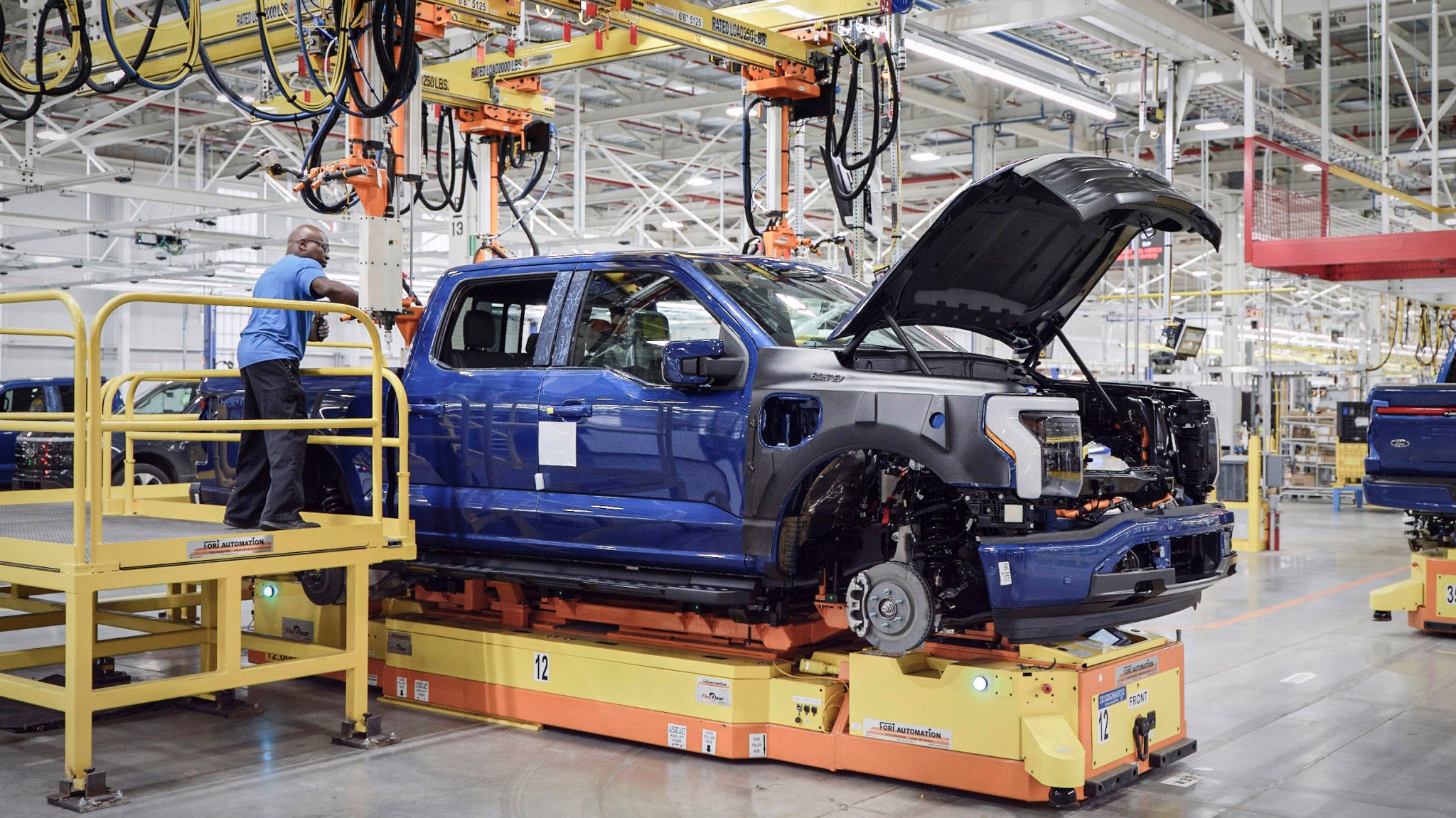
After years of doing its best imitation of a non-legacy manufacturer, Ford made a big splash last fall when it announced a new, “software-defined vehicle” platform aimed at bringing affordable EVs to the U.S. market. But if the current (now discontinued) F-150 Lightning and Mach-E aren’t software-defined EVs, then what are they? And just what constitutes a true “software-defined” vehicle?
In broad strokes, a software-defined vehicle is exactly what it sounds like. If a car’s features are effectively digital, rather than requiring physical hardware, it fits the bill. It’s a tantalizing notion for automakers, whose traditional production costs balloon as feature offerings become more diverse. In the ideal software-defined vehicle, virtually every car rolls off the line with the same equipment; software is what decides which features are enabled or not.
Not only does this approach reduce production and support costs (replacement parts, etc.), but it also gives the automaker greater control over a vehicle’s lifecycle. Over-the-air updates can address safety issues, fix glitches, and even add or remove features (whether in exchange for cash or otherwise, unfortunately) in a way that simply isn’t possible in an analog car—or in a way that is incredibly frustrating for those who tried to cobble together software-defined practices within the constraints of a legacy manufacturing environment.
Yep, that’s where Ford comes in.
The company’s next-gen EVs will have just a handful of master electronic control modules comprising a new, in-house zonal electrical architecture. The Lightning, by contrast, has more than 70 individual system modules produced by an almost equally impressive quantity of individual suppliers. And not only do all of those modules need to talk to each other in order for the vehicle to function, but their manufacturers need to do the same every time Ford needs to push a major update to the Lightning’s software suite.
Rather than a clean, single point-of-contact setup, Ford is forced instead to rely on what it calls “people putty.”
“So we have ‘people putty’ that glues together all these various interfaces,” a Ford engineer told InsideEVs. “Because, literally, we need people to communicate amongst people because of these, these massive, complex interfaces. [The new UEV]’s team doesn’t need those. All they’re focused on is just functional execution.”
Within each of those suppliers is an opportunity for error, miscommunication, delay, or any number of other external forces that Ford can’t own or control. So, while Ford may be able to argue that its current EVs are software-defined on paper, their complex architectures effectively cancel out any of the advantages the label conveys.
All of this means that even in a different timeline where Congress didn’t eliminate U.S. EV incentives, the Lightning’s current (and now-discontinued) platform was on borrowed time. Now, let’s see what Ford can do with a clean slate.
Got a news tip? Let us know at tips@thedrive.com.
Loading comments…
Comments couldn’t be loaded. Please refresh the page.