
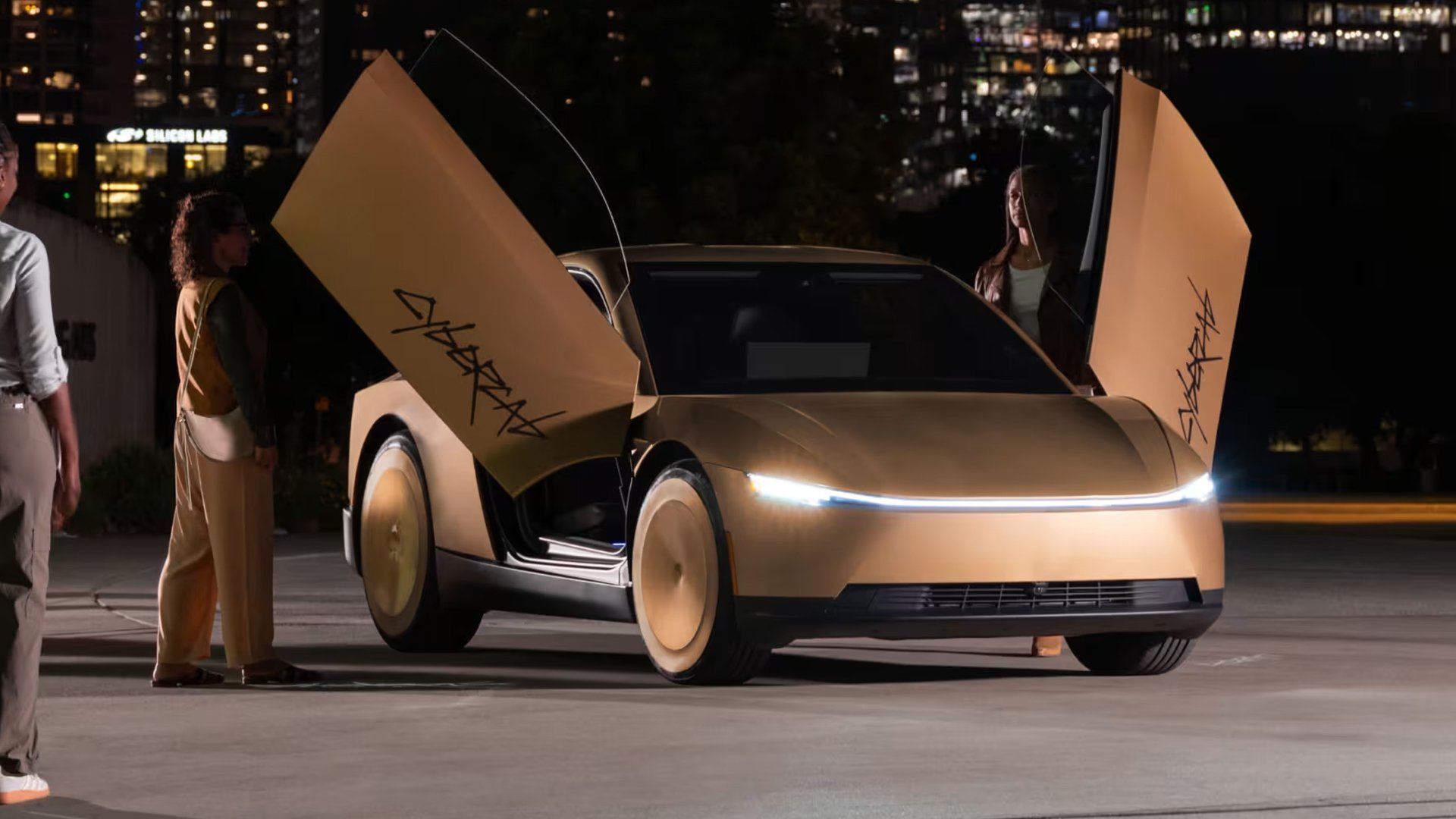
The Tesla Cybercab, aka Robotaxi, is a driverless personal transportation pod resembling a car. With no steering wheel and no pedals, I’m sure it’ll feel freaky to ride in even if you’re used to the marvels of modern automotive automation. But the differences between Cybercab and most regular cars go beyond what you can see from the seats—the brake system is fundamentally different from almost everything else on the road.
As for whether or not these things will actually be on the road en masse remains to be seen—the NHTSA has already opened an investigation into how Tesla certified these for public use. More on that later.
As for the interesting stopping tech, well, a typical automotive braking setup is hydraulic, relying on long hoses full of fluid to control the movement of the pads. When you push your brake pedal, a little piston is pumped, pushing sealed fluid out to the calipers, which then pinch spinning rotors. The Cybercab has calipers and rotors—but no master cylinder or brake lines. It uses a completely electric brake-by-wire system, which is still (almost) unheard of in 2026.
Some cars use electronic brake controls to operate a hydraulic system (like Lexus’ electro-hydraulic brake design), and Tesla isn’t even the very first to have no brake fluid at all in a production vehicle (the Chery Exeed EX7 claimed that title earlier this year).
That’s an important distinction: Electro-hydraulic (EHB) braking, like Lexus uses, has been in production vehicles for many years. Electro-mechanical braking (EMB)—no fluid at all—is newer and more novel.
The way this works is, instead of a master cylinder and plumbing and a pedal, there’s a little electronically controlled actuator putting braking force on the rotors, individually, at each corner.
Kyle Conner from the Out of Spec Reviews EV-focused YouTube channel was at the vehicle’s reveal party and shared this little clip of a partially assembled Cybercab, showing exactly what we’re talking about:
Old heads in various comment sections are calling this a little scary, but even as a Luddite myself, I think brake-by-wire here actually makes a lot of sense. The advantages are significant—I’m sure production costs were slashed (which was probably Tesla’s main motivation to employ such a system)—but it also allows for disparate levels of force to be applied to each wheel individually, which could aid in traction. As an EV, the Cybercab will likely do most of its self-slowing with regenerative braking. And when it does need mechanical brakes, it won’t let them get all that hot—it’s a city cab, not a sports car.
The Cybercab is really a marvel of low-cost construction, using as few and as light parts as possible. The exterior body panels are literally injection-molded polyurethane. It’s basically a giant PowerWheels car.
Tesla seems to have front-loaded the expense of making this thing (figuring out how to make the thing work with as few parts as possible), and now is banking on manufacturing and maintaining a ton of them for very little money. Seems like a logical model for cabs to me, though I still think it’s strange they only have two seats. (Though most cab rides reportedly are for two or fewer people, so there’s empirical reasoning behind that decision, too.)
The specific supplier of the Cybercab’s brake system has not been officially cited yet, but a critical mass of critics seem to be agreeing that it’s likely Brembo’s Sensify system.
I suspect we’ll see this in other vehicles in the near future, too. Meanwhile, I’m looking forward to learning more about the Cybercab—it’s kind of aesthetically cute and conceptually quite fascinating. Kyle Conner described it as looking like it’s built for long-term use in his video clip; it looks more to me like it’s designed to be disposable, like a phone, and similarly built so cheaply that whole-vehicle replacement would be a trivial expense.
Wall Street doesn’t seem quite as enamored with it as the first YouTubers to see it, though. Tesla’s stock is down as “underwhelming Cybercab launch draws US probe.” Oh, yeah, the vehicle is already under investigation to “examine the process and technical data on which Tesla relied when certifying the Cybercab and related issues.”
Got any Cybercab insider knowledge? Tell me about it! I’m andrew.collins@thedrive.com.
Loading comments…
Comments couldn’t be loaded. Please refresh the page.