
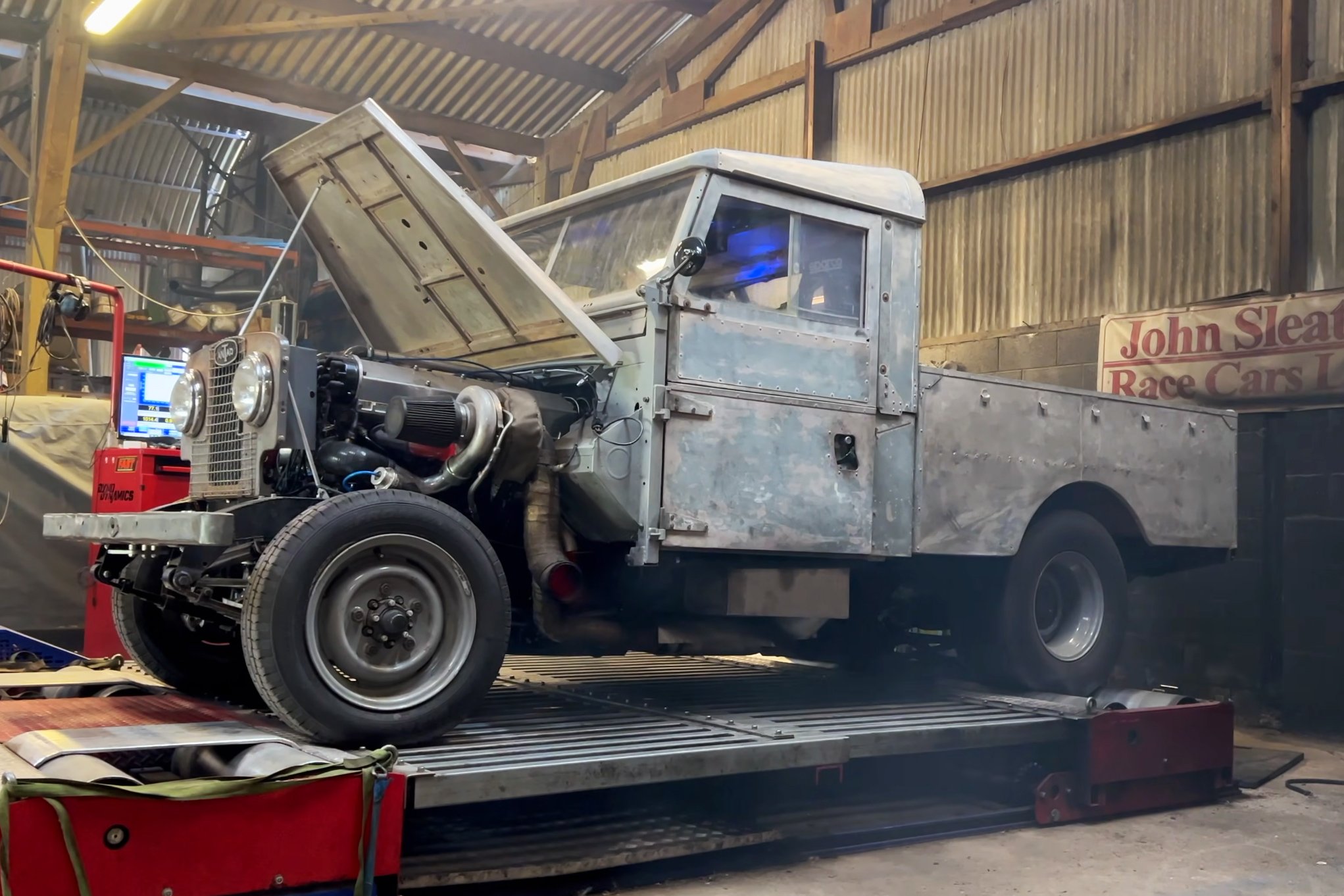
Your typical Series I Land Rover, when new, had a 1.6- or 2.0-liter four-cylinder engine that made around 50 horsepower. That’s paltry output by our standards 75 years later, but of course, that didn’t matter at the time; the Land Rover carried the U.K. on its back coming out of the war. Now, a builder has manifested his own tribute to that incredible legacy that should also modernize the Series I’s powertrain. How does 18 liters and a nice, even 1,080 horsepower sound?
Yes, the twin-turbocharged V8 in Peter Grieve’s 1956 Series I is nine times larger than anything that would’ve rolled out of Solihull all those years ago. And, what’s more, it’s actually kind of fitting (no pun intended) that it’s found its place in a Land Rover. The behemoth in question is one of Rolls-Royce’s Meteorite V8s, an engine originally intended for the Mighty Antar tank transporter that entered service in the early 1950s and lasted well into the ’80s.
The Meteorite itself was so named because it was derived from Rolls’ 27-liter Meteor tank V12, which in turn was born out of the Merlin aircraft engine. As Will of Practical Performance Car explains, one of the Meteorite’s big advantages was that it used the very same parts as the Meteor—it was mostly identical, just with four fewer cylinders—which helped keep the fleet running.

18-Litre Twin-Turbo V8 Land Rover on the Rolling Road!
Of course, to make the thing fit in the Land Rover, Peter had to save space where possible. He engineered a new system to drive the camshaft, because the assembly that normally hangs off the back of the Meteor that handles that is just far too big for car duty. The V8 also received electronic fuel injection and those aforementioned turbos concealed in the front wings, which help the Rolls engine reach titanic, four-figure power with 15 pounds of boost—though, in this footage, it’s running at around half.
In this video, Peter lets his Antar-powered workhorse loose on a dyno. He adjusts the fuel pressure and switches out the exhaust plugs when the Meteor starts to run a little choppy. On the next attempt, the cooling system, supported by that massive radiator in the bed, decides to start cooling the garage instead of the engine.
That’s as far as Peter got on this day, but it’s still remarkable to see an engine like the Meteor, with the history it carries, stuffed into an original Land Rover. It makes all the sense in the world, but it’s also unapologetically over-the-top, and yet still somehow drivable on the road. Here’s hoping Peter gets the remaining issues sorted out, and we get to watch it light up the strip.
Got a news tip? Reach out to tips@thedrive.com
Loading comments…
Comments couldn’t be loaded. Please refresh the page.