
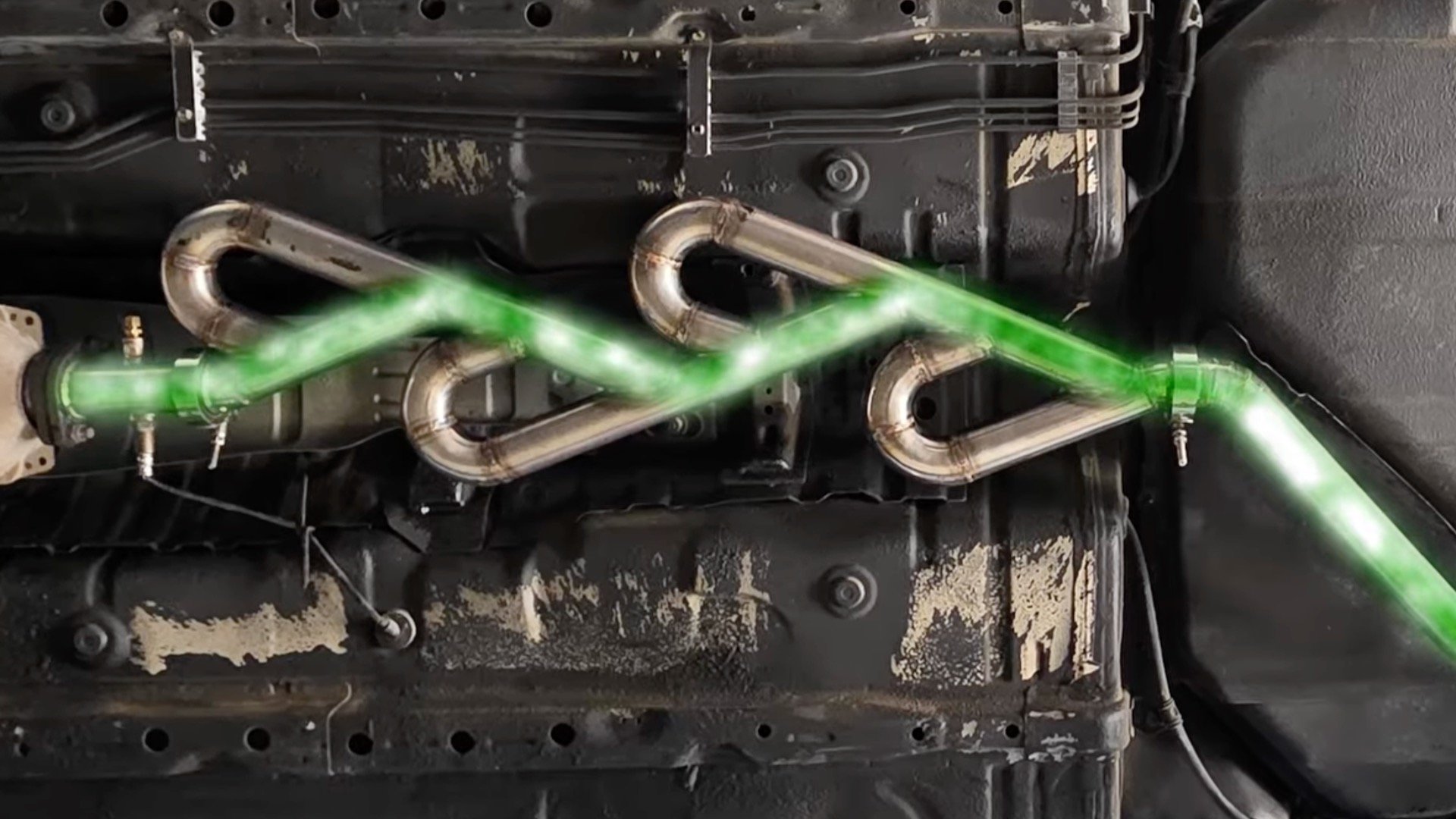
Exhaust systems come in many shapes and sizes, and that can have a real effect on performance. The Fabrication Series YouTube channel recently proved that by testing both conventional and unconventional exhaust shapes. Where does this team of fabricators go from there? To a design not even intended for cars, obviously.
The subject of this video is a Tesla valve which, while it is also named after inventor Nikola Tesla, has nothing to do with the automaker. A Tesla valve might look like a silly straw design, but it’s actually a one-way valve that has no moving parts. Curved segments that look like half hearts allow fluids to flow in one direction, but not the other. Most applications involve liquids rather than gases, but that didn’t stop Justin and his team from making a Tesla valve exhaust system and dyno testing it.
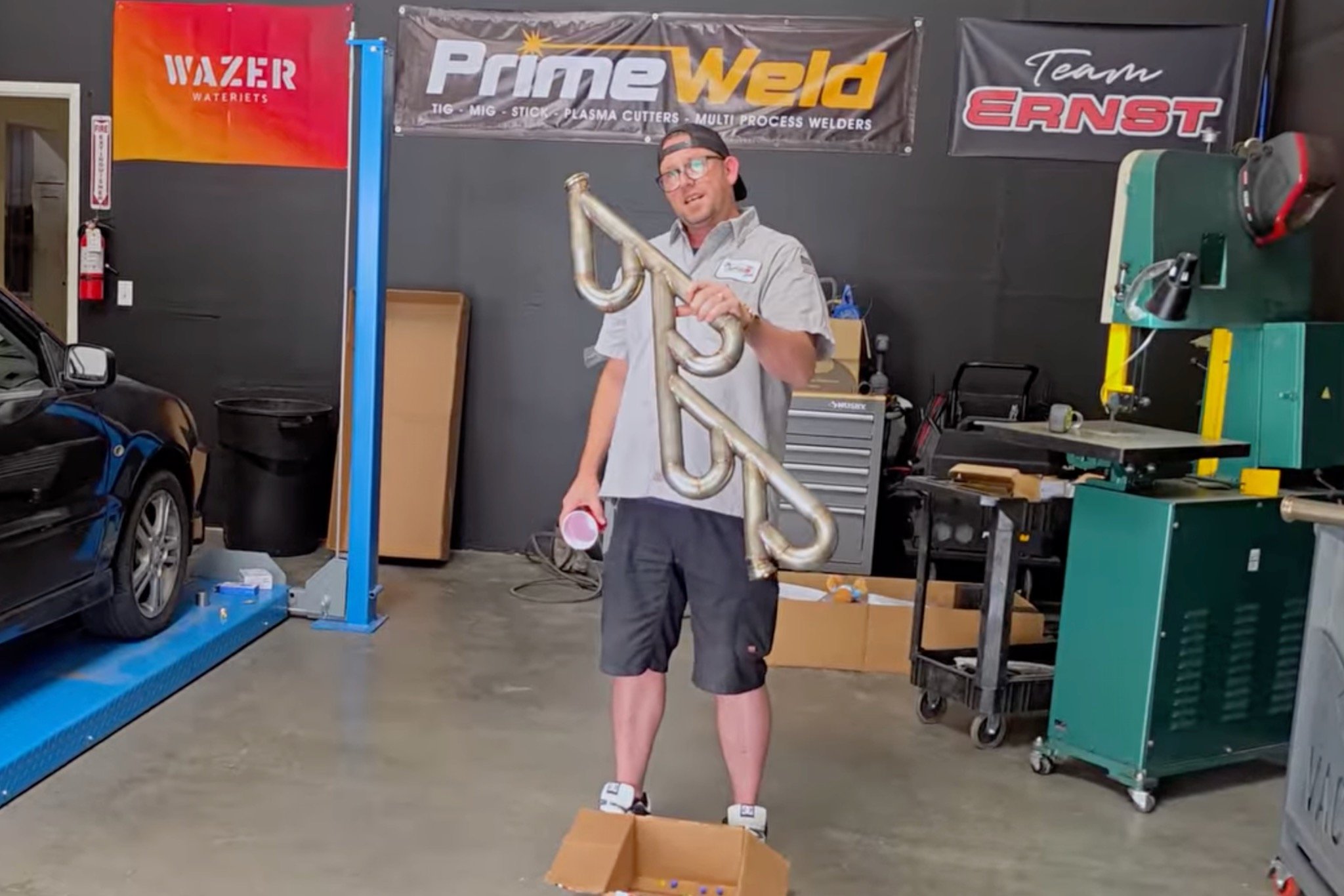
Patented in 1920, the Tesla valve’s channels direct the flow back onto itself in one direction and provide a straight shot in the other, preventing the flow from reversing. A lot of these loop-like channels are needed to get the job done, but due to the limited amount of space under the car (it wasn’t intended to accommodate so many curves in the exhaust, after all), there was only enough room for four. To see how well it worked (or didn’t), the Tesla valve exhaust was run on the dyno in both the correct and reverse directions, with a stock exhaust system acting as the control group.
With the exhaust positioned correctly, the Mitsubishi Lancer Ralliart test car made a little less power than with its stock exhaust, but we’re talking single-digit differences: 142 horsepower for the Tesla valve versus 146 hp for the stock exhaust, averaged across three pulls. The real difference was in the noise level. The Tesla valve exhaust made effectively no noise; everything audible was coming from under the hood.

Dyno Testing a Tesla Valve. Will it Run?
Flipping the exhaust around didn’t completely cut off flow—the engine was still able to start—but it pegged the back-pressure gauge. The amount of back pressure was also pretty high with the exhaust oriented correctly, granted, but it seemed to have more of an effect here. Not surprisingly, the engine took longer to build revs and made less power as it did, averaging 134 hp. The reversed exhaust also generated lots of extra heat.
So while a Tesla valve might reduce noise, it does so by making your engine run a lot less efficiently. It turns out something not intended to be used as an exhaust system doesn’t work that well as an exhaust system. Nor does it work that well as a Tesla valve. As Justin points out in the video, gases can compress, so forcing them through the valve’s channels builds up pressure but doesn’t stop the flow completely, as it would with a liquid. That’s the principle behind turbochargers, and it’s why you won’t see a Tesla valve exhaust at this year’s SEMA show.
Loading comments…
Comments couldn’t be loaded. Please refresh the page.