
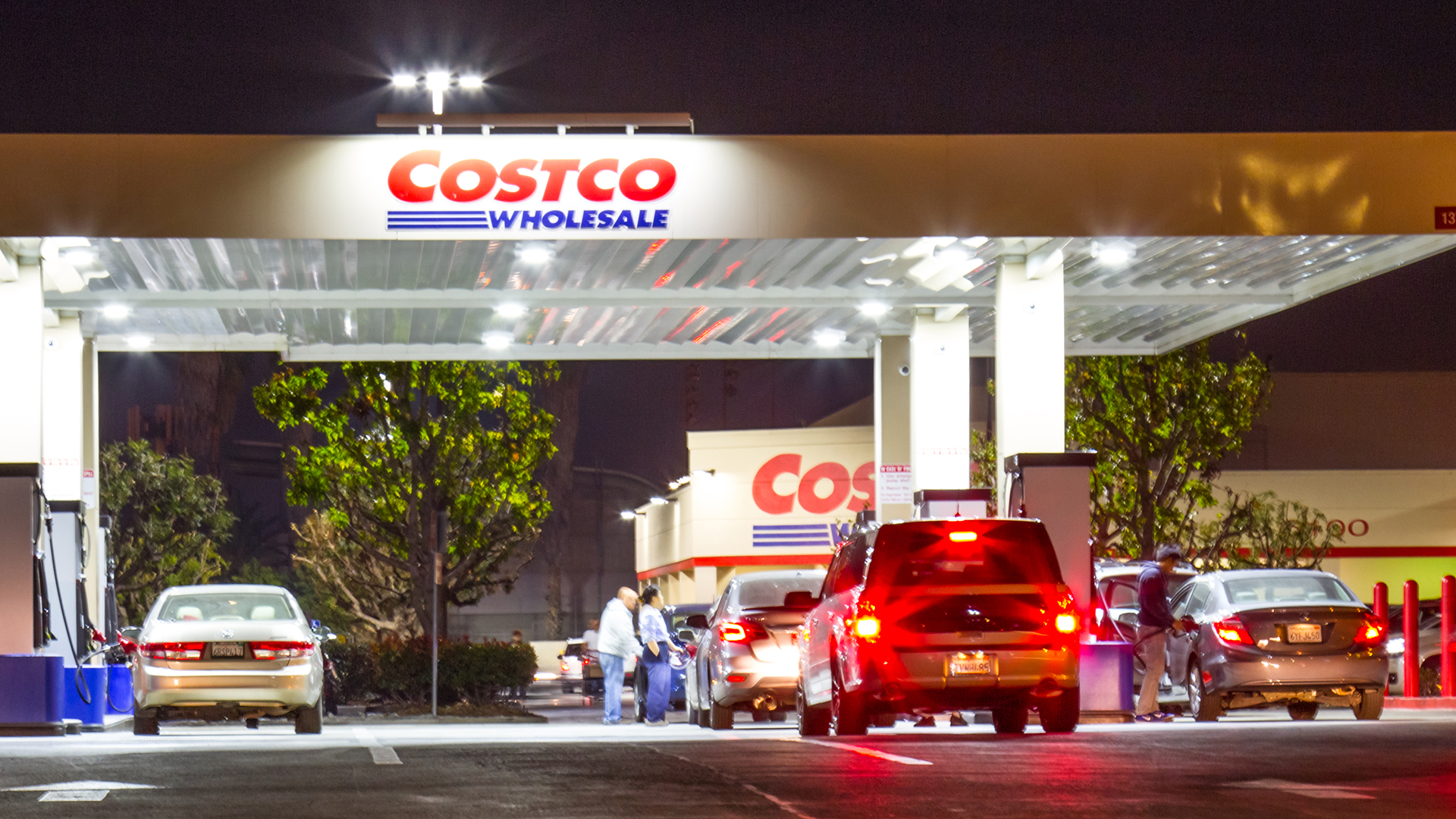
As fuel prices continue to climb toward record territory, Costco parking lots are looking more like Mad Max bivouacs than suburban warehouses. With members currently waiting for ages to score a few cents off the gallon, the timing for Costco’s next move is suspiciously perfect: The retail giant is mere months away from opening its first standalone, 40-pump oasis of discounted fuel. Just don’t expect to get in without a card.
Costco has sold gasoline at big stations in its warehouse-store parking lots since 1995. It launched the Kirkland Signature brand that year, too, with basically the same business premise: Take high-commodity items (whether it’s laundry detergent or 87-octane), strip away marketing and middlemen, and sell at a price that makes people feel like they’re beating the system. Then, of course, Costco makes its money back by collecting ever-recurring membership dues.
That’s why the brand has been cracking down on people sharing their Costco cards. You gotta pay to play; the shareholders can only cash in if more people keep buying memberships.
And a membership will be needed to access the first standalone Costco Gasoline station, scheduled to open in Mission Viejo, California (replacing an old Bed, Bath & Beyond at 25732 El Paseo, to be exact) this June. The second is reportedly planned for Hawai’i and opening in 2027—makes sense, Iwilei (Honolulu), is home to the busiest Costco in the world. And that’s just what’s been publicly advertised—a little snooping by my colleague Byron Hurd revealed that Costco’s also sniffing around Livonia, Michigan, as a potential place for a huge fuel station. Suffice it to say, there will be more than just two of these stations if Costco’s plans pan out.
But it has been confirmed that there will be no shop—not even a little three-aisle convenience store where you might grab expired frozen pizza or a dusty bottle of Gatorade—at the 17,000-square-foot fuel field opening in Southern California in a couple of months. Costco’s counting on the price of fuel alone getting people into its membership ecosystem.
A 40-pump station is not as big as a monolithic Buc-ee’s, but it’s pretty darn large compared to most fuel stations.
My guess is that a lot of people will be begging for a Costco hot dog stand at these places, and I’m sure unlicensed vendors will be walking around with bells and snacks if they don’t get chased away. But officially, the idea here is purely high-volume, fast-in-fast-out, fuel.
If you’re into conspiracy theories, “Costco convinced the American President to attack Iran and spike fuel prices before opening its first big gas station” feels like fertile ground for podcasters to discuss. I’m not going to lend that any credence there, though—and this isn’t Costco reacting to this month’s market conditions, either. Plans for this fuel station have been in the works for a long time.
Jokes aside, the deeply unfortunate geopolitical situation we’re living through does make discounted fuel considerably more appealing and Costco is certainly aware of that. As Costco CFO Gary Millerchip said in the company’s 2026 Q2 earnings call: “When prices are higher, that will tend to cause members to maybe take the extra mile that it might involve to get to the gas station because of the incremental value they see there.”
My translation: People are willing to sit in a 20-minute line to save $12, even if it eats up $2 in fuel just to keep the AC running.
Costco Gas Math
For those of you who are now wondering if these gas stations could actually save you money, here are some numbers. There are two tiers of Costco memberships: “Executive” ($130 per year plus tax) and “Gold Star” ($65 per year plus tax). Both offer access to “Member-Only Fuel Pricing on TOP TIER Gasoline” at “over 750” stations—it seems safe to assume either membership level will let you use the new non-store fuel pumps when they come online.
Since Costco gas has the “Top Tier” endorsement, meaning it meets the minimum purity levels that most automakers agree on, I’d be perfectly confident burning it in any normal car. So let’s compare some numbers.
The National Average: As of April 7, the national average for regular 87-octane gas hit $4.14 per gallon, according to AAA. That’s a big jump from the $2.80–$3.00 range we saw earlier this year.
The Costco Delta: Analysts and recent field reports (from Fast Company and The Street) show that Costco is currently undercutting local averages by $0.20 to $0.40 per gallon.
The High-Stress Variance: In high-cost markets like Los Angeles or Honolulu (where the new standalone stations are headed), the delta is even more extreme. For example, while Los Angeles County averages are flirting with $5.90, some Costco locations have been spotted as much as $0.47 lower than the local zip code average.
Fuel Tank Figures: Let’s say you’re in a late-model Chevy Tahoe running on fumes. If you’re pumping 23 gallons of gas in Orange County, California, you could be paying $137.54 (county average: $5.98 per gallon). But if that Mission Viejo Costco station were up and running, you could fill that tank for $128.34 (assuming $5.58 per gallon).
Is it worth spending 10 minutes in line to save about 10 bucks? If you’re scratching your chin trying to decide, the real answer is that you should get a more fuel-efficient car.
Got a story tip? Hit us up at tips@thedrive.com
Loading comments…
Comments couldn’t be loaded. Please refresh the page.