
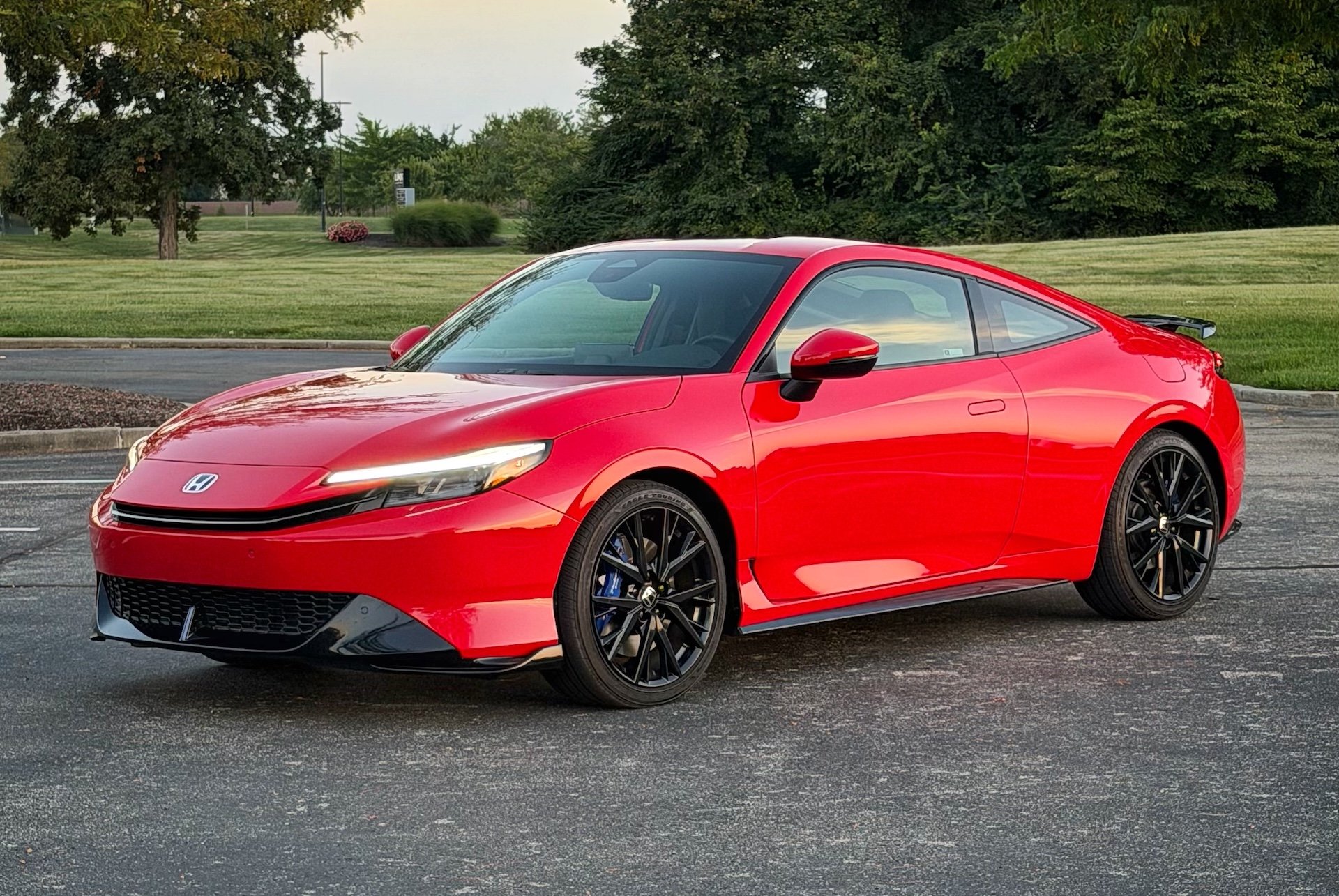
Yesterday I told you that I’d be driving a 2026 Honda Prelude until next summer. I also explained that this project aims to give you much more feedback and general information about the car than any average weeklong test drive could. From driving impressions and feature analysis to the very specific things you only notice by living with a car day in and day out, my job is to share all my experiences with you.
But first, a little disclaimer. While I’ve only had this Prelude for a couple of weeks under its “Long Term” banner, I’ve already enjoyed a bit of seat time in it. Honda tossed me the keys to this car for two weeks earlier in the summer so I could drive from Indianapolis to Montreal for the Formula 1 Canadian Grand Prix. So while I’ve only driven it a couple hundred miles recently, I already put 2,000 miles on it before this test officially started. I thought this was worth mentioning, in case you thought some of my feedback below seemed too specific for someone who’s just getting to know a car.
Without further ado, here are a few notes straight out of my road test logbook. I call these: First Impressions.

Previous Installments
Exterior
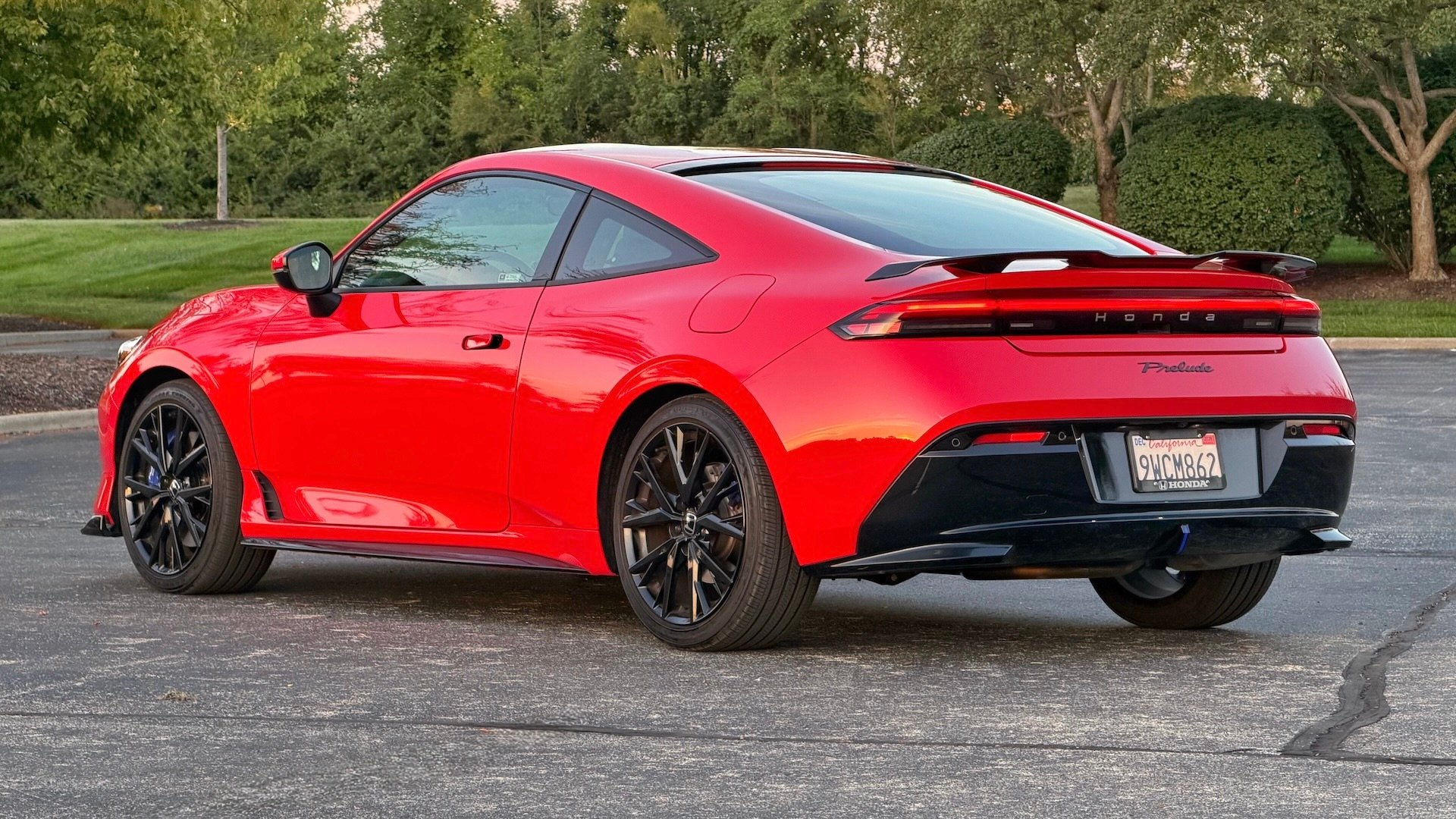
Honda calls the Prelude a “glider” because of its hybrid propulsion character, where the car is happiest in a driving environment that constantly feeds its two-motor hybrid system through acceleration and drag (more on this later). However, I believe this concept goes further than that. I also think it relates to its design. The video below helps explain the concept.
The Prelude is drastically raked up front and quite curvy at the back, but unlike most sports cars with these design traits, this one has a sort of bulbous flow to its body. And what does that resemble? A glider—the aircraft kind. This really stood out while I was photographing the Prelude, and I noticed its somewhat unconventional shape once you look closely. It’s like a reverse teardrop, with the rear as the wide part and the front as the tapered end. Just look at the side window framing in the photo above.

Honda Prelude x Glider – The Story
My tester is finished in Rallye Red, which looks quite good on the design. At first I thought it was a bit too shouty, but I’ve come to terms with it. Sadly, red sporty cars aren’t good for flying under the radar, and it didn’t take long for law enforcement to notice me zipping around. That’s all I’ll say for now.
Only two Prelude trims are offered: Hybrid and Hybrid two-tone. Mine is the former. The latter gets a black roof and side mirrors, but otherwise they’re the same. Both get 19-inch Berlina black alloy wheels as standard, though you can also choose an optional machined-finish wheel in the same size for an additional charge. My tester also has the optional front underbody and tailgate spoilers, which added $850 to its total price of $44,545 including destination.
Interior
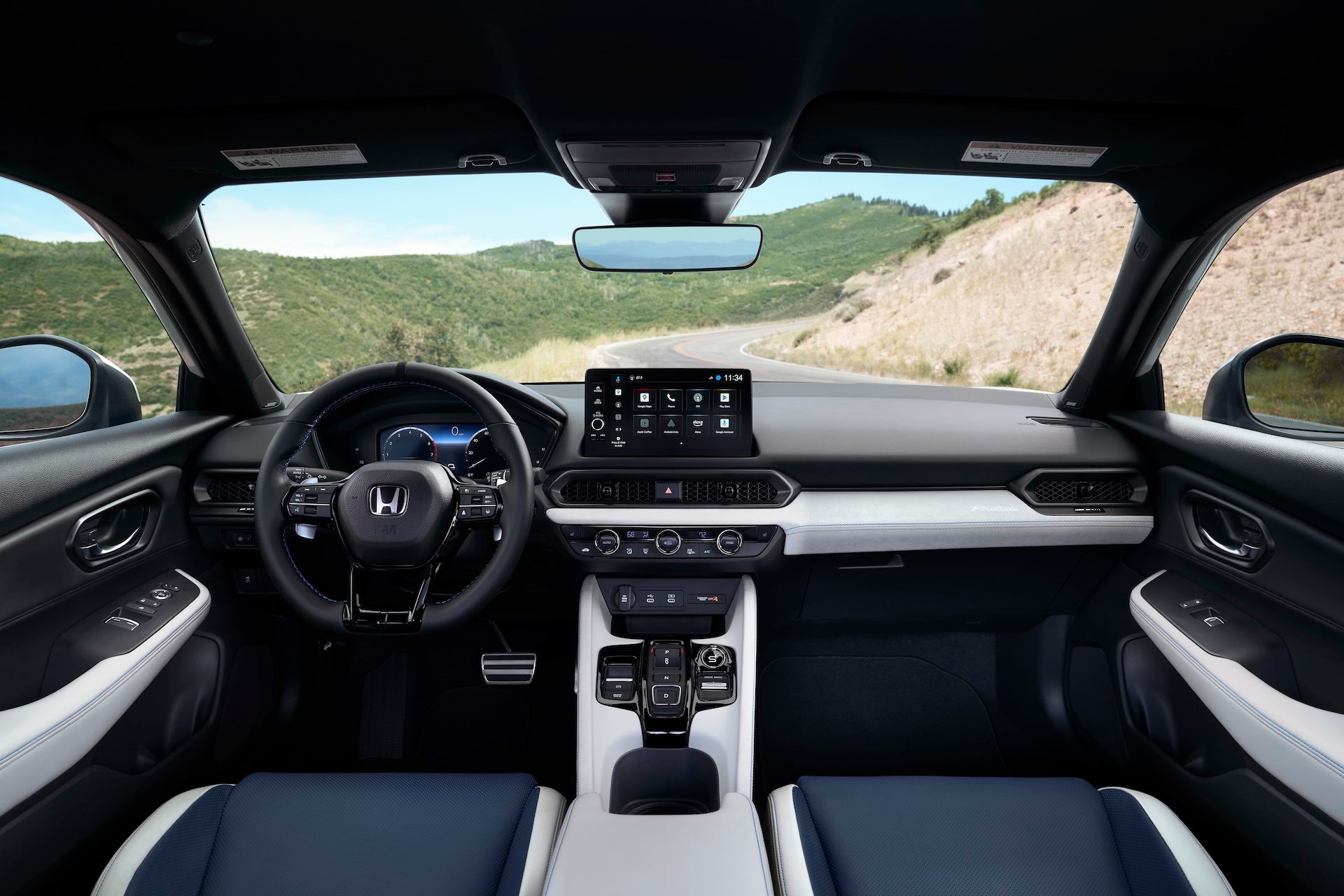
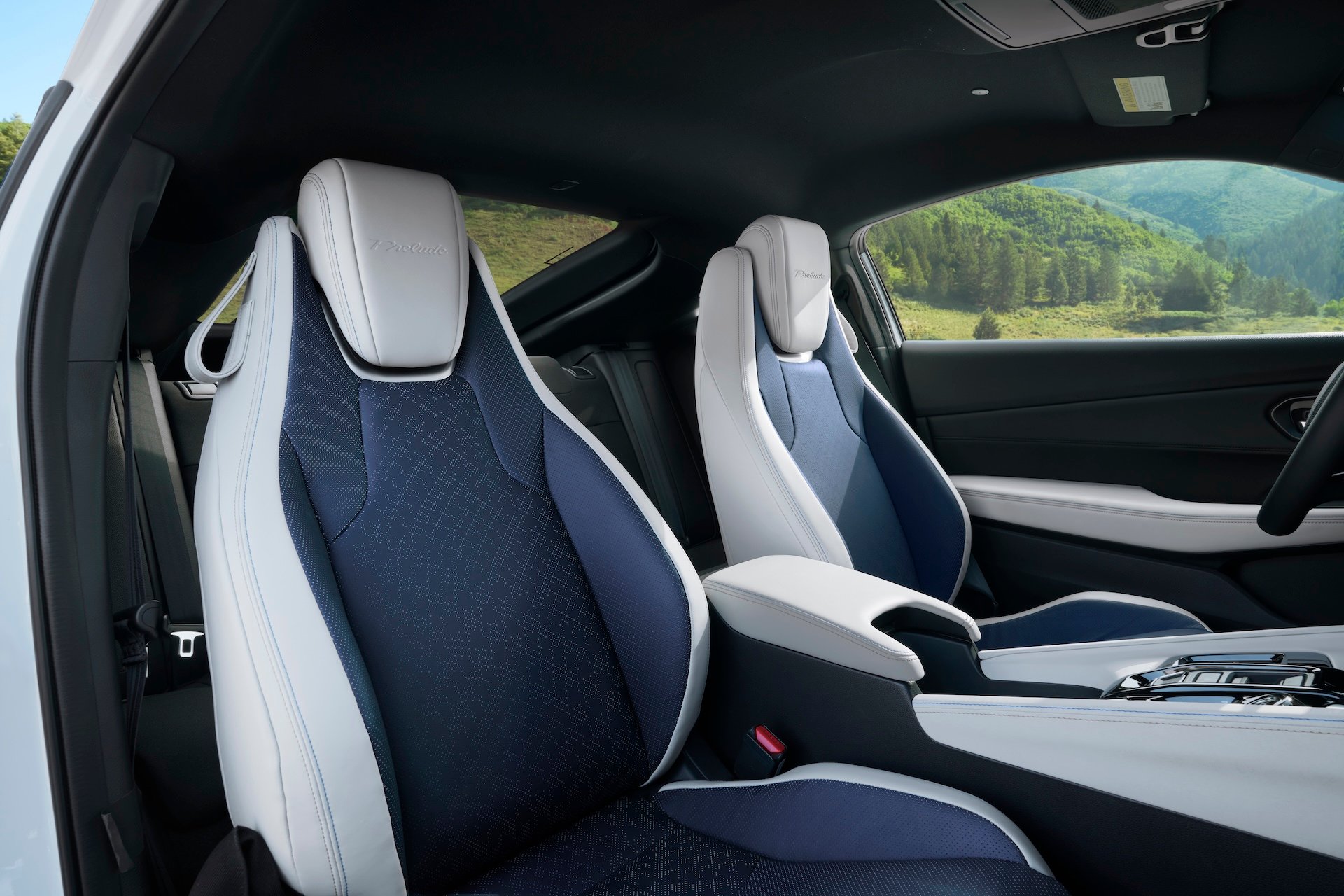
The Prelude’s cabin is truly a step above the rest of the Civic lineup, and I know because I’ve driven them all: base, Sport, Si, Hybrid, and Type R. In front of the driver, a flat-bottom steering wheel wrapped in leather features a precision marker at the top, along with a 10.2-inch digital gauge cluster. Like the rest of the lineup, it has a 9-inch HD color touchscreen with Google built-in, plus wireless Apple CarPlay and Android Auto support.
Most of the dash, seat inserts, and other cabin panels are wrapped in black synthetic leather with a special texture Honda calls “cloud-like,” though I’d describe it as suede- or Alcantara-like. Either way, all Prelude interiors come with contrast blue stitching. All the materials feel good to the touch and the seats are comfortable—however, much to my dismay, there is no adjustable lumbar support. On top of that, this nearly $45,000 car lacks a heated steering wheel and power seats, which is plenty of reason for potential customers to reconsider.
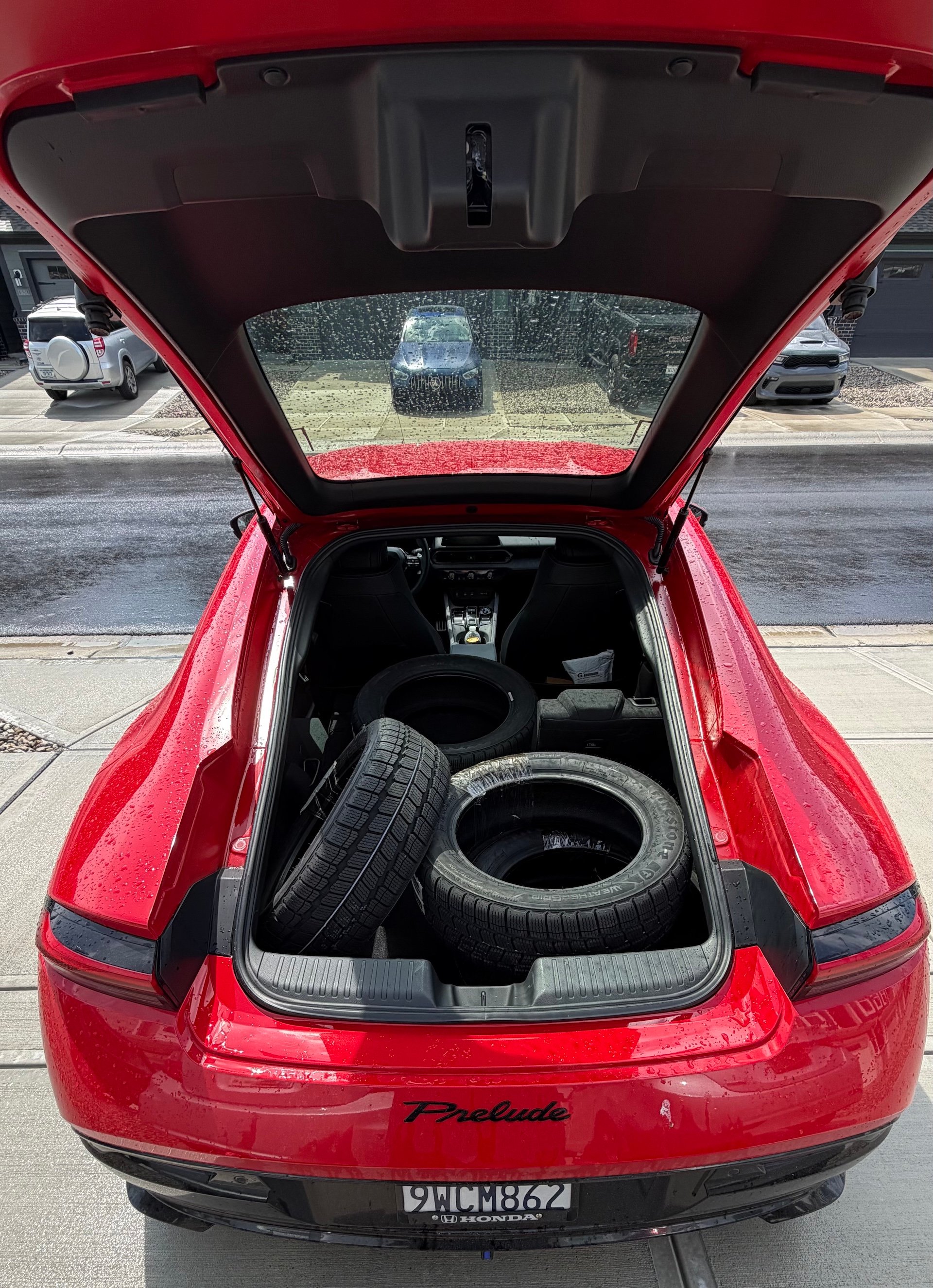
The two rear seats are decently wide, but like most cars with this seating configuration, there’s virtually no legroom. Still, depending on your passenger’s height, you may be able to carry a third passenger behind them. In my specific situation, there’s enough space for my 19-year-old son to ride shotgun, while my 15-year-old daughter sits behind. The rear backrests can be folded 60-40 to expand the trunk space, which is plenty. I threw four new 15-inch Firestone tires for my Fit in the back of the Prelude the other weekend.
Driving
Driving the Prelude can be summed up in two ways: Uneventful and exciting. And when I say that, I truly mean the full extent of uneventful and exciting. Tooling around in Comfort driving mode and with S+ Shift turned off, the Prelude is completely silent, its suspension soft (almost too soft on undulating tarmac) and steering effortless. The drivetrain prioritizes electric driving as much as possible to maximize fuel economy, and the paddles can adjust the regenerative braking threshold, though not quite like in an EV. I’ll write more on this in future installments. Still, the car’s dynamics remain agile, and if you step on the accelerator hard enough, it’ll use that electric torque to get a jump on the cars around you.
Switch over to Sport with S+ Shift turned on, and things are very, very different. For starters, there’s the fake engine sound, and lots of it. The sound quality and how it integrates with the driving dynamics are flawless, but I still can’t help feeling silly knowing there’s zero noise outside the car while there’s a ruckus inside. It feels like you’re in a driving simulator, which is a very odd way to describe a real car.
With the right road in front of you, however, you’ll get over this quickly, because even on the all-season tires my tester is riding on, the cornering grip the Prelude pulls out of its hat is downright impressive. Whatever speed you think you can carry into a corner, you can probably double that (though that’s a dangerous game to play as you get used to the car’s cornering prowess). The Prelude sticks to the road effortlessly as if the tires had suction cups on them. The steering is precise, the balance lovely, and in Sport mode, the suspension performs like something out of a six-figure European sports coupe—or maybe better, considering those are all too bloated nowadays.
Misc. Notes
- I really enjoy how fuel-efficient it is, but also that it has enough electric punch to accelerate surprisingly quickly on the highway and zip through traffic, or even for a quick sprint from a standstill.
- I dislike that it has a gas cap. I enjoy capless fuel filler systems. Here’s why this one does.
- Probably the best headlight lighting I’ve experienced on any Honda (sans the NSX).
- Really wish it had adjustable lumbar support. What happened there, Honda?
- It’s the first Honda with asymmetrical bolstering, meaning the driver’s seat has more pronounced bolstering for spirited driving, while the passenger’s seat bolsters are more relaxed.
- I’ve averaged 46.1 mpg for a full tank by focusing on maximizing its electric power.
- I’ve also averaged 43 mpg after a full tank by being a lot more playful with the driving modes and S+ Shift.
- The eight-speaker Bose is pretty good.
- I catch myself looking back at the Prelude after parking and walking away.
- Come spring, I’m going to look into fitting the optional summer performance tires to analyze any differences in behavior/performance.
- People come up to me almost every single day to compliment me on “my” car and tell me how cool it looks.
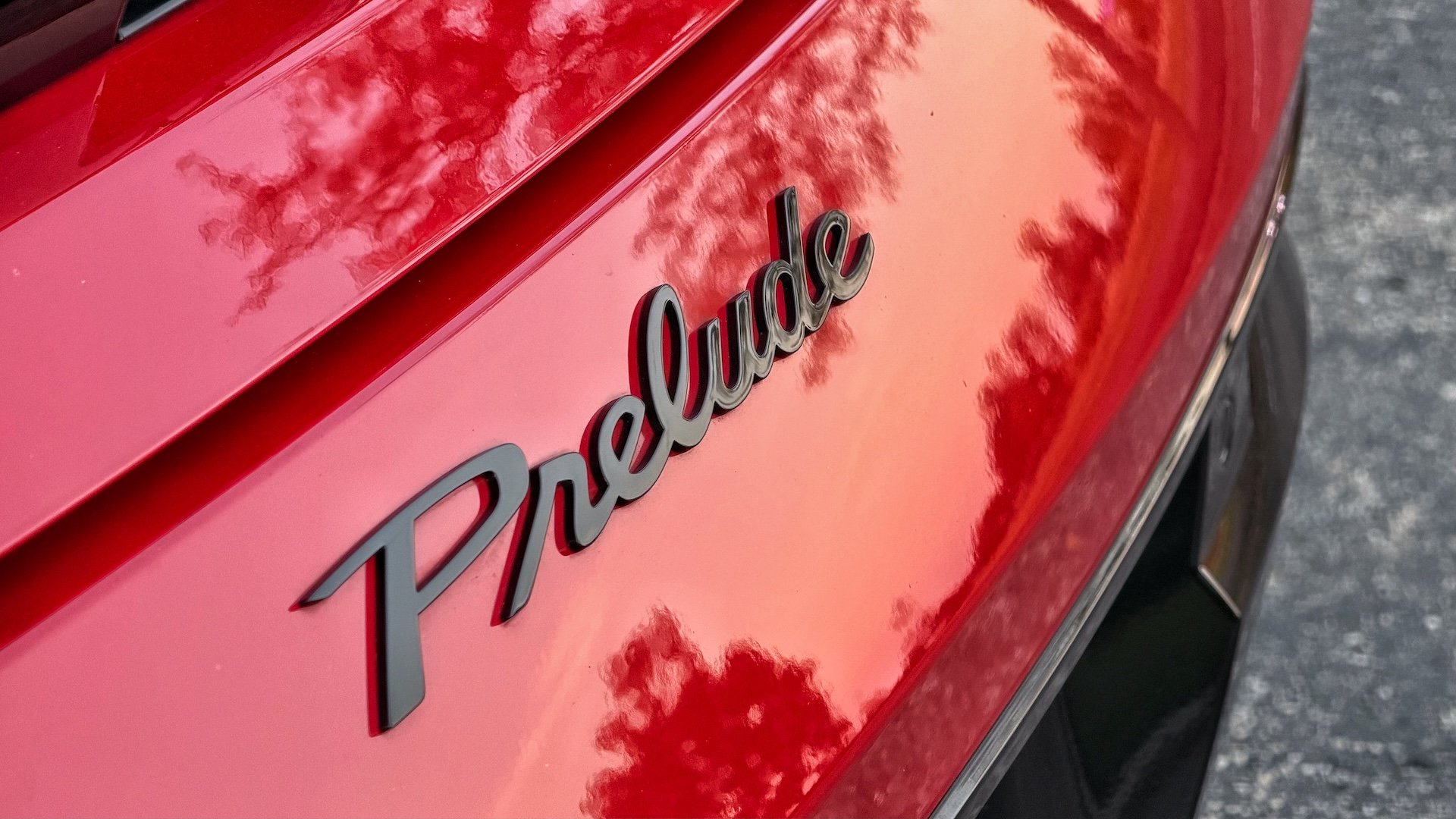
- So many people come up to me and share stories about owning the original Prelude, or how they always wanted one but were too young or didn’t make enough money. It’s nice to hear how fondly they remember the O.G. and how much they like the looks of the new one.
Honda is providing The Drive with the use of a vehicle for the purpose of writing this review.
2026 Honda Prelude Specs
| Price as-tested | $44,545 |
| Powertrain | 2.0-liter four-cylinder | two-motor hybrid system | front-wheel drive |
| Horsepower | 200 |
| Torque | 232 lb-ft |
| Seating Capacity | 4 |
| Curb Weight | 3,261 pounds |
| Cargo Volume | 15.1 cubic feet |
| EPA Fuel Economy | 46 mpg city | 41 highway | 44 combined |
Email the author at jerry@thedrive.com
Loading comments…
Comments couldn’t be loaded. Please refresh the page.