
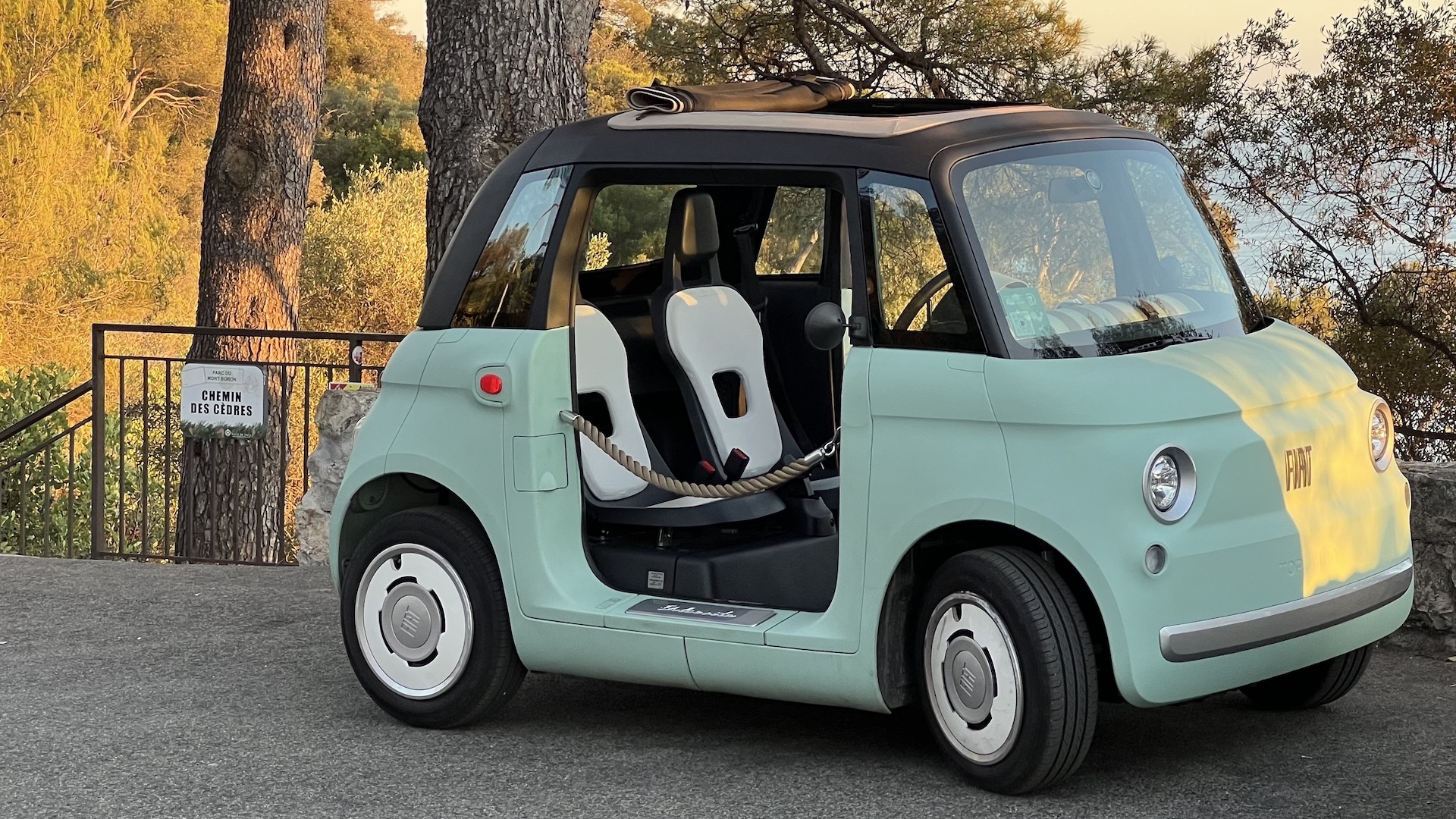
Is bigger always better? I don’t know, ask the millions of people who buy towering trucks and SUVs in the United States every year. And just for fun, ask the same question to all the Europeans who bought carry-on-sized compact cars last year. I bet the answers would be more telling of each culture than anything you could ask about religion or food.
I like a big dog and a big back yard as much as the next American, but from behind the tiny dashboard of a Fiat Topolino, I’m starting to feel like small is superior.
Topolino is Italian for “little mouse,” so right out of the gate, you know it takes pride in its smallness—talk about anti-American. This tiny Fiat’s primary mission is to zip you around chaotic cities like Milan, Paris, or London, giving you a leg up during rush hour while also making parking a breeze and saving you money at the pump, which you don’t even have to visit because it’s electric.
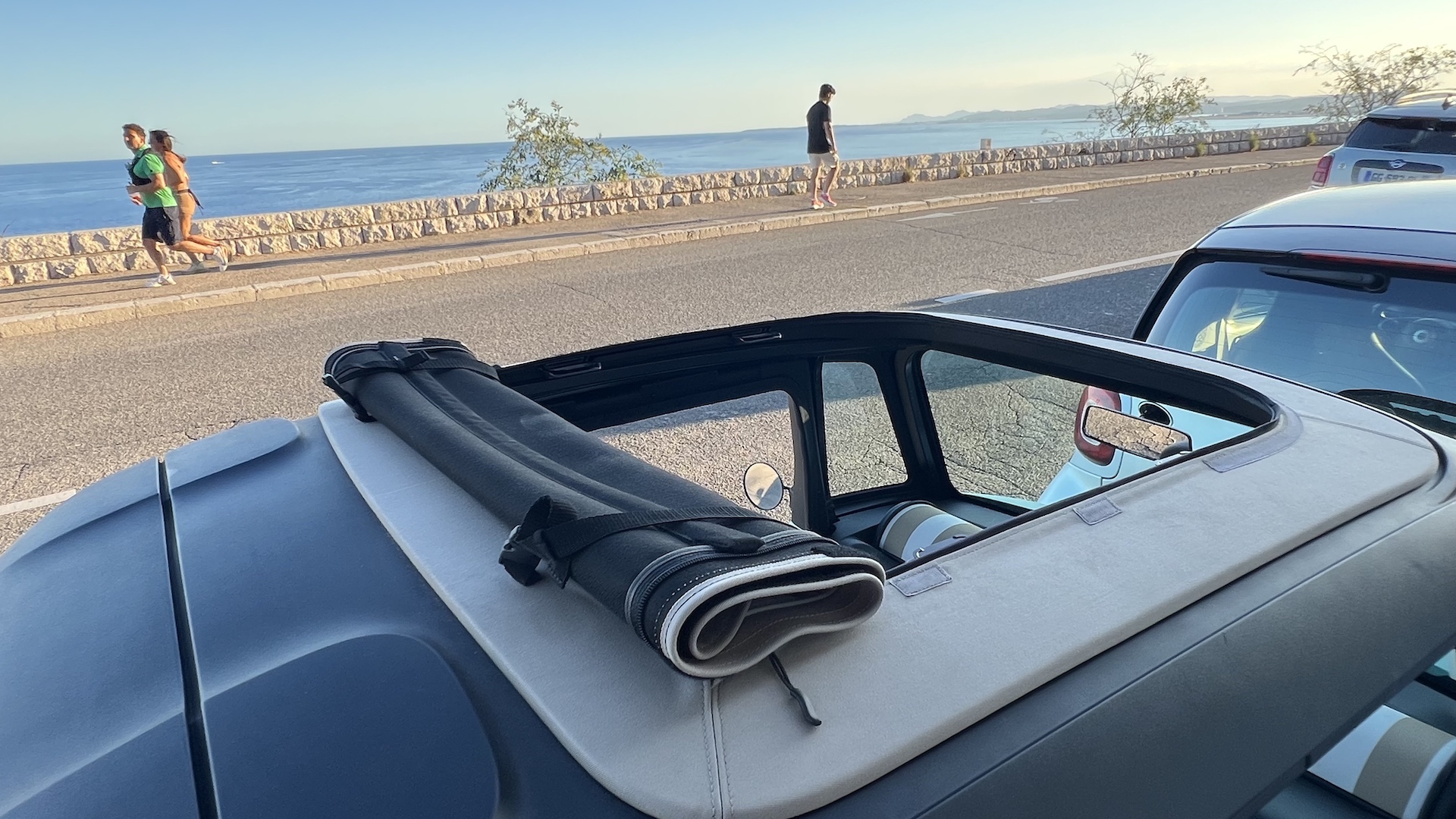
Its other mission is to make you look charming and chic, because the Topolino is a commuter car that doubles as a fashion accessory. Or is it the other way around? I think so—at least for the “Dolcevita” trim I drove around the South of France this summer, with its braided ropes for doors, roll-up tarp roof, and water-resistant seats.
The Basics
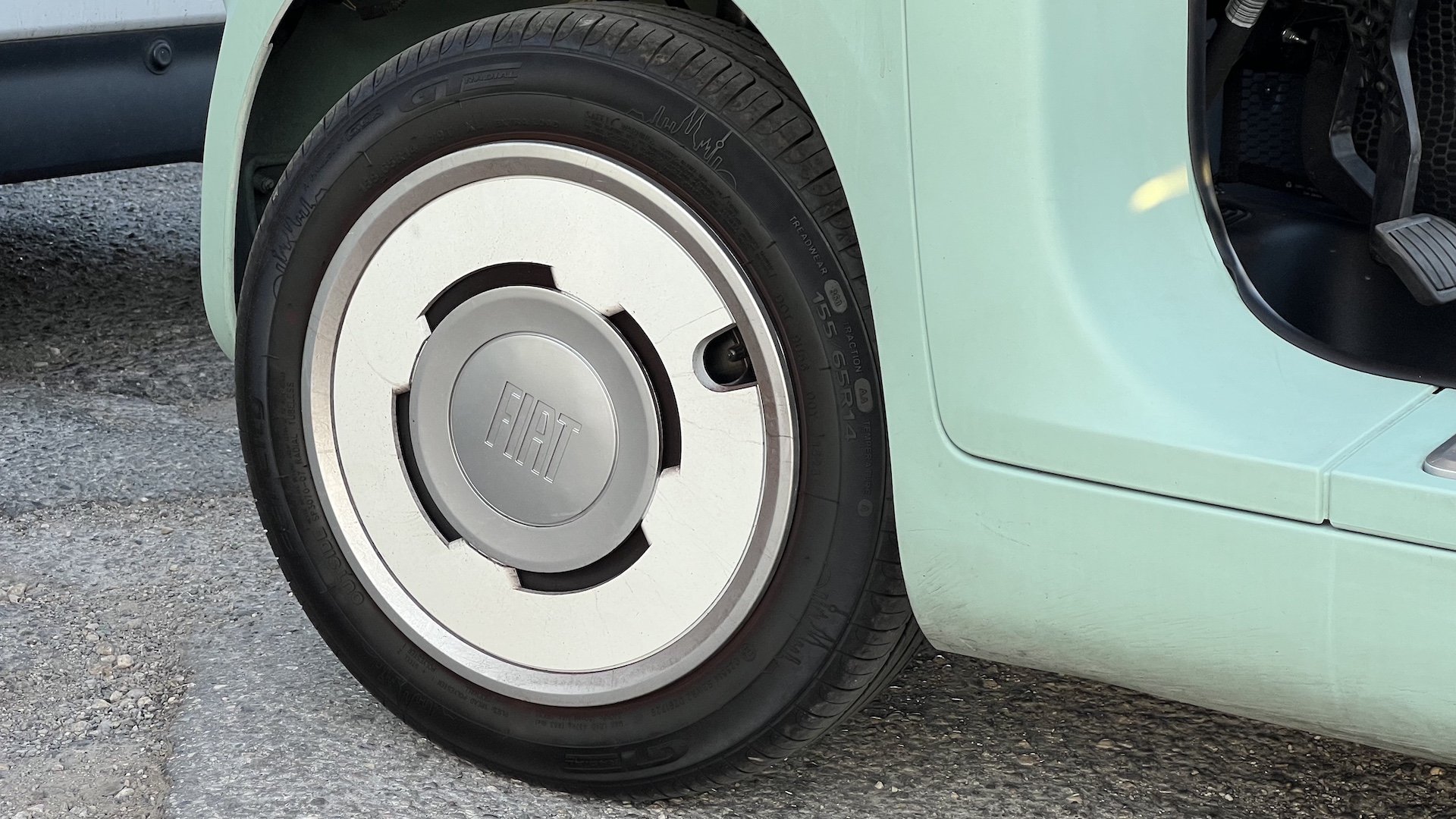
The Topolino is an electric city car that’s legally recognized as a quadricycle in Europe. It’s based on the Citroën Ami, which you may recall from the viral video of one speeding into the Fairmont hairpin in Monaco and dramatically rolling on its side. Its 5.5-kWh battery hiding under the floor is enough to deliver 46.6 miles of driving range (per the WLTP cycle), and an 8-horsepower electric motor drives the front axle.
Due to its quadricycle registration, most European governments allow anyone 14 years old and up to drive it without a driver’s license. There are three trims available, per se, the traditional Topolino, which features full doors and windows and a solid top; the Dolcevita, which is a throwback to the charming, open-air Cinquecentos that roamed the Italian and French riveras through the ’60s and ’70s; and a new Vilebrequin Collector’s Edition created as a collab with the luxury swimwear company.
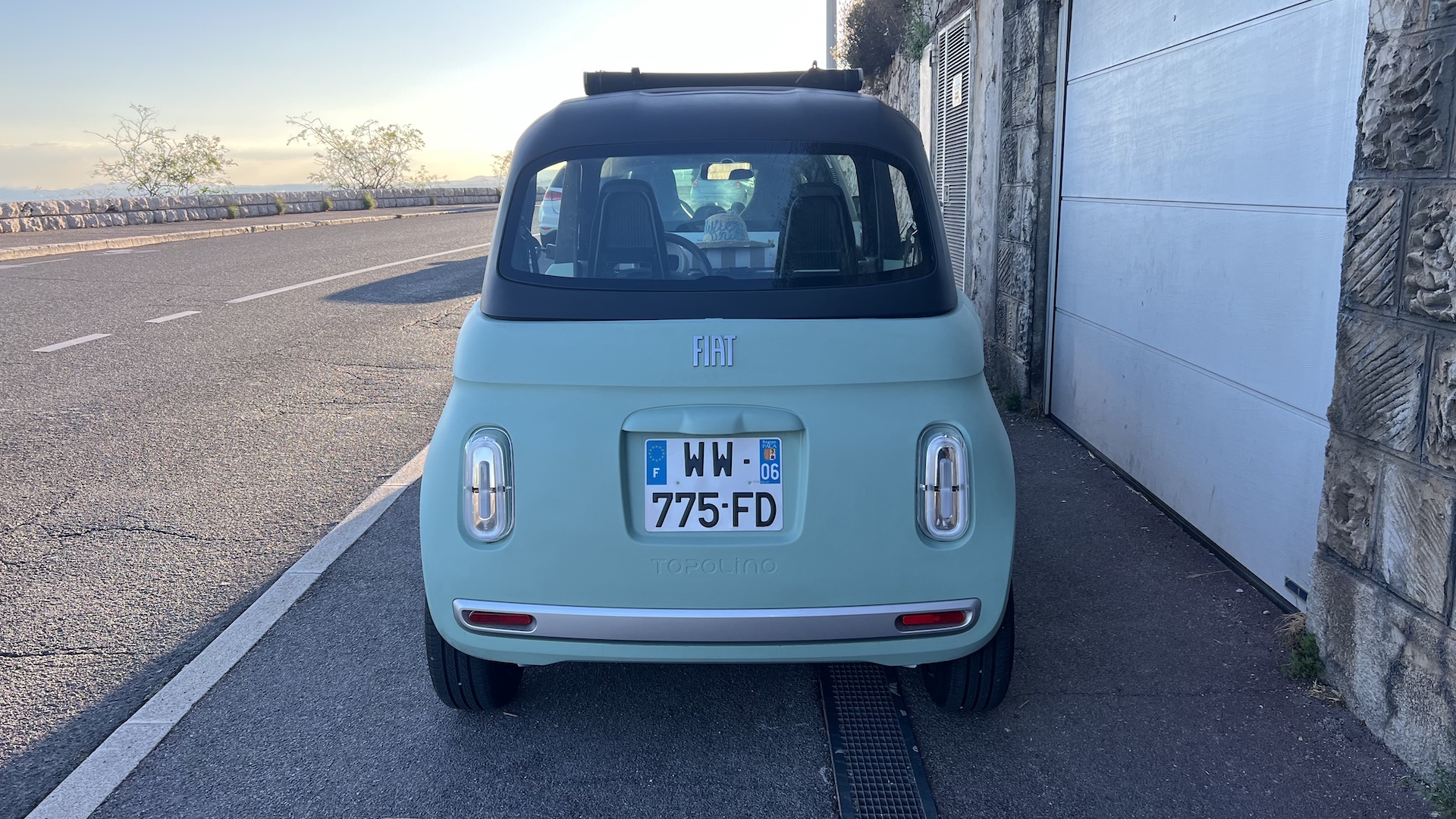
It may be small, but the Topolino is big on design. Curvy in some areas, sharp in others, and with a face that everyone can love. Its bubbly shape makes you smile, its little round headlights make you go awe, and the faux hoodline and bumpers are a nod to its predecessors. And then there’s that period-correct metal luggage rack out back—which you’d truly need if you’re carrying more than a backpack.
Despite being sold in fewer markets and in considerably lower volumes, the O.G. Fiat Cinquecento is right up there with the Volkswagen Beetle in terms of overall popularity and recognizability. More importantly, while the classic Beetle is seen as a national icon in Germany, that’s also the case in countries like Mexico and Brazil, where production continued until the 2000s. The Cinquecento, however, is as Italian as Leonardo da Vinci. It is Italy on wheels, and the Topolino cleverly cashes in on that nostalgia.
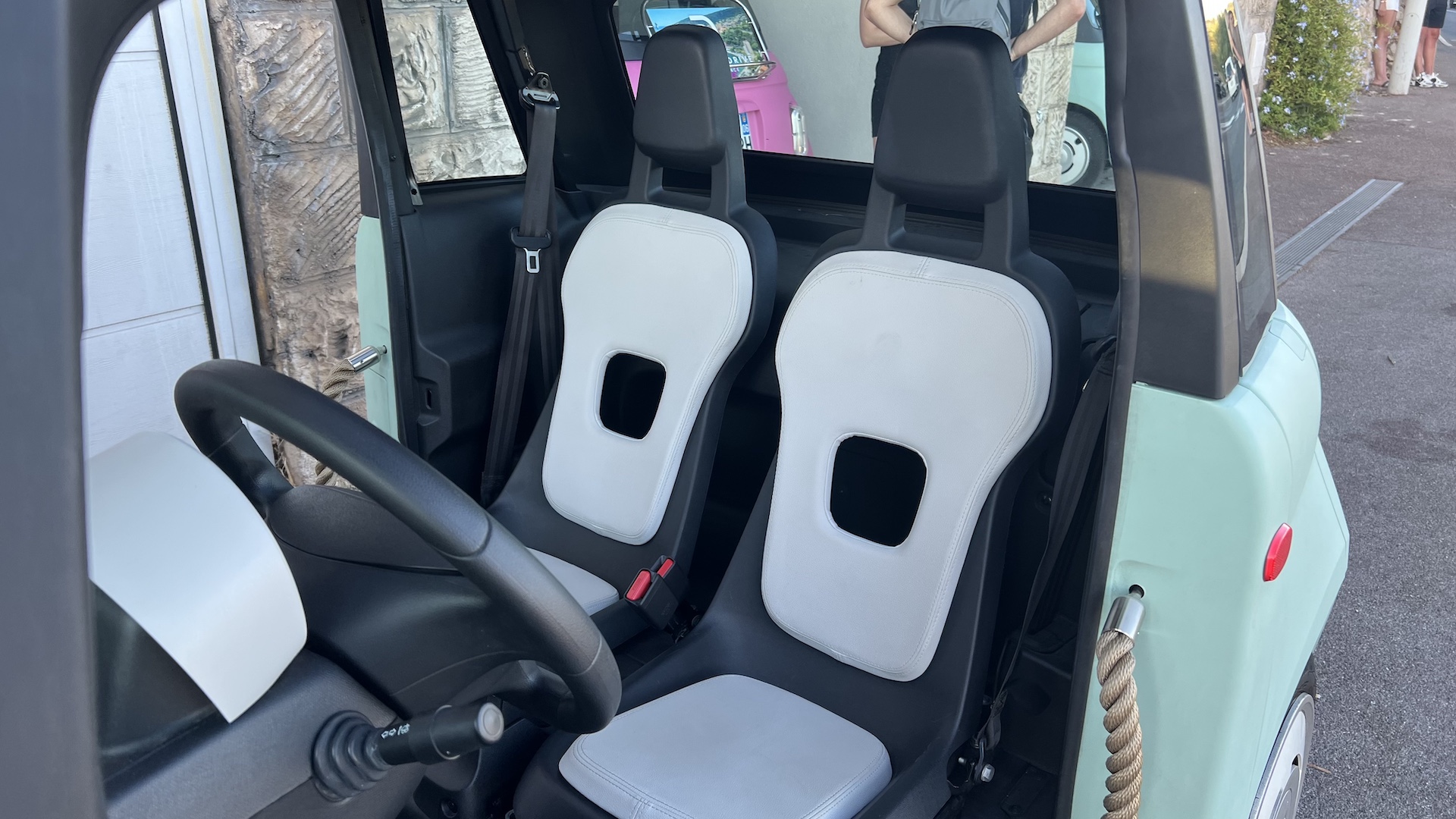
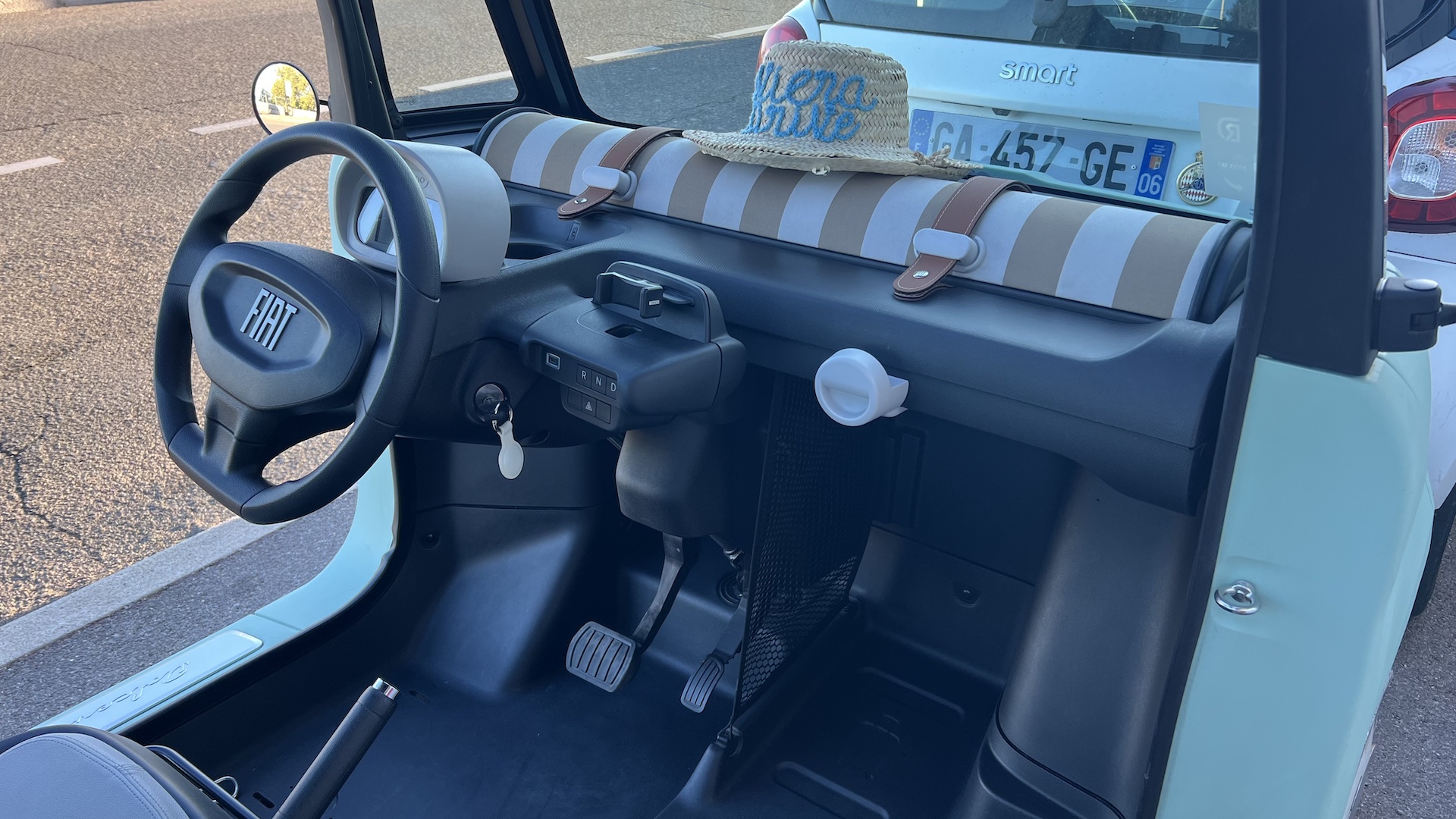
Inside, well, there’s not much. The dash is a flat surface made of black plastic that runs from one side of the cabin to the other, though a rolled-up striped tarp is tucked in below the windshield for added eye candy. A protruding section to the right of the steering wheel houses a clamp-style smartphone holder, and below it, the “shifter,” which is just four push buttons labeled R, N, D. No Parking gear here; just come to a stop, twist the key as if you were shutting off the ignition, and the parking brake will automatically engage. The fourth button is for the hazards.
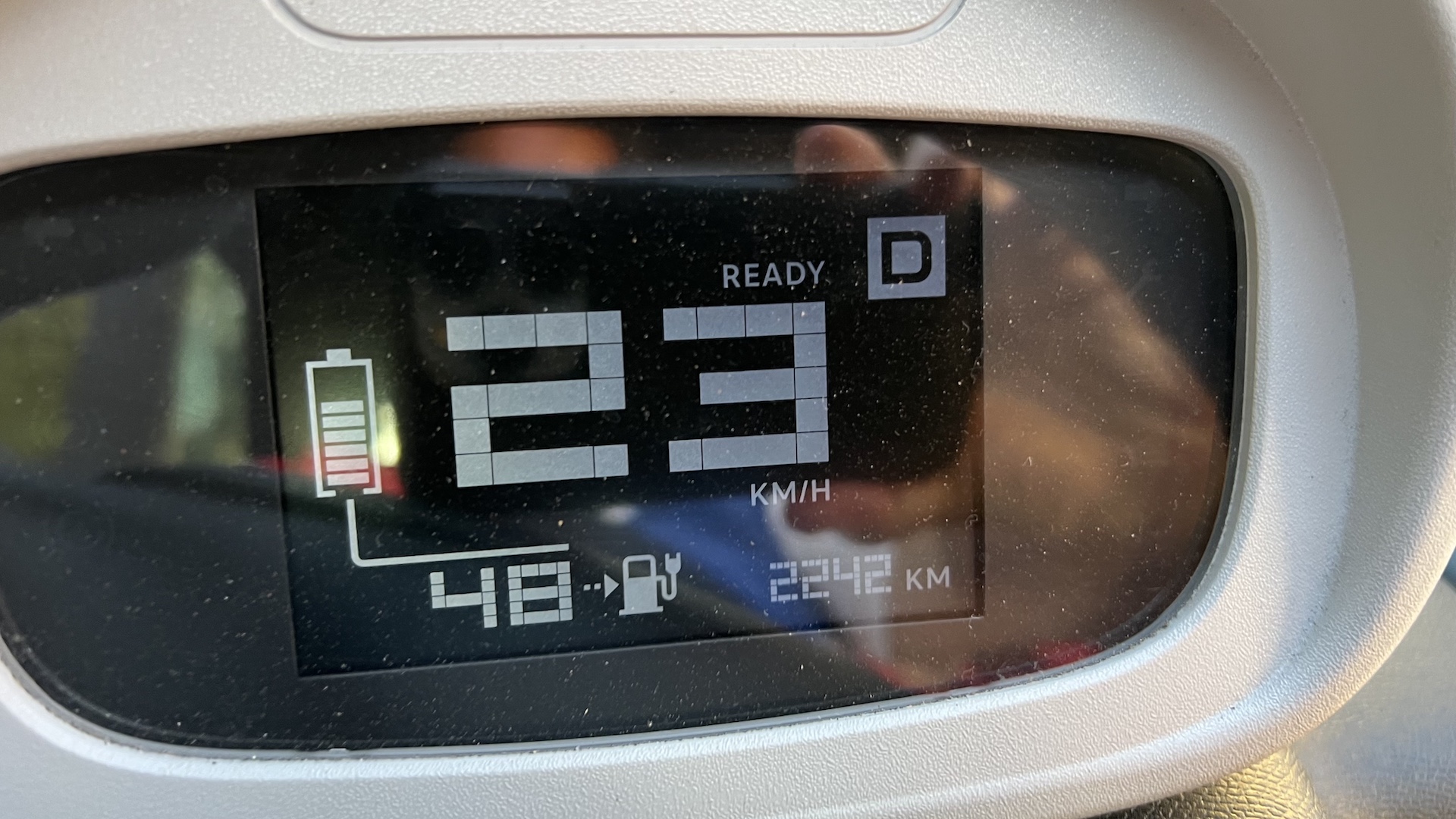
Behind the steering wheel, sitting atop the steering column, is a digital gauge cluster that displays the speed, driving range, state of charge, selected gear, and odometer. It’s worth noting that this non-color display is far inferior to anything used in even the cheapest of passenger cars. It’s more akin to what I experienced earlier this year on a snowmobile. There’s also a cupholder/cubby behind the display. The seats are more decorative and, I suppose, practical than they are comfortable, as they are made from two-tone panels of somewhat squishy rubber, making them easy to keep clean and dry while running about on the beach.
Driving the Fiat Topolino
Unlatch the door… err rope… and climb into the cabin. Even for an XXL frame like mine, this was easy-breezy, and like most little cars, the Topolino is a lot more spacious inside than you’d imagine. At a pinch over 7 feet long and 3 feet wide, most of this EV’s footprint is cabin space, so the legroom and even headroom are actually phenomenal. The driver’s seat is manually adjustable, as is the telescoping steering column; however, the passenger’s seat is fixed. This meant my short 13-year-old daughter had loads of leg room, which could double as cargo space if you were to go to the grocery store or something like that.
Put the old-school key into the ignition and turn it over twice; you’ll hear a beep, and that means the Topolino is ready to roam. Push the D on the shifter and step on the accelerator to get going. Despite its lack of power steering, you immediately feel how light the Topolino is, and maneuvering the wheel while stationary doesn’t require much more force than when it’s rolling. After all, it weighs just 1,060 pounds, which is the same or less than your average golf cart.
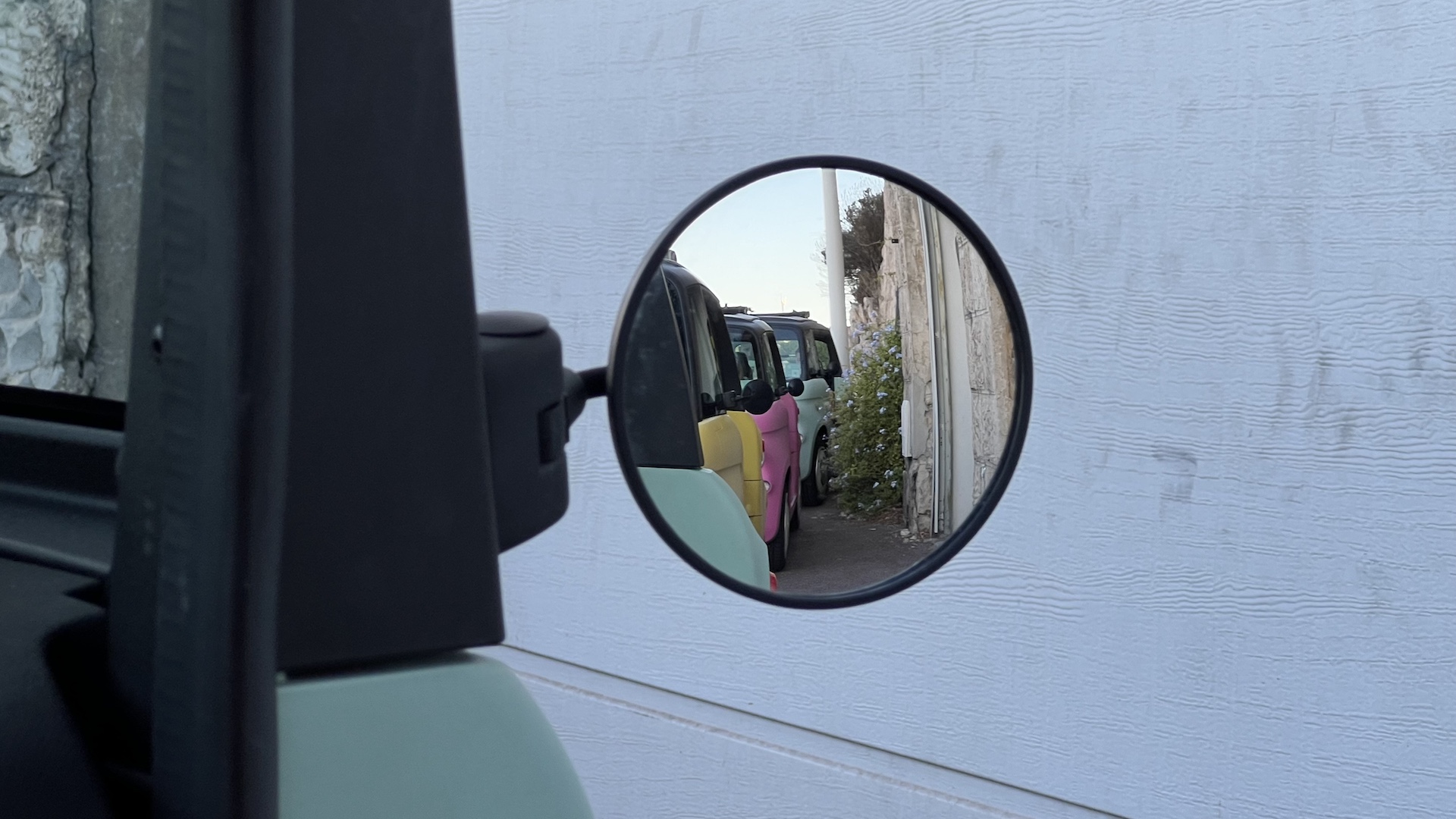
The narrow, hilly, and oftentimes maze-like streets of Nice are the Topolino’s specialty—it runs circles around average-sized cars and manages to make Fiat 500s and Renault Twingos look big and cumbersome. I was able to squeeze into gaps and get to the front of the line or sneak into a turn lane that I otherwise would’ve had to wait for a bigger one to open up. Now, despite it being an EV, there’s no breakneck, or breakwrist, or break-anything acceleration. While sprightly, Fiat’s tiniest model won’t lurch forward with the same urgency you’d expect from an electric car.
Floor the accelerator from a standstill, and the Topolino will comfortably and gradually accelerate until about 10 mph, when the rate of acceleration improves, and you feel like 20 mph arrives a lot quicker. Surprisingly, the electric motor feels even punchier at 25 mph, as it continues to accelerate with gusto to its giggle-inducing top speed of 28 mph—even uphill. I actually saw 48 km/h flash on the speedometer several times, so it can definitely reach 30 mph on level ground. While I couldn’t find any official performance specs for the Topolino Dolcevita, Citroën claims the Ami can do zero to top speed (28 mph) in 10 seconds.
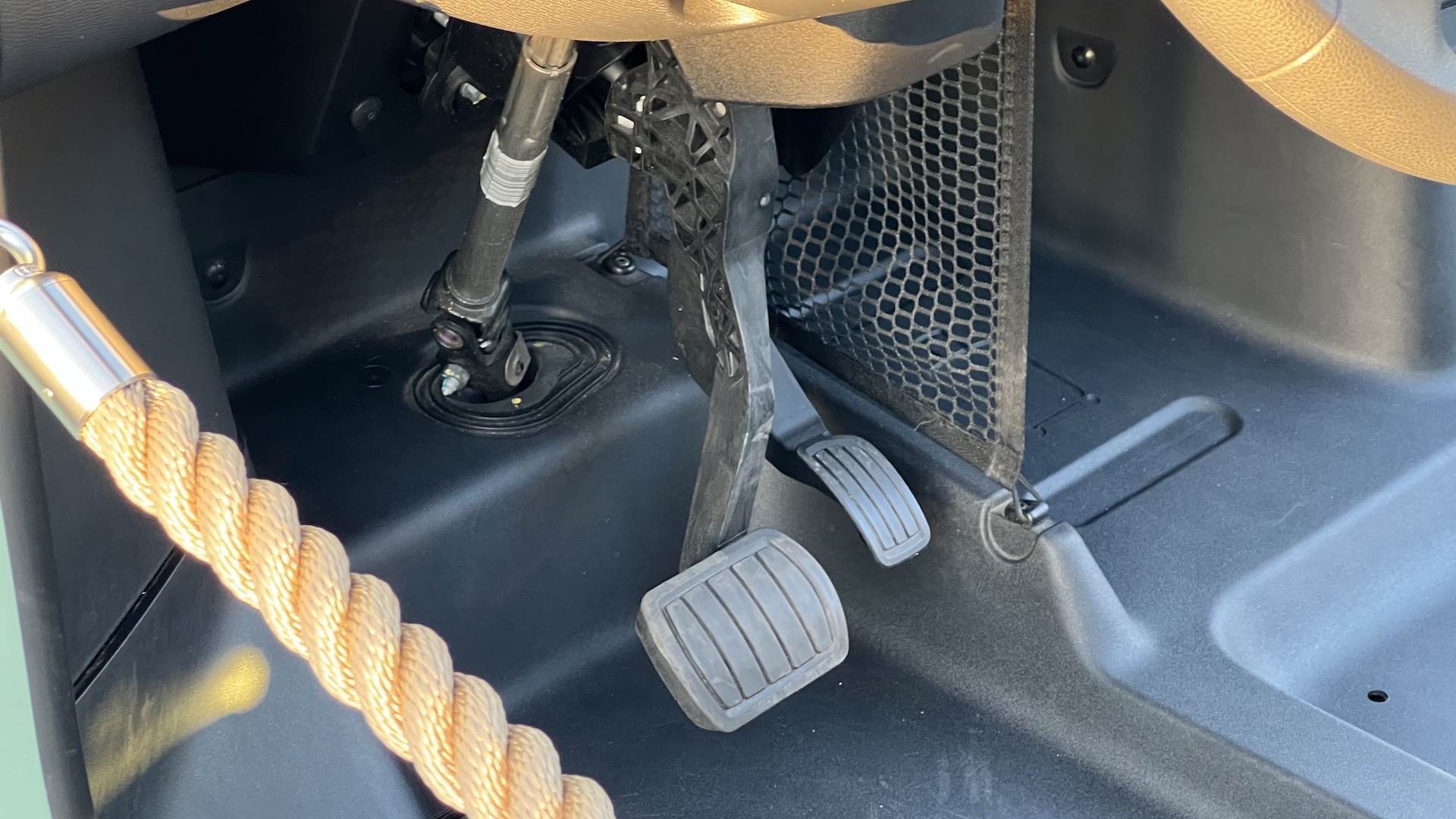
The steering feel is direct, and while it’s not exactly like that of a normal passenger car, it’s not quite as raw as that of a generic golf cart. The pedal feel, however, is very much so that way. Even examining the exposed brake and accelerator assemblies raises questions about whether this is more than a glorified beach resort buggy. The brakes are strong and surprisingly modular, though I found the position and angle of the pedal to be slightly uncomfortable for drives longer than an hour, especially in stop-and-go traffic. Then again, I highly doubt anyone is driving one of these for longer than 20-30 minutes at a time.



Put all of this together, and what you have is a nimble and fun-to-drive tiny car designed to tame some of the world’s most congested cities. The lack of doors gives you a pleasant feeling of freedom, and the roll-up roof welcomes sunshine in, so you feel extra glamorous while cruising on the Promenade, or while zooming between your docked yacht and your favorite in-town restaurant.
Quick Verdict
The Verde Vita Topolino I drove was a rental car I personally hired through this local company, and I’m super glad I did. I was able to experience a cool car that’s not offered in the States, and while it wouldn’t have been impossible to talk Fiat into letting me borrow one abroad, this just worked out better with my trip’s logistics. The car was visually and mechanically spotless, and it had only 1,300 miles on the odometer. The longest stint I did behind the wheel was about two hours long and traveled a little over 13 miles in hilly, stop-and-go traffic, and the Topolino consumed about nine miles’ worth of juice. And while I didn’t have to charge during my rental, at that rate, I estimate someone who commutes under similar conditions would likely have to do so about twice a week… maybe less.
Like I said in my recent blog about Honda’s newest mini EV, the N-One e, the time to bring tiny EVs to America is now. Even if you live outside of LA, New York, or Boston, these make a lot of sense for people whose entire lives revolve within a short radius from their homes (like me). I certainly don’t mean that everyone should give up their cars, trucks, and SUVs and drive one of these, but simply that Americans should have a choice of small, economic, practical electric vehicles that fit their specific lifestyles.
At roughly $9,000, the Fiat Topolino would be the ideal city car for me and many others—but I’d need real doors and a roof to survive the Midwest winter.

| 2025 Fiat Topolino Specs | |
|---|---|
| Base Price | $9,000 est. |
| Powertrain | 6 kW single-motor front-wheel drive | 5.5-kWh battery |
| Horsepower | 8 |
| Torque | 30 lb-ft |
| Seating Capacity | 2 |
| Cargo Volume | 2.2 cubic feet |
| Curb Weight | 1,060 pounds |
| Range | 46.6 miles (WLTP) |
| Quick Take | A nostalgia-packed EV that isn’t for everyone, but it’s still worthy of your attention. |
| Score | 8.5/10 |
Email the author at jerry@thedrive.com
Loading comments…
Comments couldn’t be loaded. Please refresh the page.