
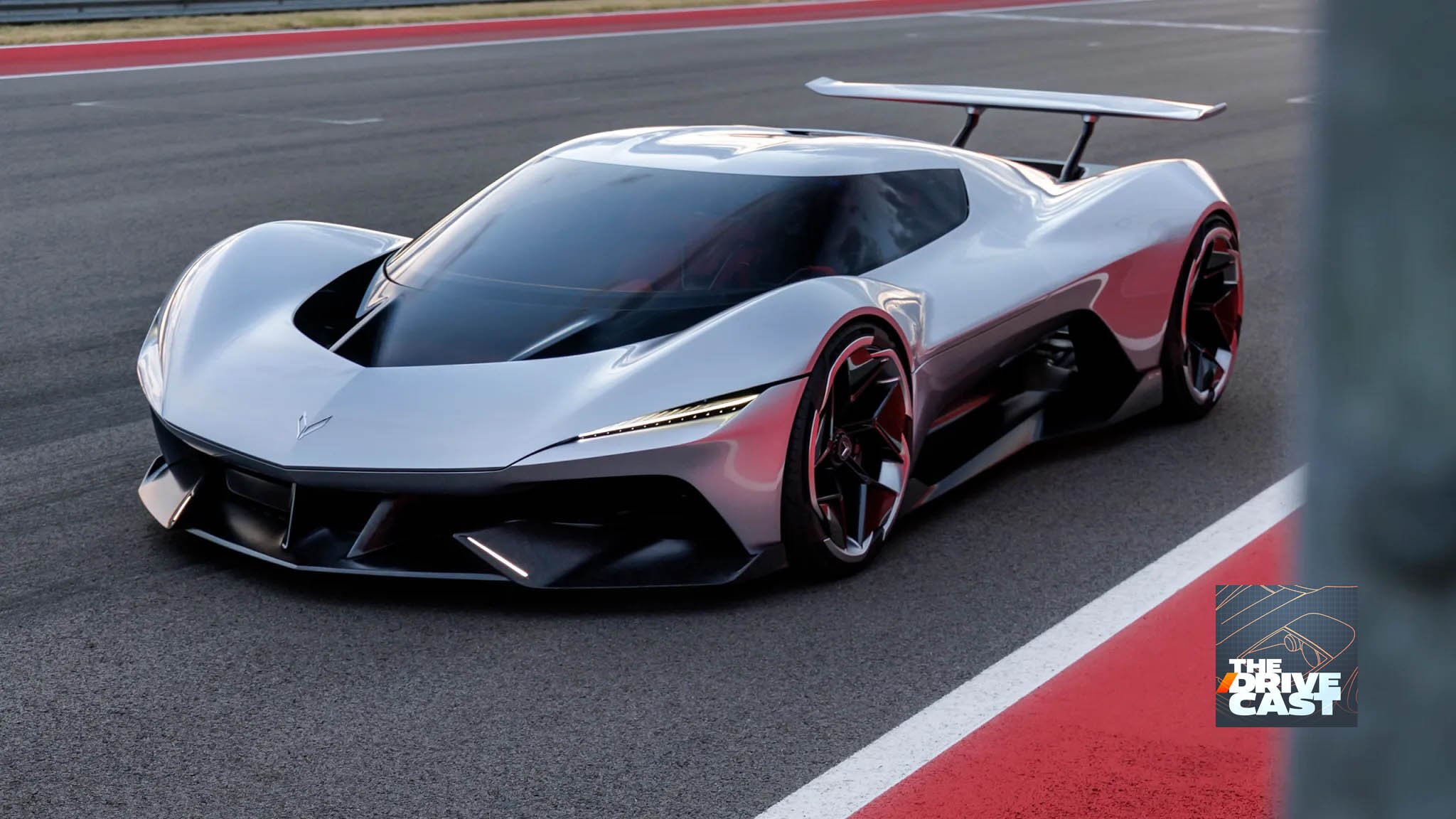
General Motors, depending on the day and setting, might try and argue that the Cadillac Celestiq is the automotive Goliath’s flagship, and there is an argument there. But let’s be real: The Corvette is the company’s most iconic and important model. It’s not the highest volume vehicle, but no one’s going to argue it is not the company’s halo.
On the latest episode of The Drivecast, Tony Roma, who is now the Executive Chief Engineer for the Chevy corvette and Performance Cars at General Motors, sat down exclusively with The Drive for a candid discussion about the future of performance vehicles at General Motors including the Chevy Corvette, Cadillac V-Series, Blackwings, Camaro, and more.
The man Roma’s taking over for, Tadge Juechter, became an industry legend over the course of 47 years. Big shoes to fill. No pressure. And Roma’s taking over at a critical moment. The next-gen Corvette is taking shape with a due date likely coming in a few years, the next-gen Cadillac V-Series and Blackwings are also arriving in the coming years. The U.S. market’s electric future and timelines have very clearly shifted and now GM’s unleashing new clean-sheet V8s into the marketplace. A timeline no one would’ve predicted a few years ago. Enthusiasts online are seemingly thrilled even as the rest of the world looks at us with a side eye. Roma has decisions to make.
You know, with the comeback story of the V8 engines we just might see the return of the manual transmission option in more performance vehicles at GM. Which, of course, would likely be short lived if enthusiasts don’t put their money where their mouths are. A story as old as time. V8s. Manual transmissions. America. What a timeline, and what a huge responsibility for Roma.
New here? The Drivecast is The Drive‘s weekly podcast that takes you behind-the-scenes on the largest controversies, stories, and characters shaping the automotive industry along with the way our roads look today. Powered by The Drive‘s inside access, original reporting, exclusives, and insights, The Drivecast aims to make everyone an insider.
Listen to The Drivecast via Spotify, Apple Podcasts, or Amazon Music. Love it? Like it? Want to help? Leave a five-star review on your platform of choice to help get The Drivecast in front of more people. Have a suggestion, tip, request, or feedback? Drop us a line at feedback@thedrive.com. I promise, we read every single email.
Full Transcript
Kyle: Joel, I know you love Blackwings.
Joel: You and I both love Blackwings—doesn’t matter which one. I love a track day in a Blackwing, I love a back road in a Blackwing. I love that America has Blackwings, Kyle, and I know you do too.
Kyle: I certainly do. I mean, it was our Car of the Year last year, so that pretty much says it all.
Joel: For good reason. And you know what? We have the man in charge of all things GM performance, ranging from the Corvette to the Blackwings, to the V-Series, to who knows what else we’ll have to learn today. Here on the podcast, Tony Roma, we have a laundry list of questions to get through that I’ve scoured the internet to make sure forums, enthusiasts, and Reddit people that have questions get their answers today the best I can. Kyle, take us away.
Kyle: Okay, Tony, the first question is, how are the restaurants doing? No, I’m kidding, I’m kidding. You must get that a lot. My actual first question is, you’ve been leading the Corvette program for about two years now. What is the biggest difference between Tadge’s Corvette team and yours in both approach, philosophy, team setup, and all that stuff?
Tony: Yeah, that’s a great question. I’d say there’s honestly not much difference. The team is the team, and it’s a bunch of A-players that come from all over GM. A lot of people self-identify to work on Corvette; it’s the kind of project you aspire to work on. So really, as far as the team goes, it’s not about being my team or Tadge’s team, it’s the Corvette team. I happen to be the one in the seat here, and I tell people that I’m the one that gets to be the public face of it more than most people, but really it’s a big group of people. There’s hundreds of people. If you look at probably the peak during a development cycle, there’s probably six or seven hundred people that charge their time against Corvette. So really, there’s not much difference. We get the A-players throughout the company, and they’re doing epic work, and everybody’s having a good time doing it.
Kyle: What has it been like to replace the brains that have been lost over the last few years just as natural turnover has happened? I mean, you’ve had some very long-time members of the team leave: project manager Harlan Charles (37 years at the company), exterior design manager Kirk Bennion (41 years). So, what is it like to replace that and bring in a new generation of talent to lead the Corvette forward?
Tony: It’s an ongoing challenge. Those are, someday when I leave, that’ll be a thing people in the public will notice. But like I mentioned a minute ago, there’s hundreds of people that work on these cars. At any given point in time, we’ve got folks—gosh, if I go back through the years of all the people that I’ve known that have done epic work on Corvette, the guy that did the crankshafts years ago, the camshaft guy years ago when he retired. Nobody publicly knew he retired, but we had a person waiting in the wings who had worked underneath him. Same thing with Harlan; Austin Fisher has got that seat now, knew Harlan, worked on the Corvette team for years, he was the right person at the right time. He’s bringing a fresh perspective to it. There’s a lot of momentum on a program like this, so it’s not like he’s going to drop the ball or anything. There’s plenty of lead time on the decisions, and we make them as a team. Same thing with Kirk. Our studio has a deep bench strength of really talented people if you’ve ever talked to the folks specifically in design. The current crop of people that are working on our car are truly the best over at the studio. Taeyoung Kim is our studio manager right now on exterior, who would be like the direct replacement for Kirk. He’s amazing; he’s the right guy right now to lead the car. So, that’s an ongoing part of the business we deal with all the time, and no worries. Fear not, the Corvette will prosper in the future.
Joel: Well, before we get to the future, I want to talk about today and the immediate future, right? So let’s talk C8. It was such a big deal, a huge departure, an inflection point, if you will. I remember when it was debuting, and then when it came out. I was at the debut of the C7, and I remember the bankruptcy and everything that changed with this, so C8, we went mid-engine. We just had a huge change to the lineup running into this 2027 model year with new engines, the Grand Sport launching, we have the Grand Sport X. Talk to me, because Grand Sport models typically, for those that do or don’t know about Corvette history, in general, Grand Sport models come last. They are, in general—not always the case, but typically—they mark the end of the Corvette generation as we wind down and go into a couple of years later where we start moving to the next gen, or next half-gen, or whatever. With Grand Sport and Grand Sport X joining the lineup, is that where we’re at with C8? Was this the finale for C8?
Tony: First of all, your intro there, I think you’re interviewing for a job at GM because you’ve got the speech down pretty well, right? Historically, we come out with Grand Sport towards the end of the lineup, and you’re spot on with all that. As far as the end of C8, we’ve got nothing to announce about the rest of it. We’re still selling cars, we’ve got some more to go, it’s not over yet. I know everybody’s talking about what comes next, and there will be something next, but I don’t have anything more to talk about.
Joel: So, you led me right into—man, Tony, you could work here, Tony. We could change spots for a minute. Maybe we’ll do one of those “bring your kid to work day” things where you and I will just change spots for a minute, like Wacky Fridays. So, we have this new “X” moniker, right? ZR1X, Grand Sport X. We don’t have a Z06X. Does a Z06X make sense? And I worded it very carefully because I know you’re going to say, “Well, we can’t comment on future products,” which is a fair thing, so I said, does it make sense?
Tony: It is something that has taken on a life of its own on the internet and at public events that I go to. I think it could make sense. Certainly, we could put those pieces together and make that. All I’ll say is, it’s been a fascinating journey we’ve been on when we introduced the electric all-wheel drive system on the E-Ray years ago, and a lot of people thought it needed a plug and all that stuff we went through, and it’s been well received. The people that have those cars love them. And then, of course, we always had the ZR1X in mind when we did the E-Ray, and just the performance that it gave the car, the attributes that it brings, all the crazy things we’ve been able to do with the Nürburgring and Pikes Peak earlier this year, and the lap records we’ve been setting. The car is just phenomenal to drive: 8.67 in the quarter-mile, just silly numbers it puts up. So, honestly, that’s what we had thought about and architected for this. The idea of putting the LT6 and the electrification together, not knowing how well this was all going to be received—it’s a fairly expensive option, and so on and so forth. So, to answer your question in a hypothetical, yeah, sure, I think we could certainly do that. Obviously, you predicted my answer is I’ve got nothing to announce today. But I think as far as “could we do it,” yes. I always turn the question around on customers when they ask me: would they buy one? Would they want to pay that kind of money? It would have to end up being almost ZR1 money for a car with a different kind of performance envelope, right? A lot of what we run into on Corvette is there’s a lot of great ideas, and every space in the sports car market is covered by a sub-model on one of my competitors, right? And so, it’s definitely a situation of we can do anything, just not everything. So, we try and pick the high-value targets, make good business sense for us, and make great cars that our customers are going to enjoy. So, who knows? Maybe in the future, we’ll decide that’s an entry worthy of the investment, but right now, yeah.
Kyle: The hybrid nomenclature, the outward label, the marketing terms, it was changed from E-Ray to Grand Sport X. I know there are other changes in the car, it’s not just rebadging it. But I am curious, what drove that decision directly? Were you getting feedback from customers being like, “I don’t know what an E-Ray is,” and the letter X is just cooler? Was there a concern that the E-Ray was just not positioned properly in terms of the branding to make sense as a hybrid?
Tony: That’s a really, really good question, and it’s funny how this has evolved over time. It was about the time we figured out that the ZR1X was the right label for that product was when we really came up with this strategy of the X would mean our all-wheel drive, E-all-wheel drive system. And so that meant, and we knew we were coming out with a Grand Sport when we made that decision, and so we said, okay, it makes sense to reposition the E-Ray as an extension of the Grand Sport lineup and make it integrate better that way than to continue to have a standalone product. So, yeah, it was really just, at least as I sit here today, that’s what X means to us: it means that’s the car that has our E-all-wheel drive system, and it has a slightly different mission than the rear-wheel drive car. So if you look at a Grand Sport and Grand Sport X, they’re related, but not going after exactly the same customer.
Kyle: Well, for what it’s worth, I thought E-Ray was a cool name.
Joel: So did I! I feel vindicated now. So, I do have to ask, Grand Sport X is quicker than Z06, technically by paper specs, right? Quicker in a straight line, but it costs less. It begs the question of what’s the buyer for the Z06 in the year 2026/2027 versus the buyer for the Grand Sport X, because clearly, they’re different targeted buyers, right?
Tony: Yeah, to us in the Corvette team, they’re pretty dramatically different buyers, I think. If you’re more inclined for straight-line use, if you’re more of an “I’m going to use this car for longer trips and maybe drive it in the rain” type… If you’ve driven a Z06, the engine is higher strung, it sounds just glorious when you wind one of those out above 8,000 RPM, it’s just amazing, it makes a lot of power. It’s rear-wheel drive, stiff, still comfortable, but less comfortable than a Grand Sport X. So it’s really a different buyer, and I hope people that approach the cars look at it that way. A lot of people come in and talk about just zero-to-sixty time or just power. Well, there’s way more than that here. So I hope people aren’t just buying like, “Well, now the Grand Sport X has 721 horsepower so it must be better than a Z06.” Better depending on your use case, right? If you want to take a Z06 to the track, it is super rewarding. That car is razor sharp and just amazing. A Grand Sport X is also a great track day car too, but it’s not as razor sharp, it’s a little bit heavier. Yes, it’s got the all-wheel drive to claw out of the corners, it’s just a different experience. It’s like going to two different Michelin-rated restaurants and debating about whether one is better than the other. Well, do you prefer this cuisine or that? That’s the way I look at it, right? They’re both great cars, they both do exactly what they get asked to do, it’s a taste thing, right?
Joel: I drove that Z06 when it first launched on a racetrack, Atlanta Motorsports Park, love AMP. And I remember looking at my team at the time and saying, “This is the end, like this is special, there will never be another car like this.” And they all looked at me knowing that we all knew that E-Ray and ZR1X, which didn’t have the name at the time, and ZR1, all these cars were coming after. And they all said, “What are you talking about? More powerful Corvettes are coming, faster Corvettes.” And I said none of that matters, right? On paper that matters, but the reality is that nobody in the world makes a mid-engine sports car bordering on a supercar with a flat-plane crank V8 that sounds like this, no matter where you go, no matter how much money you spend. And I said all those cars you just said are going to be electrified, they’re going to be heavier, they’re going to have turbos, they’ll have more power, but they won’t deliver this experience, and this experience is special. And I knew faster Corvettes would come, but I knew this was the end, like this was a moment in time that day I would never forget because that sound above 8,000 RPM, like you said, blasting down the straight, it’s special. But speaking of cars that were going to come, we’ve got to mention the name Zora. Everyone thought the ZR1X was going to be called Zora. I have to ask, what happened? It was very clear the internet was united in this, that that was going to be called Zora.
Tony: It’s funny, and I’m sure you guys know there’s things that you know that other people don’t know, and so to watch the internet just swirl with things that they’re just convinced they know…
Kyle: No, never, never.
Tony: So that’s the way I look at it, is yeah, well, you know, there’s a reason we have a PR and a marketing department. We tell our story when it’s time. So nothing really happened.
Joel: It was never going to be called Zora?
Tony: I think what confuses people is we renewed the trademark for Zora, I think we’ve renewed it like three times now in the last whatever number of years. And every time we renew it, there seems to be this big, “Oh my gosh, it’s coming!” But I can tell you I’ve been on the other side. I think years ago we didn’t renew the trademark for the ZL1 name years and years ago, and we had to go basically buy it back from somebody. So we tend to renew a lot of these old names or names that we think are cool, and there’s nothing more than that. So yeah, sorry to disappoint you guys.
Joel: You’re not disappointing, but I will ask on that track: you told Top Gear that the ZR1X is not the end of the story, it’s just the latest chapter. And you mentioned earlier, and hinted to this, alluded to this with the Grand Sport of like typically it is, but, and you kind of stopped short, right? But you were very clear with them, word for word, of “it’s the latest chapter, it’s not the end of the story.” Can you elaborate on that without going into getting choked by your PR handler?
Tony: At the time I was talking to Top Gear, I was more alluding to Grand Sport at the time. So that was more directly, “Hey, I know there’s something big, you know there’s something big.” Right now, it’s more I’m just trying to say to customers, don’t wait and not buy a Corvette today because you think I’m about to release C9 and you’re going to buy one in the spring. That’s more what I’m trying to say right now, is we’ve got runway left on C8, so stay tuned.
Joel: I don’t want anyone to think I’m cutting Kyle out. I only got two more questions, then it’s the Kyle Show. Back in 2022, I watched Mark Reuss on CNBC tell the world that an electric Corvette was coming, and he teased simultaneously what became now the Grand Sport X, at the time the E-Ray, right, the first electrified Corvette. It was black and white, let’s be clear. There was no mincing of words of like, “an electric Corvette is coming.” No timeline was given, but it was pretty clear it was during the C8 generation. Now we have a Corvette Grand Sport, we also live in a very different timeline than 2022, I will preface that. Where is the electric C8 Corvette, and what happened? Are we getting an electric Corvette? Did the timeline just shift and now we’re all just moving into a different era?
Tony: Yeah, this is why we don’t talk about future products. Mark did make that statement, you’re not wrong. And the future, as we’ve said publicly as a company, involves electrification heavier and heavier as we go, right? The electric cars are the end game, so someday there will be an electric Corvette, and I think that’s what Mark was trying to say. Right now, we have electrification on Corvette, like you mentioned, we have two models. And so, yeah, someday we will announce something to the world, but yeah, I’m not going to take anything away from Mark’s statement, it stands on its own, and someday we will fully electrify Corvette. But not today.
Joel: Last question before the Kyle Show for a minute. The Nürburgring. You guys—and I wrote this story of like, here’s how they did it, they didn’t do it once, they did it twice—you guys came out and everyone knew Ford was testing, everyone knew Ford was doing it, and you guys just one day were like, “So by the way, we destroyed them.” That day, to Ford’s credit, I loved what they did, it was hours if that, that Farley was like, “Game on, we’re going back, we own this,” whatever. And I love that rivalry. I think enthusiasts love that rivalry, that sells cars for both of you guys, right? It’s an American dueling passion. You guys have been pretty quiet; they went back and they didn’t just win, there’s a gap. I am curious, will you let Ford have the title? Is game on with you guys? Are we done? How much do you guys care about this at this point?
Tony: I think the way you said it, I like kind of the intro, right? We hadn’t been to the Nürburgring I think in 13 years. Well, we’ve been there, we do development there, but we hadn’t as far as releasing a time in over a decade. And so, honestly, we knew Ford had been there, we planned our trip there before we saw what their lap time was going to be. We were at our last development trip on ZR1 talking to Ken Morris and Mark Reuss and a couple of other senior leaders saying, “You know,” and we kind of came up with this idea of taking our own drivers and doing our own thing, and really making it like a homegrown “look at what we can do” kind of thing, right? Versus what a lot of most other folks do is they hire some Nürburgring specialist and get all the racers out and go crazy and do something kind of what I’ll call different than what we did. So, we came up with that idea on our own to show what we’re capable of, and it was intended to be more than just “look at how fast our cars are,” it’s “look at how capable our whole team is.” Our whole team operates like a race team, and if you saw the video that we did, the Michelin engineers are there, some of those Michelin engineers work on the Michelin race tires, our analysis team was on call and we’d done a bunch of analysis on how to get the most out of the battery pack, and blah blah blah. You know, everything about that activity was intended for look at how cool our cars are and, equally as importantly, look at how cool our team is, right? And the lap time was amazing, and at the time it was the fastest American car around the Ring, and look, I think it’s a time we’re super proud of. I mean, just drop the mic, it is an accomplishment to be under seven minutes with our own development drivers. And anyway, so I love our story, I love what we did, and yeah, I agree with you, Ford’s response was also, as a car fan, kind of epic. Like, “Hey yeah, we’ve got this crosstown rivalry thing going on.” And yeah, they went back there this year, but by the time they went back there this year, we had already planned on going to Pikes Peak. So our event this year was again showcasing what our car is capable of in a truly American, iconic motorsports event that goes back almost a hundred years. We found pictures of Zora Duntov racing a prototype Corvette up Pikes Peak in the 1950s and stuff like that. So, we just went a different direction this year. So, I don’t view it as a “I have to run back to the Nürburgring and answer what Ford did.” I’m sorry, I know that disappoints a lot of people, I hear about that at corrals and public events. When we have something that’s worthy and a story that’s worth telling, we’ll do something, but I’m not planning on running back and tit-for-tat “look at what we can do” to answer what they did. We’re going to do something that makes sense for us.
Joel: I just want to say I appreciate you addressing it flat out because the amount of comments people that are on the internet all over, right, even on The Drive, on Reddit, I appreciate you just addressing it and explaining it. Whether it disappoints people or not, I appreciate the answer. Let’s go on to the Kyle Show though.
Kyle: Yeah, well, about time, Joel. No, it’s okay. America loves a beef, right? So the whole Ford/GM, Ford/Chevy thing is always going to compel a lot of attention, and I think we’re all excited to see what’s next in that rivalry. But speaking of the Nürburgring, honestly one of my favorite Nürburgring laps from the last 10 years was the Camaro ZL1 1LE lap in 2017. That video of Bill Wise just hammering that car around the circuit—the stick shift model too, so it is amazing to see his footwork, his handwork, and just what that car was capable of. The Camaro is a big question mark right now, the future of the Camaro, and that’s what I wanted to ask about. My first question is, why does the Camaro keep dying? Why does that car not stay alive? I can’t think of another iconic model like that that takes half a decade off every now and then.
Tony: You could probably write a whole book on Camaro—oh wait, people have! So, yeah, I don’t really have much comment about Camaro, why does it keep dying. I can tell you it just didn’t make good business sense to keep going with where we were with the last gen, and I’ve got nothing to comment. I read all the same things you read or talk about about what people think is coming, but yeah, Camaro is a storied nameplate that we make when it makes sense, and it’s taken a couple of hiatuses here and it’s currently on one. So yeah, that’s it.
Kyle: Well, saying it’s currently on a hiatus implies that it’s a hiatus that will end. So, even if you can’t talk specifically, how are you guys thinking about the place of the Camaro in a future Chevy lineup?
Tony: The way I look at it is, it’s a situation where, again, it’s a storied nameplate, and so we have these in our past that if the opportunity is right at the right time, we would bring one back, but there’s nothing to talk about today, unfortunately. I mean, I still own a Camaro. I’ve worked on, I worked on the fifth-gen ZL1, I love them, they’re iconic cars. It just doesn’t—it has to make sense. It has to make sense for the whole business, and I know, again, as a car fan, nobody wants to hear that, but this is a business at the end of the day, and it has to make some amount of sense, and that’s where we are.
Kyle: So, on the topic of making sense, one of the reasons why the C8 moved to a mid-engine platform was because you guys said that you kind of had maxed out what you could do with a front-engine, rear-drive setup, and this was necessary to get to that next-level performance. When GM made its big announcement about its electrification plans, an electric Camaro, or an electric Camaro-like sports car, was heavily teased. If the Camaro is coming back, do you think it can take the same form that it’s taken for the last 40, 50 years in today’s market, or would it need to evolve to fit in today?
Tony: I need to go into AI and ask it, “How can I say nothing without saying nothing, like in a different way, right?” Man, that’s a really hypothetical question, you know? There’s too many tentacles in that, right? If we could make something that was compelling that customers would want to buy at the right price that we think we could get the right volume for, blah—I mean, there’s like so many ifs, you’d have to go study all that. But I mean, I think Ford proves there’s still a market for a car called the Mustang, and I think Dodge has been talking about what they’re doing, so I don’t know, you’d have to fill in the blanks there, there’s a lot of blanks to fill in.
Kyle: We’re good at that, thankfully. But no, you actually just said something that I think hopefully you can answer this question. Affordable sports cars are kind of a thing of the past, and the Mustang is unique in that its price range spans from the low $30,000s to whatever the GTD costs,
Joel: $325,000-plus.
Kyle: That’s a lot of money for a Mustang. But without the Camaro, GM is kind of missing out on that lower-cost sports car market, kind of leaving it all to the Mustang currently. Do you guys talk about affordability of these cars internally? How do you look at that?
Tony: We do, and that is the challenge. You need a critical mass of volume, and you need to make it at an affordable price with enough content that people find value in. So, yeah, you just kind of outlined the one-pager that we would put together to kind of say, “Hey, we want to go do something.” The part that nobody wants to think about is the very, very large check that has a lot of zeros on it that has to go upfront, and that has to compete with resources against every other project in the building, right? And so, a lot of times it’s not “if we could do something,” it’s “do we choose that to be the highest priority of thing we do?” And again, I know these are not the answers that car people want to hear sometimes, but it’s the truth, and so when the time is right, if the time becomes right, we’ll do something.
Kyle: You are equipped to make good on that promise, I will say, because the platform that the internet, let’s say, has been talking about this next-gen Camaro using is the current Alpha 2 platform, which is underpinning the Blackwing cars with Cadillac and was also the Alpha 1 that was the previous Camaro, right? So you guys already have a great rear-wheel drive passenger car platform. How much of a challenge has it been to keep investments going into that platform, which is admittedly just not as popular in the market as it used to be, but continues to command a lot of attention from enthusiasts?
Tony: Yeah, it’s an interesting time to be a part of this whole industry, as you guys know very well. The road we were all on with the expected adoption of EVs was kind of making us prioritize doing certain things. I think now we’ve got a pretty balanced approach on offering what customers want, and so we’re making moves internally that I can’t talk about, but the architecture like we’ve announced, the CT5 is coming back. So CT5 ends production here in December, we’ve said that publicly, we’re retooling the plant, redoing the paint shop, redoing a bunch of things. CT5 will come back; we haven’t announced exactly when, but it will come back. So there’s ongoing investment in that rear-wheel drive architecture, it’s not gone. We, constantly, just like all of our competitors, look at all the regulations and what do we have to change about it and how much does electrification need to be included, all those things, right? So yeah, it’s trying to look in the long term, trying to play the long game, right? And so that definitely factors into this, but yeah, the platform is surviving and we’ve announced we’re coming back with the CT5, so that’s all I can say.
Joel: You know, I really feel like you’re on my side of the screen right now. I need you to stop, you’re jumping ahead a little!
Kyle: Joel likes to be in control.
Joel: Yeah, but Kyle’s really in charge here. Anyway, we’ll take a pause from Camaro. I think we beat that horse, that pony to death here for a second. And Kyle will come back here in a second, we’ll go back onto that platform that you talked about, but taking a shift back and going back to Corvette for a second. And I’m going to preface this all: we can’t talk about future products, I’m very clear on this, okay? But, given we have a Grand Sport, given we know how hierarchy works, right, we do know that there will be a C9. We do know there will be a next-gen Corvette. We’ve talked about this, we all know this, whatever. Can you speak to, now as the man in charge—and this will also be your first clean-sheet Corvette generation, right, because Tadge was involved for the C8, that was his baby—this will be your first. So I am curious, what does a C9 need to be, and more importantly, what can’t it be? Does that make sense?
Tony: Ooh, that’s an interesting way to come at it. The C9 needs to be a Corvette at its core. It needs to have value; we would obviously try to improve the performance over the C8, and that goes to the value offer the customer something more than what they have in their current car. Beyond that, yeah, obviously I’d be talking a lot of inside baseball if I went further than that. What it can’t be: more expensive just to use technology for technology’s sake. Even though we’re a mid-engine car now, there’s a lot of people that think that means we need to go chase Lamborghini and Ferrari tit-for-tat, and that’s not the core of what a Corvette is. We just happened to move the engine to the back for reasons based in first-principle physics, right, of putting the weight over the drive wheels, and I think all the performance metrics show the car is just faster, better. We were able to maintain the ride comfort that people came to expect from all the previous generation Corvettes. So yeah, you can expect we’ll just do what we do, only better, newer, faster.
Joel: So, the world is in multiple levels a different place, marketplace, than when C8 was being developed and launched, and even just the last couple of years. And to a fine point, Pebble Beach this year really was an interesting dichotomy because there’s a resurgence of supercars with manual transmissions. Who in their right mind would have put money on that lottery pick, right? But to that point, I’m curious, does a C9 or a future Corvette—we already know the C8 can’t and won’t—but does a future Corvette need to bring back a manual transmission given what we’re watching, whether it’s just a portion of 911 and GT3 and that whole saga, or even the McLaren supercars and Lamborghinis? It’s an interesting timeline I wouldn’t have predicted.
Tony: Yeah, it’s an interesting timeline, although let me give you my theory because I think as far as being able to predict it, there’s a certain amount of luxury that is “I can have something you can’t have.” That means luxury to some people, right? And so when everybody else had manual transmissions, luxury meant the first Ferrari F1-shifted automated manuals and some of the things those competitors were doing. That meant “Look, mine’s cooler than yours, I can have something you can’t have.” Now that most of the mainstream market’s gone DCT or otherwise, now it’s the other way. “Oh, well, you’re not cool, mine’s got three pedals, yours doesn’t.” You know, so we don’t look at it from that perspective. You don’t do it just because you can, you do it because it makes the car better. Now, there’s a visceral engagement that comes with three pedals and a true manual transmission. I think I did the math for somebody: all of my hot rods, my ’66 Corvette’s a manual, I’ve got a bunch of old cars and they’re all manuals, and there’s a reason for that. And I’ve talked about, I’ve gotten in trouble for some of the things I’ve said about Corvettes—not in trouble, but I’ve gone too far in some of the things I’ve said. I love manual transmissions, I would love to do it. And again, I’m like a broken record, it comes back to transmissions are super expensive. When we had C5, C6, and C7, we could use basically the same manual transmission architecture that had been around and slowly developed over like 30 years, and it was mostly paid for and we were doing slight upgrades on it and it cost reasonable amounts of money to keep it in production. We moved the engine to the back, we’ve now got this transaxle that’s fantastic, it can handle an insane amount of torque from an LT7, and so now I’d have to go develop something all new. And that’s tricky because the proportions of the car are based around from the front of the engine is right up against the back of the front seats to the centerline of the axle means there’s nothing in the world to buy, I have to go make one, and that’s a really, really expensive thing. So, the short answer is I don’t know. I would love it as a driver, as a customer, I would love it. I just don’t know if we can make it make sense. And again, I keep giving you guys disappointing answers, I’m sorry.
Joel: No, I appreciate the honesty.
Kyle: It’s reality. But I do have a quick follow-up question on that, and sorry Joel, I know I’m jumping into your section here. But last year, Tremec revealed a 6-speed manual transaxle at SEMA and said, “Oh, this will drop right into the C8, we’ve figured it out.” And you had a quote come out shortly after that where you said that you wished they hadn’t revealed that. And there was a lot of reaction to that quote. I want to give you a chance to clarify that.
Tony: Geez, thanks for reminding me what I said that I wish I didn’t say! Well, it’s not that I wish I didn’t say it, so I guess I could try and, hopefully this won’t go backwards, but what I should have said was I wish they wouldn’t have made it sound like it was so easy. They made it sound like, “Oh look, this could drop right in and you could do this.” They made a transmission. It’s a lot of billet, but it’s something that you could put in a car, and I know a lot of people have said they were going to build a car. I still haven’t seen one, maybe they’ve built one, I don’t know. Certainly you could, with CNC machines and enough money, you could certainly do that. For us to do it means it’s got to be validated and all of that, and become real, and I’ve got to certify it for emissions, and blah blah blah. So they implied to the world like, “Look, we solved Chevy’s problem. The only thing they couldn’t figure out how to do was make a transmission.” Well, okay, hold on, like that wasn’t the hard part, you know? That was what I really meant to say more than just I wish they wouldn’t have implied like, “Gee, this was easy for GM to do.” That’s more the answer.
Kyle: That makes sense, and that’s a good point that it’s been about a year and so far we have not seen a working prototype with that transmission hooked up.
Joel: Staying on the C9 route, which knowing everything we know, just couple other things, broad strokes, right? Again, not asking specific questions, then Kyle’s going back to his true one love, Blackwings and Cadillacs.
Kyle: Yes, sir.
Joel: We know where his heart lies. You mentioned earlier about C9 can’t be more tech and etc. I am curious as we’re watching everything from like Bugatti and Mate Rimac, right, and what they’re doing with their future cars, then we’re watching what Ferrari is now currently doing. Again, I know these are cars that cost more, but I’m curious: analog versus digital, right? Does C9 need to—and I don’t want to say walk back or revert back—but does it need to be more analog than today’s C8? Are we going back to that point where people want more tactility and more engagement in terms of less screens, or is it not that way?
Tony: You’re asking all the right questions, and I think one of the things that I thought of when you were talking earlier about the Z06, I’ll kind of bring it back to that. I think the Z06 is the spiritual center of the Corvette lineup, right? And why is that? It’s the most raw and pure experience, right? The naturally aspirated engine just sounds incredible, the urgency that it revs when it downshifts when it’s coming into a corner, you know, it’s like amazing. It’s that visceral connection that people want. They want to feel like the car reads their mind, that they don’t have to—you know, we’ve all driven cars where you have to like convince the car to do what you want it to do and you’re like fighting with it. You turn in and the car doesn’t want to turn in so you’ve got to turn in further, or you’ve got to predict the turn-in so much further ahead of the corner. When you drive a car you really love, it’s like you turn the wheel, the car gives you a response immediately and predictably and exactly what you want. I think that’s what people really want out of their car. Again, back to the comment about like a lot of these exotic makers, well yeah, now it’s like going back and wearing an analog watch. People go back and buy an analog watch now because everybody’s wearing a smartwatch. A while ago, the smartwatch was the cool thing that everybody had to have, so it’s the same kind of inverse. So yeah, I’ve seen some of what these folks do with their dashes and it’s like, wow, that is amazing, it’s like jewelry on the IP, and it looks really cool. At the end of the day though, to use a Corvette—and we sell so many of these versus the handfuls of like Bugattis—a lot of the modern things you want out of your Corvette, you want to be able to type your home address in and have it figure out traffic for you on the way home, and a lot of, you know, you still need it to be a useful car. So I want to give you that engagement, that like precise, spiritual almost driving experience. But as far as the screens and things like that, we also want to give you a logical, modern interpretation of the sports car. So I don’t see us going back to like all analog gauges and getting rid of all the screens anytime soon, that’s just not practical. But we need to find the right balance of what feels authentic and what customers want. So it’s interesting to watch the market evolve.
Joel: You said something about the turn-in and the sharpness and all those things and doing what you want, and I agree with you in that I love the steering, I love the intoxicating noise and the building of the revs. And I will also tell you I despise your brake tuning on that car. I’m a big fan, Tony, but just so you know, the brakes are really strong, but the way it works with the pedal behind, the little rubber pedal behind it and you push it, it’s very wooden. Like the harder I push it, it doesn’t instill any more confidence. I’m stopping faster, I just don’t have feel. So, feedback. Feedback is a gift, Tony. The new LS6 engine you guys just debuted, and all these other engines that are new, right—the flat-plane crank engine is new—like we have these new engines. Can we expect to see these new engines live into the future with C9 and Corvettes, or are these like three or four-year, whatever year, I don’t know how many years to C9, are these “this is it” kind of thing? Do we get to see these live on?
Tony: I feel like you went to like CIA torture school or something, you got dripping water on me and asking me the same question 73 times, right? Stay tuned. We’re going to make awesome cars that you’re going to love, so I can’t say that, you know.
Joel: Last question from me, and then we’re going back to the Kyle Show. And I’m kind of combining these two questions: the largest complaint about the C8 in terms of design, if you go across the internet, you know I’m going to say it because you go across the internet too, from Corvette traditionalists, is the proportions. Because they say it doesn’t look like a Corvette. It doesn’t have a long hood, they’re off, is what people will tell you. And obviously, it’s a mid-engine car. Factually, engineering and scientific formulas you have to do to make this thing cool, run, and not overheat. But we’ve also seen the non-C9 concept cars you guys have been trickling out over the last year or two from the design studios. They are all mid-engine proportions. Whether they’re electric or not, doesn’t matter. You guys have obviously seen this. Do you plan on addressing and/or changing any of this, or is it just like, “This is what it is, guys, this is a mid-engine car?”
Tony: I think that arc of acceptance that you just kind of went through, right, when we debuted the car, people loved it, they loved the price point, they were unsure about the utility. People, you know, I go back to that old statement, you know, 120 years ago when you asked people about whether or not they wanted a car, they just wanted a faster horse that ate less hay, right? They didn’t know what they could even get, right? I kind of think of it that way. They wanted to make sure that this thing that we came out with was still a Corvette, and I think by and large the answer is resoundingly yes. It has utility, it’s got a trunk, you can still go on trips with it, you can still do the things you want to do with it. And we expanded the performance envelope in frankly mind-boggling ways, right, with all the crazy things we’ve done. So we’ve been able to give people more of everything they wanted. It’s got great utility and performance, and I think the car wildly is seen as being good-looking. It’s not an ugly car, it’s really, really good-looking. So our challenge in the future is to just make the next successor of Corvette. It’s not a cut-and-paste. I mean, you have a pretty good idea of what the next 911 is going to look like, right? It’s not like they reinvent the wheel every single time. So Corvette doesn’t have that. We’ve been kind of bold with design choices. You look at a C4 versus a C2 versus a C8, you know, there’s a lot of variation. And so that’s really our challenge. And what you saw us do over the last year was kind of publicly show some of the design exercises of the “what ifs,” and that’s all those were intended to be. We had our studios from around the world do design competitions. It’s a way for all of our really, really creative designers to exercise their thoughts and do a little bit more than just a sketch, to make one of those clay models and develop it takes a long time. And that’s all going towards what are we going to do in the future. So those aren’t intended to be “that’s the next car,” it’s more like “this is the design language that we’re talking about that’ll enable us to make a really, really cool car in the future.” Because like you said, it’s got to meet all the regulations, it’s got to cool, it’s got to, you know, blah blah blah, all the other things that go underneath it. So yeah, don’t—we’re going to make a really, really great car that’s going to do the things that our customers want, and you know, it probably won’t have the same proportions as a C6 or a C7, and there’s good reasons for that, and we’re going to make the car have utility and performance and do the things you want it to do.
Joel: Kyle’s going to do the Kyle Show here in a second, but two things: One, very impressive that you didn’t mention golf clubs. You danced around it, but you didn’t, I’m very proud of you, very impressed. And two, pop-up headlights. I’m just saying, everyone wants to bring back 6-speed manuals and that’s cool, that’s cool, but you could do pop-up headlights on a mid-engine car. I’m just saying, over to you, Kyle.
Kyle: I mean, if we can figure out pedestrian-safe hood ornaments, I think we can figure out pedestrian-safe pop-up headlights. It would definitely give you a pass on the manual. I think the internet would call that a draw.
Tony: You’d think so, you’d think that would be an art. There you go, okay.
Joel: I’m not sure on that by the way.
Kyle: Speaking of utility and making it more of an all-rounder and meeting all these different targets, a few years ago there was talk about the Corvette brand separating itself out from Chevrolet and becoming a sub-brand with multiple models under there. And then a couple of years after that, Reuss came out and said no, actually, the Corvette stays the way it is, it’s an icon and we’re just not going to mess with it. Is that still the thinking at GM currently, that Corvette is what it is in terms of the branding and that’s what it will be?
Tony: Yeah, Mark said it and I’m going to stand by what he said, right? It’s a staple of the Chevrolet brand, right? We’re inner-linked, right? There’s a bowtie in our cross flags for a reason, so I don’t see that changing anytime soon. So yeah, Mark kind of said it, I agree.
Kyle: So the Corvette SUV, I assume, is not in the cards right now. But it’s funny because there actually is a Mustang SUV, the Mustang Mach-E. It’s not the same platform obviously, it’s an electric car versus gas, but they used that name to launch that car and get a foothold in EVs. Do you see a world in which the Corvette name could be repurposed like that, or no?
Tony: No comment. I’m just going to take the easy route, I’m sorry.
Kyle: That’s okay, you can always plead the fifth, that’s always an option.
Joel: You know what, you made it almost the entire episode with no “no comment.” I’m impressed, I’ll give you that one.
Kyle: We’re going to transition to my favorite topic now: the Blackwings. Just so the record is set, I love the Blackwing. The CT5-V Blackwing I think is my favorite new car of the last 10, 15 years easily. Just the combination of that crazy V8, the rear-wheel drive character, the stick shift, the luxury sedan, it’s one of a kind. You can’t get that combination anywhere else. So I was very excited to hear it’s coming back. These are not high sellers, obviously, though. So how do you guys see the brand value of having Cadillac represent the manual stick-shift performance sedan versus Chevrolet?
Tony: All I can say is we don’t necessarily look at it that way. I think the Blackwing, the V-Series and the Blackwing, right, the Blackwing is really an extension of the V-Series, it’s not its own sub-brand, right? It’s V-Series Blackwing. We’ve been doing V-Series now, I’ve worked on almost every single sedan we’ve done certainly, almost every single one we’ve done for the last almost 25 years. It was pivotal in repositioning Cadillac as a modern luxury brand, I think, right? We were kind of the last full-line luxury brand to not have a performance entry. We started, as you guys know, kind of chasing, trying to prove that we’re worthy, and now there was a pivotal point around the third-gen before we did the one that’s on the road now, the fourth-gen, where we looked around the market and said, “Well wait a minute, everybody else went all-wheel drive, they’re bigger, now they’re hybrids.” I mean, gosh, you look at how heavy an M5 is now, I joke with people it’s the age-old story of the nimble, light, good-handling American car against the overpowered German imports, you know! It’s like, what world do we live in now that that’s kind of the way it is? But so really, with Blackwing and with CT5 in general, we’re making a car that we want to buy. That’s really the easiest way to look at it. So for Cadillac, that’s the luxury car that we like, that’s the flavor of ice cream that we want to sell to people, and people like our ice cream. So yeah, don’t overthink it, right? We’re not competing head-to-head with anyone anymore. Name me another rear-wheel drive manual, nimble sedan? There’s a lot of really fast cars, and it’s another example of it’s a great time to be an auto enthusiast, but I think that’s why the Blackwing resonates with people, it’s back to the point I’ve made a couple times: luxury is buying something unique and different, and this is becoming, in a weird way, unique and different. So yeah, I love it, I love the cars, I’m a fan just like you are, there’s a reason we make them and tune them that way. They’re really, really cool.
Kyle: That resonates, because we often tell our team, write stories you want to read, and those generally end up being the best stories that we do. So, make cars you want to buy, same transferable logic. Cadillac is just now dipping its toes—I shouldn’t say dipping its toes—is now in Formula 1, and a lot of the other major automakers that are involved, they have made a big show about the tech trickle-down, whether or not it actually is a huge amount of tech that’s transferring to the road cars, there’s still a connection that they’re trying to promote. This is obviously Cadillac’s first season, and the new power units are on the way, so it might be a couple of years, but how has it been to sort of work with or around the new F1 connection, and how do you think about the transfer of tech from F1 cars to road cars?
Tony: Yeah, I guess let’s talk about the transfer of just racing tech and knowledge in general, and then we can talk a little bit about F1. F1 is unique because of the structure of the team and the cost cap involved with F1, and there’s a lot of kind of uniqueness with the Formula 1 impact, and it’s very early days for us, right? The team is new, the people are new, the designs are new. In general, a lot of what’s going on with racing, and this has been this way for the entire time we’ve been doing V-Series, is heavily integrated in racing. We raced V-Series right around the time we launched the very, very first car, right? 2004, Sebring, the support race for the 12 Hour was the World Challenge race that we came out with the first car that was right around the time the car went for sale. A lot of the team, the people that worked on that car including myself, I was on the wall with the headset on at that race at Sebring, and I was also the powertrain manager of the production car at the exact same time. So working on the race engines and the production engines, and back and forth. And there’s plenty of examples over the years of that back and forth. Our aero team is connected in such a way that they’re inseparable from the racing aero team, you know? The folks that do cooling, our vehicle dynamicists, you know, sometimes we’ll bring the race car out, we’ll have the pro drivers drive our cars, we’ve had the opportunity over the years to drive certain cars. So the link with motorsports is real and it’s active, and we’ve got some exciting stuff that I can’t talk about today that we will talk about and that’ll make that with an even bigger exclamation point in the next couple of years. To talk about it specific to Formula 1, though, would imply we haven’t been that well integrated and we needed Formula 1 to do that integration. So I expect as the team matures and the technology matures, and Russ O’Blenes, when he runs our power unit development for the Formula 1 team, Russ worked with me on the fourth-gen CTS-V and Blackwing when he was in the performance area here on the production side. So there’s lots of connections to the Formula 1 team, and I do expect great things in the future. But right now, the Formula 1 team is focused on the Formula 1 car and making it all it can be. So I don’t know if that answers your question, but there’s lots of ties between motorsports, and I expect someday we’ll be talking about the specific Formula 1 stories, I don’t have any of those yet, it’s too early.
Joel: I have one last question, and just super appreciate all the time you’ve given us, this has been great, super enlightening. I’m sure whether they heard what they wanted to hear or didn’t, we got real answers. And this may not be your realm, I know that obviously you’re the Chief Engineer for Global Corvette and performance cars, and so I consider these performance cars, but you might say, “Joel, that’s just, this is not my area,” and that’s fine too. But I am curious, in the nicest, easiest way to put this: where is my Raptor competitor? Where is my desert high-speed running truck jump truck?
Kyle: He complains about this all the time, by the way.
Tony: I don’t know, is the short answer. I work on things that are not trucks or SUVs, so…
Joel: I didn’t know how all-encompassing performance cars was. I consider Raptors performance, so I was just curious, I had to ask.
Tony: That’s not me, I’m the wrong guy.
Joel: Fair enough. Well, see, we ended on a note where you got to literally without saying “about future products,” “That’s not my department, Bob.”
Tony: Yeah, yeah, yeah.
Kyle: That must have been satisfying, right? And I’ve got to say, Tony, a fantastic job ducking and weaving around all those questions. You managed to not repeat yourself or slam the computer in anger. So, we really appreciate it. No, seriously, we really appreciate your time, Tony. This was a really great conversation, a lot of stuff to dig into, and looking forward to that future Camaro…
Joel: That may or may not have a business case. We’re waiting on the edge of our seats.
Tony: Yeah, yeah.
Joel: Thank you for coming on, Tony.
Tony: No problem, good talking to you guys.
Loading comments…
Comments couldn’t be loaded. Please refresh the page.