
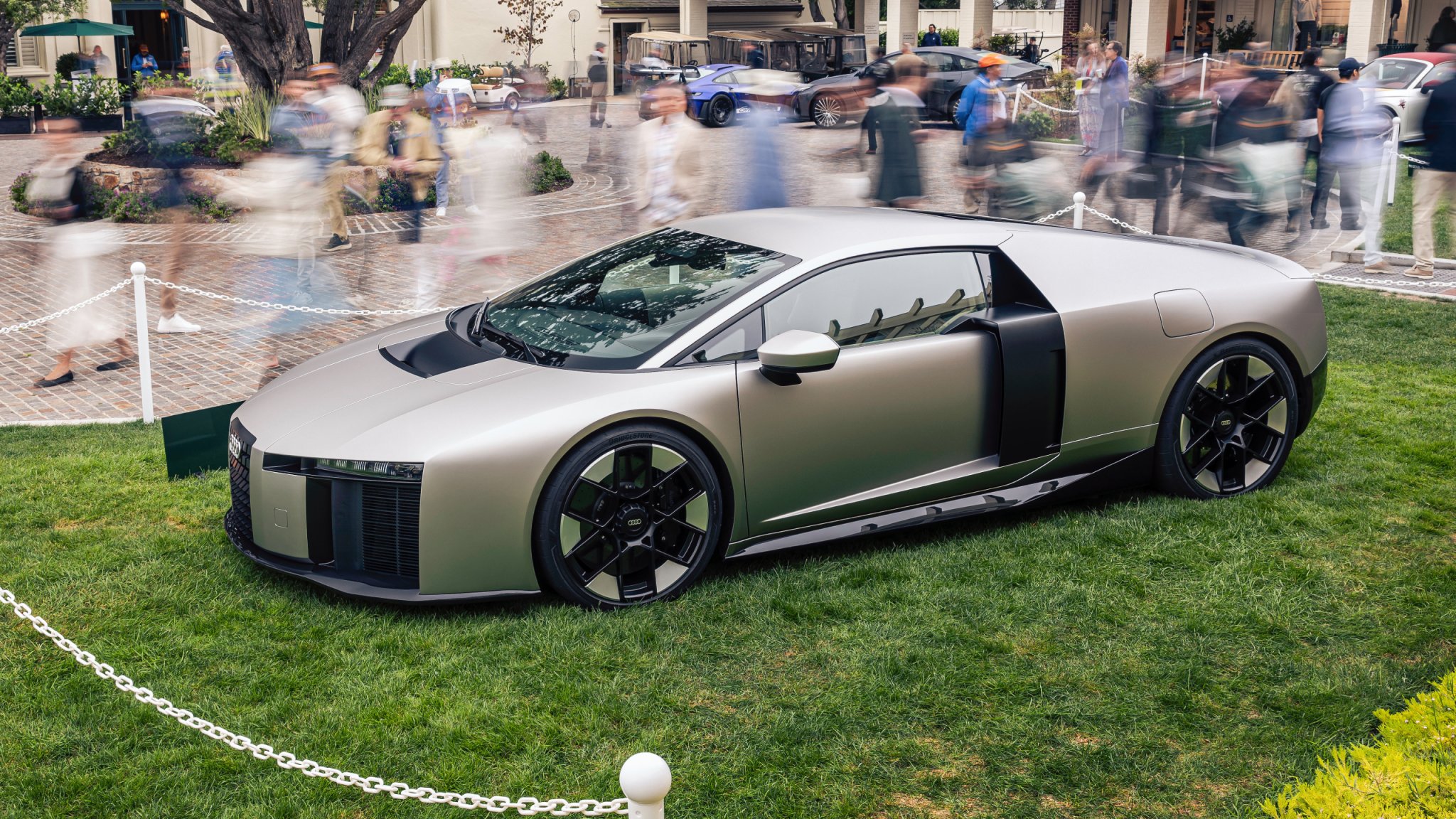
Audi’s 1,000-horsepower Nuvolari supercar sure looks like the old R8. Heck, it even shares its underpinnings with a Lamborghini, just like its iconic “everyday supercar” did. Audi would love to build a third-generation R8, but the company has stubbornly refused to nudge the Nuvolari in that direction.
Instead, Audi has pitched the Nuvolari as a more exclusive halo model. For such a thing, the Nuvolari seems to have come out of nowhere, which seems antithetical to the meticulous planning that brought us the R8. Is that why the Nuvolari is destined to be a limited-run footnote rather than a series-production supercar?
The Drive Editor-in-Chief Kyle Cheromcha sat down with Rouven Mohr, Audi’s chief technology officer and head of R&D, and asked him why we got this niche offering rather than another R8. Turns out, the answer is threefold, and it came down to more than simple manufacturing logistics.
“One is, timing was king, because you want to catch the first year in Formula One,” Mohr said.
To move that quickly, Audi put together a relatively small, nimble team—not the normal behemoth that you’d find at work behind an effort like the R8. And that meant sacrificing some of the potential scale that comes with a larger project.
“There are aspects that are enabling the short timeline that you cannot transfer to mass production,” Mohr said. “We decided also for the small volume to be fast and to accept higher material costs because we are choosing the carbon technology. In carbon technology, they are super fast with the tooling timing.”
“If you go with metal,” Mohr continued, “starting to make the tool until you have the tool is defining a big chunk of your industrialization timeline. So this is for sure not representative because you cannot do it in mass production. You are not fast enough.”
There was another critical timing concern too. Missing its desired launch window would have forced Audi to re-engineer the Nuvolari’s powertrain to comply with a new set of regulations.
“Secondly, we wanted to catch the regulation window of the change from Euro 6 to Euro 7, because otherwise the effort would increase a lot,” Mohr said. “So this means we have to produce the cars for Europe in a certain time window; otherwise, it’s gone.”
To truly take advantage of economies of scale, Audi would have to build the Nuvolari in much larger numbers, which presents its own set of problems—especially since, like the rest of us, Audi has to contend with rising prices.
“To make the car cheaper is simply not possible with the material cost,” he said.
That means Audi’s up-front cost has a pretty high floor, and asking customers to pony up big bucks for something mass-produced is a dicey proposition. Audi would rather bank on the Nuvolari’s niche appeal to maintain interest from car collectors. Take away that cachet and the Nuvolari’s business case starts to evaporate.
“We have chosen the technology, but the technology is then so expensive that it would also not make sense to have a 10,000 volume because the market for 10,000 of this, you lose the exclusivity,” Mohr said.
“We really always try to underline that it was never planned as a successor of the R8,” Mohr said. “It’s a different animal because it’s more a halo brand vision related to the Formula One entry.”
Got a news tip? Let us know at tips@thedrive.com!
Loading comments…
Comments couldn’t be loaded. Please refresh the page.