
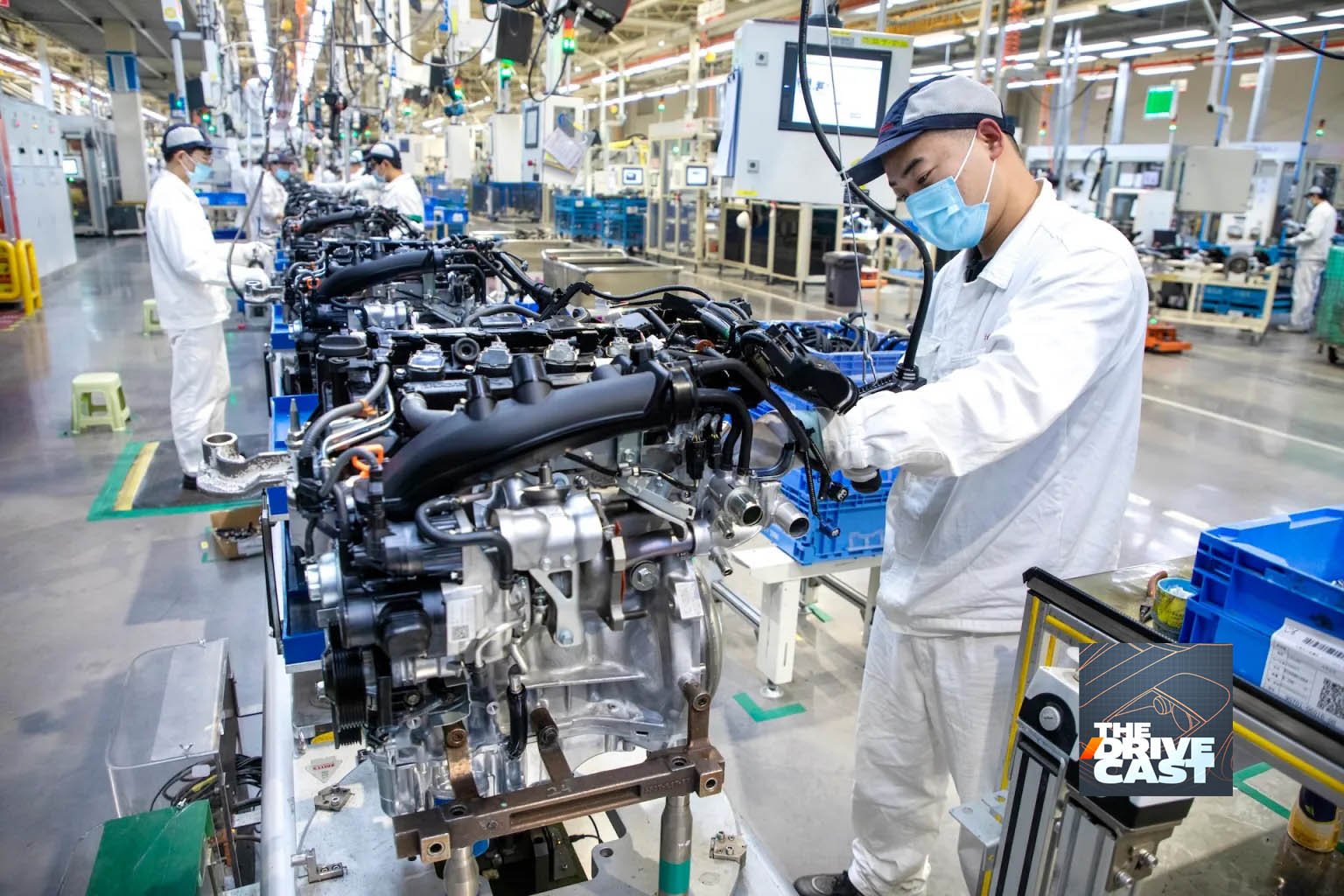
As cars have become more complex and filled with technology we’ve seen reliability become a serious issue, even for automakers that built their entire reputation upon rock-solid reliability. Toyota’s catastrophic issues with its latest-generation V6 engines is no secret. It’s also keeping Honda executives up at night.
Executive Vice President of Honda Motor Noriya Kaihara and American Honda President and CEO Eiji Fujimura told The Drive how the automaker is evolving its quality control systems to address today’s challenges and avoid Toyota’s nightmare.
Honda has indeed had its own issues in terms of recalls in recent years. More recently, with head gasket issues and whatnot. Overall, they’ve ranged from major mechanical failures to minor situations like faulty wiring or rear view cameras and stuff like that. But these issues pale in comparison to what is playing out currently at its Japanese competitor, and Honda’s determined to not suffer the same fate.
On the latest episode of The Drivecast we go behind the scenes with Honda’s top executives and discuss how the automaker’s make sure its engines don’t grenade themselves, and if or should something go wrong customers see and feel the automaker taking quick action to address the issue.
New here? The Drivecast is The Drive‘s weekly podcast that takes you behind-the-scenes on the largest controversies, stories, and characters shaping the automotive industry along with the way our roads look today. Powered by The Drive‘s inside access, original reporting, exclusives, and insights, The Drivecast aims to make everyone an insider.
Listen to The Drivecast via Spotify, Apple Podcasts, or Amazon Music. Love it? Like it? Want to help? Leave a five-star review on your platform of choice to help get The Drivecast in front of more people. Have a suggestion, tip, request, or feedback? Drop us a line at feedback@thedrive.com. I promise, we read every single email.
Full Transcript
Joel: Jer-bear, are you legitimately Honda’s number one fan? How many Hondas do you even own? How many Hondas have you owned? Do you even know?
Jerry: It’s not that many. Across the family, we have several, so four or five. My parents, my sister, they all own Hondas. So, I’m a fan. But I’m also a fan of them on the racing side. What can I say? I’m a Honda guy. That doesn’t mean that I don’t hold their feet to the fire whenever it’s needed. That’s my job, in the end.
Joel: I think “fan” is an understatement, super fan at least. But I also would emphasize to people that super fans are the most critical. They are the most passionate, so they are, like you just said, the ones that hold people’s feet to the fire. They hold companies accountable because they have the highest expectation for the companies that they are fans of. Whether it’s Apple, Nike, Honda, it doesn’t really matter the market. Fans are passionate, and passion means you care. Then you hold people accountable to hold the standards upon which you are accustomed.
That rolls right into today’s topic. Before we even get to the Honda thing, we need to backtrack a second on how we got here. I want to talk for just a brief moment about something we’ve already talked about before: Toyota and its situation. We did a whole Drivecast episode about this in June about how Toyota built its reputation on reliability, and now the Tundra is threatening to completely undo it. The reality is that Toyota’s in its turbocharged era. Toyota has now shoved a turbo V6, a 3.4-liter V6, in basically all of its body-on-frame vehicles for the most part. There’s exceptions like the Tacoma and the 4Runner, which have turbo fours. But the Tundra, the Sequoia, the Lexus GX, the Lexus LX—all of these vehicles share the same engine.
Interestingly, only the ones in the American-made Tundra are the ones with an issue—not the Sequoia either, by the way. Maybe we’ll have issues later, but the Tundra is having catastrophic engine issues. We’ve now had about 270,000 or more engines at this point that are having an issue. They’ve been recalled. The automaker can’t fully explain why, because we keep having new issues, whether it’s engine debris, etc. We’ve got different fixes that have come along: knocking with a hammer, checking for reverberations, using software to check stuff, and we can’t seemingly get the issue under control. It seems we keep having issues. After every fix, we are told, “This is it,” and then we have another report of catastrophic engine failure.
So, TBD on that. The turbo fours, admittedly, we haven’t had issues with yet. That said, it’s a “yet.” Everyone’s sitting here like, “What’s going to happen?” That’s just the context of how we got here. The reason is because Jerry has spent a lot of time with the Executive Vice President of Honda Motor and the American Honda President and CEO, and they brought the topic up. Jerry talked with them about Honda and the fear they have of Toyota’s issue becoming their issue. Jerry, what did we learn?
Jerry: Cars are getting more complex. Companies are building different types of engines than they’ve always built. Things are changing, things are evolving. I wanted to learn how a company moves forward with coming up with creative products, whether it’s technologies, engines, whole new models, software, while still checking that very important box of reliability—which for companies like Honda and Toyota, it’s pretty much everything. Those two companies, that’s what people know them for. If you can’t provide your customers with reliability, then what do you even have in the end?
What I learned is a little bit about how Honda’s quality control systems work, how they have separate departments that work completely independently from development, from testing, from the designing and the R&D side of the life cycle of a product coming to market. Obviously that’s normal; all companies have that. But what does it really look like to a company where their main thing, priority number one, is reliability?
Mr. Kaihara, Honda’s Global VP, explained how their process has had to evolve in recent years to include not just hardware testing—because engines have existed for a long time now—but software and different technologies. That’s a whole new ballgame on how you test software. How do you replicate possible issues that may happen in the market? So, he explained how quality control now happens in tandem with the development of a product, rather than waiting after the product is created and then checking its quality. It now happens at the same time as a product or a technology is being developed. Not only does that speed up the process—and speed to market is everything for these companies—but that also gives you a lower chance of something going wrong at the very end of the creation of a product, where you kind of have to start again from scratch. They have better chances of catching something early.
Now, this is a guy who actually led quality control globally for Honda for over a decade. Whenever he tells you, “This is how it works,” he didn’t just get these notes from his assistant on how these things are being done. He lived it. That was his main job for many years, so I would say that he knows a thing or two.
Joel: If I remember correctly from reading your story, there were three words that both executives kept mentioning and coming up with. What were those three words, and what was the reason behind them?
Jerry: It was really interesting. So: China, manufacturing, software. There was a fourth word that I mentioned later on, and that was actually India as well. You could sum it up in the manufacturing superpowers like China and India, and then software. Those are important because, living in the year 2026, that’s where things are happening. Whether we like it, whether our government likes it, these are the countries where things are happening. Honda has teams in China learning the latest manufacturing techniques from the Chinese. As Fujimura-san, who is the American Honda CEO, said, not many years ago, it was actually the other way around, where the Chinese were in Japan learning from Japan. Now it’s completely the other way around, so that’s why it’s important. Those are your manufacturing superpowers.
The other word was software because, whether we like it or not, software rules the road. Everything that happens in a car—from the software that makes the engine tick, to ADAS, to your backup camera detecting that a car is driving behind you—it all runs on software. That’s why software is so important. Software can be glitchy. Let’s face it, software issues really drive us mad. Last time your computer, your iPhone, or your car had a software glitch, you were probably pretty ticked off, and so was I. How can Honda avoid issues with those three major pillars?
Joel: One of the things in your story that struck me as interesting is talking about speed to market, and how speed to market is crucial in today’s fast-paced globalized economy. The reality is that China, above everything and everyone, has been the forebearer, the proof of concept, that speed matters. Every day there’s something out of China that’s more impressive, whether it’s battery technology, ADAS, software, capabilities, bouncing cars, or floating cars that can go into water and tread around.
Speed inherently, typically, is at the opposite end when it comes to reliability. That’s one of the things that Honda and Toyota have not usually been the ones to speed to market when it comes to technological innovations on a lot of different things, but inherently, that’s made them so much more reliable. Toyota’s second-gen Tundra, for instance, lasted 14 years with the 5.7 V8, which was an icon. It was bulletproof, indestructible. It guzzled gas, but it was not a technological engine. To that point, it was bulletproof, and it was able to be fixed from any NAPA Auto Parts. The opposite situation is what we’ve got going on with this turbo six.
When I hear and read about speed to market being crucial, it feels counterintuitive to the idea that you need to be keeping your reliability and your quality up. I know they talk about a quality department and how they handle that situation to go against this whole speed to market situation. Tell me about that.
Jerry: I very directly asked about speed to market, and Fujimura-san, the American Honda CEO, said speed to market is very important. But there was a quote from him specifically: “When we want to compete with them”—by “them,” he’s talking about China and India—”we first need to look inward and ask, ‘Who is Honda?’ and ‘How can Honda compete?'” Later on, he says, “We cannot just compete with them purely on speed. We need to use our traditions and our thinking,” meaning what you just said. Honda and Toyota are known for having a product and sticking with it forever because “if it ain’t broke, don’t fix it.”
They also know that they need to compete on speed to market, but they’re not just throwing everything out the window and the kitchen sink to compete just on pace. Yes, they need to be quicker. Yes, they need to be more creative. Yes, they need to bring newer solutions, but they can’t just say speed is everything, because as we’re seeing with the Toyota issue, mistakes can happen. It doesn’t matter how good your quality control systems are. Same thing with Honda; they have issues. It’s not saying, “We don’t have issues and we are not capable of producing bad products.” No, it does happen. But that’s one more reason why Honda is acknowledging speed isn’t everything.
Joel: Toyota and Honda have kind of taken different paths, and I want to talk about this, too, now that we’ve gotten the topic of China and their take on the situation. Honda has leaned into turbos on its cars, specifically its cars and smaller SUVs: the Civic, the Accord, the CR-V. But in anything meaningful in terms of size, hauling duties, etc.—and that goes for the Odyssey, the Pilot, the Passport, the Ridgeline, even the Acura MDX—they’ve stuck with the tried and true naturally aspirated V6 we all know. More importantly, that’s how they’re doing it for the next-gen cars.
The next-gen cars that aren’t hybrids will have the smaller ones I mentioned, like the Civics and the CR-Vs. I test-drove a prototype of the next-gen Civic Hybrid, which will end up being the same powertrain in the CR-V Hybrid with all-wheel drive, and it was a naturally aspirated four with two planetary gearsets and electric motors. They will have a turbo four, of course, for the gas engines. But the next-gen Odyssey, Pilot, Passport, Ridgeline, MDX are getting a brand-new, clean-sheet, naturally aspirated V6 engine that’s electrified with a hybrid system. It’s very interesting to me: they’re not going turbo. They are sticking to NA in anything that does any meaningful work, unlike what Toyota’s done. What do you make of that?
Jerry: I think they’re sticking with what they know. Maybe they’ve learned more lessons from Toyota than they told me about, but a major company like Honda isn’t reacting purely to one of their rival’s issues. There’s a lot more there. But yeah, they’re working on, I believe, two new hybrid powertrains. I believe one, if not both, are two-motor hybrid units, just like in the CR-V Hybrid, just like in the Prelude that I’m driving right now—which, I will say, are extremely complex engines. They’re the kind of engines where the actual gas engine doesn’t even drive the wheels. That’s how complex they are; it’s almost difficult to wrap your mind around how they work.
It’s going to be interesting how these types of engines work on these bigger vehicles because, like you said, they’ve always had the naturally aspirated, non-hybrid motors, and now that’s about to change here in the coming years. Good luck to them, that’s all I can say.
Joel: There is an instance where they did dip their toes into the turbo engines in the larger vehicle, and it was in the Acura MDX Type S. That was—I’m trying to think—I don’t want to say the only turbo V6, but I’m trying to think of another turbo V6 in a modern Honda. I’m struggling off the top of my head at the exact moment. It was a gem of an engine; it’s a gem of an engine still existing today, I guess, but it’s not high volume. It was also the first vehicle that Honda/Acura did an air suspension system in.
I’ve got to tell you, I remember driving the Acura MDX Type S the first time it came out with the turbo six and the air suspension system—it was that bright, golden color—and I just got into it and I was astonished. I drove it and was like, “This air suspension system and adaptive damper setup is tuned better than any X5 BMW I’ve ever driven.” I was floored, absolutely floored. It is a special, special thing.
Jerry: I remember driving that. It may have been the same program you were on. Hands down, one of the best driving days I’ve had. That MDX Type S handles so well. That suspension is such a gem, and the engine’s such a gem. It really is a magnificent vehicle.
Joel: It is such a special setup in that car; I was just blown away. That engine’s proven to be reliable, but again, we don’t have a huge sample size. It’s been a low-volume car. Like I said, they’re not using turbos on the next-gen V6 that’s a clean-sheet engine. I’m just floored. I can’t help but wonder if they’ve watched Toyota and they got skittish.
Granted, you’ve got Ford. Ford went all in on the turbo V6 with EcoBoost branding in the F-150 and the Expedition long ago, and overall, they’ve proven to be reasonably reliable. Everything has a thing, but there hasn’t been some insane recall. They still sell very, very, very well in the F-150. The Expedition is the only engine you can get; Navigator, same deal. They’ve pivoted away from V8s in that regard compared to something like an Escalade or a Tahoe, so there’s even an American company that’s done it. Now we’ve got Stellantis with the Hurricane 3.0-liter, which Caleb Jacobs, senior editor at The Drive, says something like, “This is the 2JZ of America.” He’s not wrong, guys. The high output is just a rocket.
Back to Honda: it’s just so fascinating to me that the smaller engines are getting turbos, and the larger engine isn’t. I just can’t decide why.
Jerry: It’s going to be interesting to see how the strategy shakes out. Honestly, if the Prelude I’m driving—and by the way, I’ll be driving it until next summer as part of our long-term test program—is any indication, I think it’ll be very interesting. Those two-motor drive units are complex. They are interesting to drive, they are extremely efficient, but they are pretty new. It’ll be interesting to see how the first round of CR-V Hybrids that have been on the road now for a few years, as they get up in the really high mileage—150,000 miles and up, 200,000 miles and up for those who put a ton of miles on their cars—it’ll be interesting to see how they hold up. That’ll tell us a lot about these new engines that are coming and how those will perform down the road.
Joel: The CR-V Hybrid that you’re talking about with this specific powertrain debuted in about 2023, so we’re about three years into it. We’re just coming off lease on a lot of these, or we’re just past that point on the early ones. But that engine is a powertrain gem. I’ve driven the current one in the current Civic and the CR-V. I’ve driven the next-generation one with a prototype review on The Drive—and of course, I will link to it in the show notes for those that want to read it—but it’s not a turbo engine.
Interestingly, Toyota has gone and done the dual route with its hybrids. We’ve got the hybrids, which are naturally aspirated with their two planetary gearset setups, but then they have the Hybrid Max. Anything with a Max badge for the hybrids there, it’s a turbo engine with a battery and a hybrid setup. That is not focused on fuel economy like the regular hybrids at Toyota; the Max is focused on max power. It’s focused on either being a replacement, depending on the vehicle—so the ones with a four-cylinder, like a Highlander or Grand Highlander, are supposed to be a replacement theoretically for a turbo V6 setup, and the ones that are in the larger body-on-frame vehicles, like a Sequoia or Tundra, are supposed to be like a V8 replacement. They do have the power outputs that are like that.
Interestingly, like I said, all of the turbo fours so far, seemingly—I’m sure there’s exceptions to every rule—have not had the turbo six issues of catastrophic engine failure in high numbers. I’ll be curious to see how that all plays out. Honda has not done the turbo hybrid thing yet, and I don’t know that they’re going to go down that route, because they don’t seem to be needing to do the power Max situation. Even the new V6 is naturally aspirated with the hybrid system. Time will tell on all of this. I think that Honda’s quote that you have in the story, “The most important thing, however, is that quality is in our people’s minds,” that’s important, because that is, again, how Honda and Toyota built their reputation, and Toyota’s got some cracks in their reputation right now because of all this. We’ll see how it plays out.
Jerry: Yeah, we’ll see how it plays out. Also, Honda does not believe that they make perfect products or that they are incapable of making mistakes, because he also talked about how to handle a mistake and how they’ve learned from Toyota’s mistake. The answer there was quick action. Those were the words he used: “Quick action, come up with a countermeasure, and roll it out.” Obviously it’s very easy to say, and as some of the commenters pointed out in the story, there are issues going on with head gaskets and whatnot. It’s not about not making mistakes, and it’s not about blaming Toyota for being the inferior Japanese automaker. No, it’s about, yes, mistakes do happen, and this is how we handle repairs, this is how we handle countermeasures. This is also very important to us because when you leave a customer with a deficient product, that’s when it really starts to affect the brand. The Japanese are extremely proud of what they do, and they take it very seriously. If you ever met anybody who works for Honda, it’s not really just a job for them; it’s a sense of national pride, and it’s really a sense of their culture, too. Again, this is not to say mistakes don’t happen, but just a little bit of insight on how Honda handles all those things, including making mistakes, including issues which sometimes take years to fix. Remember the Takata airbags and stuff like that? Shit happens.
Joel: You got a deep pull there with the Takata!
Jerry: You’ve still got to clean up whatever messes you make, and they’re well aware of that.
Joel: I think we’ll end it with a good line that’s showed up in such infamous movies ranging from Coach Carter to Dodgeball to, of course, as a Minnesota boy, one of my favorites, The Mighty Ducks: “Quick feet! Quick feet, people! You’ve got to have quick feet!”
Loading comments…
Comments couldn’t be loaded. Please refresh the page.