
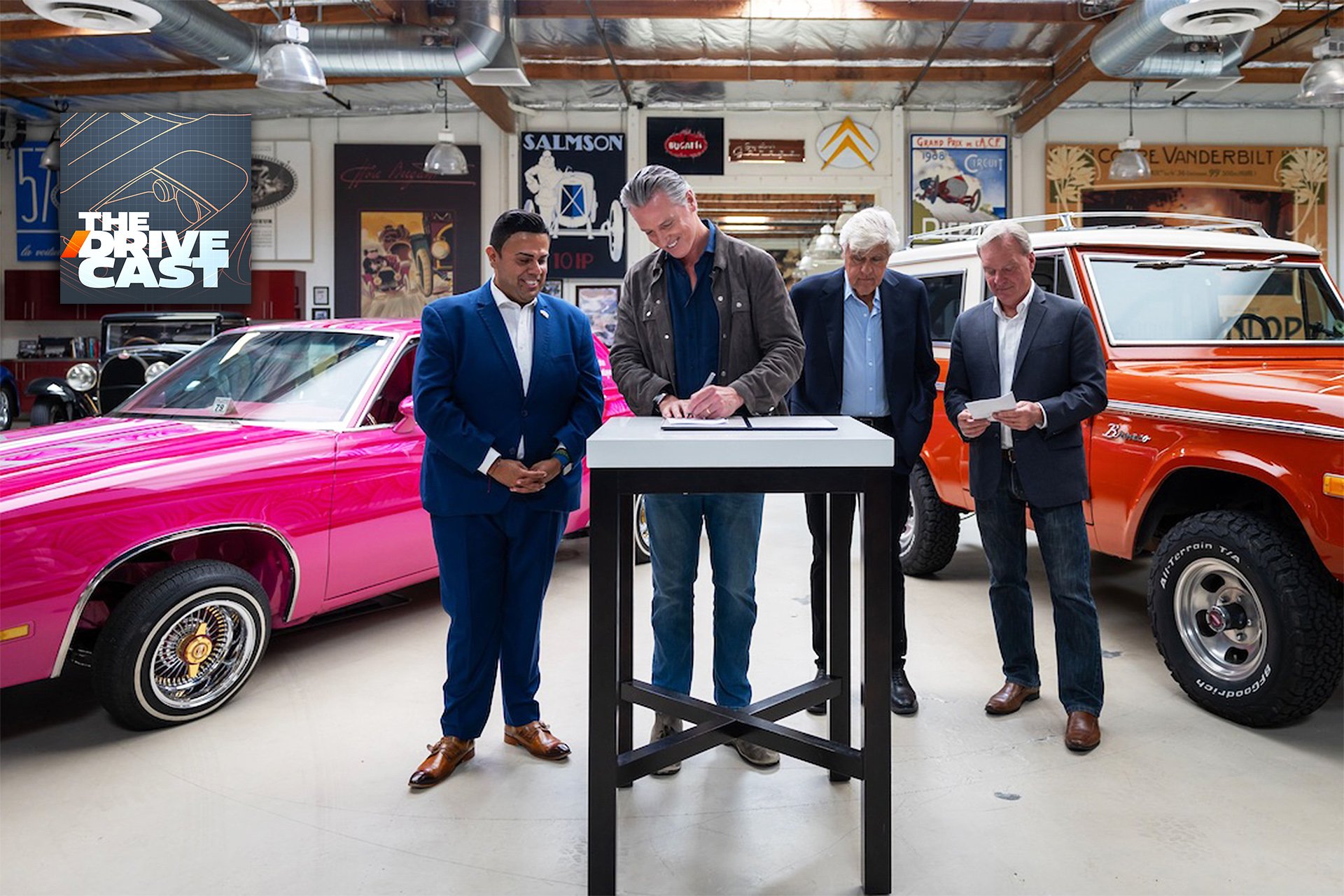
It seemed like the car community scored a rare win last week when California finalized a new law backed by Jay Leno and others that relaxes its notoriously strict emissions tests for classic cars. But now that the photo ops are over, “Leno’s Law” looks less like a landmark victory over burdensome regulations and a lot more like a giant missed opportunity.
Though California is just one of 29 states that require some form of emissions testing for cars, its rules are the strictest in the nation, requiring any gas-powered car made after 1975 and more than eight years old to pass a biennial smog test in order to be registered. Every year, by design, the law forces thousands of inefficient old vehicles off the road as the cost of compliance rises and parts become harder to find. Even if it runs just fine, a stubborn check engine light will cause it to fail.
The system has succeeded in improving air quality significantly since the 1980s, and it’s also turned smog testing into a boogeyman and punching bag, and the source of many a Commiefornia joke. But in a place like California, where the weather is kind and the cost of living is extremely high, it’s not just enthusiasts and collectors who are affected. There are lots of residents who drive old cars because they can’t afford anything newer, nor can they afford to overhaul their cars’ emissions systems when the government demands it.
And what’s especially frustrating is that in a state with over 36 million registered vehicles on the road, the vast majority of which are less than 20 years old, the number of 1970s, 1980s, and 1990s cars being targeted by the law represent a drop in the ocean of tailpipe emissions.
After years of failed attempts to change the law to keep more classic cars on the road, a group backed by SEMA and Jay Leno finally succeeded, and there was much rejoicing. But here’s the catch. While the narrow exemptions Leno’s Law carved out—including a 1,000 annual mileage cap—might help rich collectors with their pampered classics, it won’t do anything to help everyday people daily driving old cars. And now that the energy has been spent and everyone involved is patting themselves on the back, it’ll be a long time before anyone tries to push for real change.
On this week’s episode of The Drivecast, Joel and Kyle—a Los Angeles resident with a old truck that recently failed its smog test—go beyond the headlines to explain the uncomfortable truth about Leno’s Law that no one wants to acknowledge.
New here? The Drivecast is The Drive‘s weekly podcast that takes you behind the scenes on the big stories, controversies, and characters shaping the automotive industry and the way our roads look today. Powered by The Drive‘s access, original reporting, exclusives, and insights, The Drivecast aims to make everyone an insider.
Listen to The Drivecast via Spotify, Apple Podcasts, Amazon Music, or right here on our site with our JamX player. Love it? Like it? Want to yell at us? Leave a five-star review on your platform of choice to help get The Drivecast in front of more people. Have a suggestion, tip, request, or feedback? Drop us a line at feedback@thedrive.com. I promise, we read every single email.
Full Transcript
Kyle: Joel, do you even have emissions testing in Minnesota?
Joel: Fair question. No. Hang on, we have laws and regulations. I could rattle off all of the laws and regulations pertaining to the size fish I can keep and species in our lake. I could not rattle off the emissions regulations in the state of Minnesota. Although I’m very well versed with our automatic license plate reader laws in Minnesota now, weird.
Kyle: Of course.
Joel: But I did live in Portland, Oregon for four and a half years and they have similar rules, regulations and checkups like you have in California. And when I had an E34 M5, I had to go and have someone violate its tailpipe.
Kyle: With the sniffer.
Joel: I did not appreciate the sniffer violating my vehicle. It was traumatic.
Kyle: It must be nice to not have to worry about that. Also, how old is your Z anyway? Because if it was here in California, it would not be exempt. It would still be smog tested.
Joel: Correct. Our Z is at 1990, so it would not be exempt. Although here it’s over 25 years old, so we have collector’s plates on it. And there are a whole bunch of rules and regulations for that. So can only drive so many miles a year, it can only blah, blah, blah. But I mean, it’s a family heirloom at this point. I think I put four miles on it a year. I’m a caretaker. It’s not a toy.
Kyle: Well, as the caretaker of my own family heirloom, my father-in-law’s 1988 K5 Blazer that just became a victim of the smog law here in California, I’m jealous because getting that thing to pass is getting harder every year—which this law is supposed to help, but actually won’t.
Joel: Getting onto that, Kyle, I come to you with 99 questions. As the guy that did the video, the guy that lives in Commifornia, California, whatever you want to call it, the guy with Gavin Newsom as his supreme ruler.
Kyle: We’re going to get emails about that.
Joel: We’re going to get emails about that. My first and foremost question is why. We need to do background, right? Everyone needs to understand why we’re even talking about this. Why is smog testing such a flash point in California? Is the smog ruining your hair?
Kyle: No, it’s not. The dry air is actually, but actually that does relate because smog has historically been a big issue in California. The state’s geography, the topography, cities like LA, it’s sitting in a giant bowl surrounded by mountains with ocean on one side. So it traps smog in a way that we as a people didn’t anticipate when we built LA there and then turned it into the automotive capital of America. So one reason is that smog has been a big issue in California and it has bedeviled regulators for decades, and then it actually has gotten a lot better. Smog testing in general did its job in terms of reducing the amount of harmful emissions coming from tailpipes, even as the number of cars has exploded on the road. But the real issue is that because of the way it is a fixed cutoff, and that anything made after 1976, which is 50 years ago, needs to be smog tested every two years and pass very strict standards, that ends up forcing a lot of cars off the road because you can’t register a car if it doesn’t pass.
That ends up forcing a lot of cars off the road that are otherwise in really perfectly normal operating condition. And as we referenced in the intro, in a state like California, it’s not just enthusiasts with crazy collector cars and car people who are affected by this. There are a lot of people who just drive old cars here because cars last longer in California. The weather, again, it’s very kind to cars. You’re sitting in traffic, you can see old ’70s, ’80s cars that you wouldn’t see anywhere else just being daily driven by people. And sure, some of them are car people who could drive something else or buy something else and they just choose not to because this is what they want. But a lot of them are people who can’t afford anything else. It’s a very expensive place to live. So not only are these people having to potentially get rid of a perfectly functional car because it can’t pass smog, it’s either that or they have to pay someone to fix their car so it can pass the standard.
I think the big flash point for a lot of people is that the number of cars that we’re talking about, say from the mid ’90s back through the mid ’70s, it’s a very small percentage of the over 36 million cars that are on the road in California. And so if you’re talking about emissions testing as something that is supposed to bring down emissions, it’s supposed to keep emissions in check, it’s a very, very small slice of cars that are being kind of targeted, or that’s how people feel that they’re being targeted, and saying, “You driving your 1988 K5 Blazer, you are polluting too much so you can’t drive it.” Meanwhile, 30 million other cars are on the road. A lot of them are in aggregate polluting a lot more than just this one person. So overall the law, while it started from a good place and it has actually worked in some respects, a lot of people just feel like it has turned enthusiasts into the bad guys here.
Joel: I mean, yeah, enthusiasts love their old 911s. But my sister lives in LA and you live in LA, so I come to visit the people I love and I go running around the neighborhoods and I see cars. It’s great for car spotting. So I’ll see all these old Tacomas and T100s and Frontiers and I’ll even see some, I’ve seen a Chevy LUV. Yeah, sure, they’re patinaed from the sun because you guys got a lot of sun there, but aside from that, they’re perfect. You would never, ever, ever see that in Detroit or even Minneapolis here. The salt, the snow, it would eat them alive. Those things are so lost to time, but then you have the traffic. So great car spotting, but you’re sitting doing the car spotting. I don’t like the traffic there.
Kyle: Yeah. It’s a fantastic car spotting city. And that’s the upside of all the traffic is you’re not going anywhere, so you got plenty of time to look.
Joel: It’s quite the spin you got on the traffic, my guy.
Kyle: Hey, we justify what we can to stay sane here.
Joel: So tell me before we get into what’s different, how smog testing worked in California before this law passed. And we do highlight in the story that while this got signed this week by Gavin Newsom, actually at Jay Leno’s garage, literally in his garage—
Kyle: That guy knows a photo op when he sees one.
Joel: Yeah, no kidding. And also garage is relative. It’s more like his car museum, not his house garage. It’s like three warehouses combined. Anyway, it doesn’t change anything today. This is changing things as we go forward. Let’s be clear. So nothing changed yesterday just from the swipe of a magic pen, despite what politicians might say on Instagram and TV. Anyway, how did smog testing work in California before this law passed?
Kyle: California’s not alone in emissions testing. There’s no federal emissions testing, by the way. That’s the thing that sits over all of this, is that every state has been just left to its own devices to decide whether or not it needs to do this. California is one of 29 states that does emissions testing of some kind, but every other state has either a rolling cutoff, so once a car hits 20 years old, then it doesn’t need smog testing anymore. So every year a new batch of cars gets grandfathered in and exempted, or there are generous mileage exemptions, or if you are driving on collector’s plates or you only need to have it tested in specific metro areas. California is unique in that up until now it was blanket policy across the whole state. It doesn’t matter—if a car is made from 1976 onwards, it needs to be smog tested every two years.
Then if a car is less than eight years old, it’s also exempt, so it’s like a window within that. So today as we’re talking, it’s from 1976 through 2018. The way it works is just every two years when you get your registration renewal from the DMV, it comes with another little notice that’s like, “Hey, it’s time for your smog test.” And so you have to take that notice and go to a smog shop, of which there are many because it’s a whole industry here. Go to a smog shop, get it tested and hopefully pass, and then you get to register. If it doesn’t pass, as my Blazer didn’t, you’re out of luck. You have to go get fixed. They don’t tell you why it didn’t pass. I mean, they’ll point to where it violated the emission standards or this graph is too high, but they’re not going to tell you, okay, this is the cause.
You have to then go troubleshoot the problem or take it to a shop that can figure it out for you, which costs money. After that, as it happens sadly in a lot of cases, it’s too much money to fix it, the problem is not worth the actual value of the car, and then it just ends up for sale on Marketplace. If you look around Craigslist or Marketplace in California, you will see listings where the car is very cheap and it’ll say in the description like, check engine light on, car can’t pass smog, and you can take a chance and buy it and see if you can fix it, or in most cases, it ends up being bought by someone out of state who doesn’t have to worry about that. So that’s how it worked.
Also, diesel vehicles, the range is less strict of what needs testing. It’s anything older than 1998 is exempt. There are other exemptions as well, like if a diesel truck has a gross vehicle weight rating over 14,000 pounds, like a massive Ford F-350 dually, doesn’t need smog testing. Hey, that’s convenient. Or any fleet vehicles by the state doesn’t need smog testing. The rules have already had a lot of exemptions, but that hasn’t helped a lot of people who are either daily driving or collecting or just have a cool car that’s been in their family forever, to keep that thing in good standing and registered with the state.
Joel: Tell me what is different now. Once this all gets enacted, bound, goes into law, not just getting signed on Instagram posts, but once this becomes a thing, then what?
Kyle: Starting next year, starting on January 1st, the cutoff for the exemption is raised to 1981. So that means any 70s vehicle now in California, you don’t need a smog test, which is great because especially ’70s cars, like in 1978, and you think of the emission systems, the primitive emission systems they were trying back then to get fuel economy up and those old carbureted V6s and V8s, that’s a nightmare to keep in proper working order, especially to basically an arbitrary standard by the state. And so 70s vehicles, good to go starting next year. 1981, that is the new cutoff. And then every year going forward, that cutoff will, for at least the next six years, that cutoff will continue to roll with the times. And so the idea, if there are no other changes, is that by 2032, anything from 1986 and older will be exempt, which is great news, although not for me because my Blazer is an 88.
But there are some stipulations, and that’s where we get into this is not really helping that many people. One is that the car cannot be used as a daily driver, and the two ways that they’re going to go about enforcing that is that—well, their definition in the text of the law is that it must be “Used primarily in shows, parades, charitable functions, and historical exhibitions for display, maintenance and preservations, and is not used as the owner’s primary mode of transportation.” The way they’re going to be enforcing that is that the car also needs to either have collector’s car insurance, which comes with its own stipulations on how much you can drive it, or a car needs to be driven less than a thousand miles a year, and that will be verified by the DMV through a process which has not been established yet. The law actually says that.
They have until 2030 to write that process, but basically either your insurance company or the DMV itself will be checking your mileage to make sure that you’re not exceeding that. In a state like California, which is huge, a thousand miles a year is not that much. I mean, you cover that in a round trip from LA to San Francisco, and that’s it. That is your mileage allotment for the year. And so for anyone who is trying to use an old car as a daily driver, they’re going to exceed that very quickly, and so therefore their car will still need to be smog tested, and therefore this law actually doesn’t do anything to help them.
Joel: So bigger question, why did this take so darn long to get into law? We saw this all in the whole news cycle last year, and before we even made that news cycle, we saw them talking about it, but then it failed to pass.
Kyle: Well, is inertia a cop out answer? Because I think that’s actually the truth. California, it’s a massive bureaucracy here. It’s just a fact, that’s not a political statement, it’s just a fact. There are a lot of people here and there are a lot of rules to help govern everything, and there are a lot of stakeholders in place too. And so the law, when it was initially introduced last year, it’s not the first time that people have tried to update this regulation. And in fact, people have been lobbying for at least a decade and unsuccessfully, but there has been movement towards it. But every time it’s run into the fact that no one wants to own this.
For one thing, in a state like California, no politician wants, or very few politicians, I would say, and not enough to create a majority, want to have their name on a bill that someone could spin and say, “You are allowing more pollution.” Being green, being climate conscious is a political plus here, and so this bill could be very easily spun into a negative in that regard.
And so politicians were just kind of like, “Why would I even bother touching this? It’s not worth it. No one’s banging on my door. My constituents don’t really care. This is not worth the hassle.” And then there’s the fact that there are a lot of regulations that have to be adjusted around this. One of the reasons why the bill failed last year was because the state put out a report, did some analysis, and determined that to update all of the computer systems at the DMV to account for this, to put out environmental studies to keep track of how pollution rates were affected, to track all of this over the next five years to determine whether or not this law should be continued or updated or whatever, was going to cost millions of dollars. And so also no politician wants to say, “Yeah, I’m going to vote for spending potentially millions of dollars on this thing that doesn’t really matter to me.”
So there was just a lot of… stuff. It’s the simplest way to put it, a lot of stuff in the way that didn’t make it possible for this conversation to get to this point until now because it just wasn’t important enough to the people in power.
Joel: Before we started recording, you actually said that this was a rich guy’s law and it wasn’t going to make a huge difference to regular enthusiasts and everyday drivers. But for Betty who’s got a 1988 Honda Accord and she can’t afford a new Honda Accord, if these things don’t help her, they hurt her, they’re no better off, your Chevy’s no better off.
Kyle: I would say it doesn’t hurt directly now. It doesn’t help, and it may hurt in the long run because now that this bill has been passed in its current form and will continue to take effect over the next six years, there’s not going to be that much appetite to change it. And so it could very well be that once we get into the next decade, the state says, “Oh, well, okay, this isn’t causing huge problems. We’ll just keep this going.” So the rolling exemption will continue. My Blazer will get grandfathered in and exempt, which is great, but then I won’t be able to drive it more than a thousand miles a year, which to be fair, I don’t currently because gas prices, they already got that covered off with gas prices. They don’t need to put a law saying don’t drive this thing a thousand miles a year.
But I think there’s a feeling that the hard work’s been done. We got this passed, the law’s been changed, smog testing is less strict. It’s going to take an equal amount of effort or more in a few years time to update the mileage standard or eliminate the mileage standard for vehicles with a certain age range. Or if you can provide some proof of hardship, that means that you can avoid smog testing. It took eight years to give a very narrow exemption to this. If we’re talking about making it something that can actually make a difference for people who are relying on an old car for daily transportation, it’s probably going to take longer than that. I mean, and who knows what the next decade will bring because we’re already talking about where federal emission standards might be or where the EV mandates have kind of fallen off or what’s going to replace them.
The future is very uncertain. This kind of was our best shot at a big significant change, and I don’t want to discredit Jay Leno. He’s a great guy. He’s a lot of fun, and he put his backing behind this, and that’s the reason why it passed. Straight up, it would not have passed if Jay Leno didn’t get behind it and lend his star power to it. So I don’t want to take anything away from him, and I don’t want to discount what he did or discredit the motivations behind it.
All I’m saying is that this was the moment where all the stars aligned and something got done, and that does not happen easily or frequently. And so it will definitely be a while before any sort of conversation kicks up again about what more changes need to be made. And by that point, who knows how many more cars that people are relying on for daily transportation will be forced off the road because they need to drive them more than a thousand miles a year and they can’t afford collector’s car insurance or they don’t know how to go about getting that because they’re not in this world.
I think there’d be a lot of people who are patting themselves on the back over the next couple of years and saying, “Job well done, we did it.” And that is going to be a much smaller pool than the number of people who this bill could have actually helped.
Joel: So taking a step back, what does this mean for the landscape of emissions testing across the country? And for context here, because I know not everyone’s an enthusiast that listen to this podcast, there was a timeline not long ago where we had Hellcats dying. We weren’t sure if V8s were going to live in Mustangs anymore. We had an electric Mustang debuting, and it really did look for a moment like the global stage was going to be electric and electrified, and that America was part of that. And then we had political winds change, and frankly, we pulled back. We pulled back in so many ways, but in automotive, we pulled back on electrification and green energy in terms of that. And now suddenly GM literally just debuted a brand new clean sheet V8. I can’t even imagine me saying that was going to happen a couple years ago, and yet I’m reviewing Hellcats again.
And so under that whole premise of the world, timelines change, and it almost feels like America’s just taking a step backwards. I can’t imagine the world’s not looking at us like with these new V8s and these Chevys thinking, what are you doing while Europe and China and the global movers and shakers of the industry now are continuing down the electrification path? But what does this mean for the landscape of emissions testing across the country and how things evolve in the future?
Kyle: Well, for starters, I do think it makes some sense that we don’t have a federal emissions testing policy because the fact is that states are so different, the populations, the needs, the geography, the size, it would be hard, I think, to have a federal emission standard that works for everyone in this country. So it makes sense that it’s left to the states. Typically, when we’re talking about pollution regulations or air quality rules, California leads the way, and then because it’s so big and the market is so big and companies make decisions based around what is going to be legal to sell or legal to do in California, those rules then end up being adopted or used by other states. And so California historically has been able to kind of set the trend. But in this case, it’s the inverse because California had the strictest rules and now they’re making them a tiny bit less strict.
It is still more strict than every other state. And so I don’t see any other states really reacting to this. It’s not like any state that doesn’t have emissions testing right now is going to see this and be like, “You know what? We really need to add that. We really need to follow California’s lead here.” Anyone who has followed California’s lead with emissions testing has already done so, and California’s already stricter, so making it less strict is not really going to change much for anyone else. But I also think that this does show that ground support from the people who are actually affected by law, if you can marshal that and get that together, change does happen. The emissions or the zero emissions goals being rolled back, that has a lot more to do with the economics of it and what people are actually buying and wanting to buy and the manufacturing of it than it does a bunch of people on the ground demanding that we want all EVs, right?
Those goals were incentivized by the government at a tax level, at a regulation level, and then companies responded and tried to sort of lead the consumer towards it. This is different because we’re not talking about new cars, we’re talking about old cars, so there’s no business element at the top end like there is with new cars. But the fact is what this really shows is that good things can happen when people come forward and say, “Hey, we understand this law’s purpose. We want to comply with this law, but complying with this law as it exists today is almost impossible. So we are asking for the law to be changed slightly so that we can actually comply with it.” I don’t love the fact that I haven’t registered my Blazer in eight months and still kind of drive it around my neighborhood sometimes because it can’t pass smog.
I know people who have registered their cars in other states, hello Montana, purely because of the emissions aspect and they would love to be able to do it here and not jump through all those hoops, but they can’t and they want their car, so they’re kind of forced into it. There’s a lot of ways that the law was structured that made it the easier way was to not comply. And I don’t think anyone really wants to break the law. You are incentivized to by the structures around you. And so what I think was good here was that this had the backing of a lot of people who said, “You know what? I would love to have my car smog tested to make sure that it’s not over polluting. The way that we’re going about it right now makes no sense, and so let’s change that.” And lo and behold, we do have some change at least.
I think that that could happen elsewhere with other things, but it’s too soon to say. We’ll have to really see what happens when it rolls out next year or starts to roll out next year.
Joel: Well, so we’re in September now. Something to already look forward to in the new year after the holidays for Californians.
Kyle: Yeah. It’s not coming soon enough for my Blazer though, unfortunately. Still got to get that cat replaced.
Joel: Well, something for you to do on the weekend.
Kyle: Or I’ll just wait for someone to steal it and then kind of have insurance take care of it. I don’t know. We’ll see.
Joel: That’s sad.
Kyle: No, I mean, someone already tried to steal it. I chased them off. My wife loved that.
Joel: There is a thought. We’re going to close on the image of Kyle chasing off a car thief today. Solid close, Kyle.
Kyle: I’ll end on this advice. Don’t do that. It’s not smart to chase after someone trying to steal your catalytic converter. You don’t know if they’re armed. I didn’t even think about it. I just reacted, but I’m kind of proud that I did. Stand up for what’s yours. But… don’t.
Loading comments…
Comments couldn’t be loaded. Please refresh the page.