
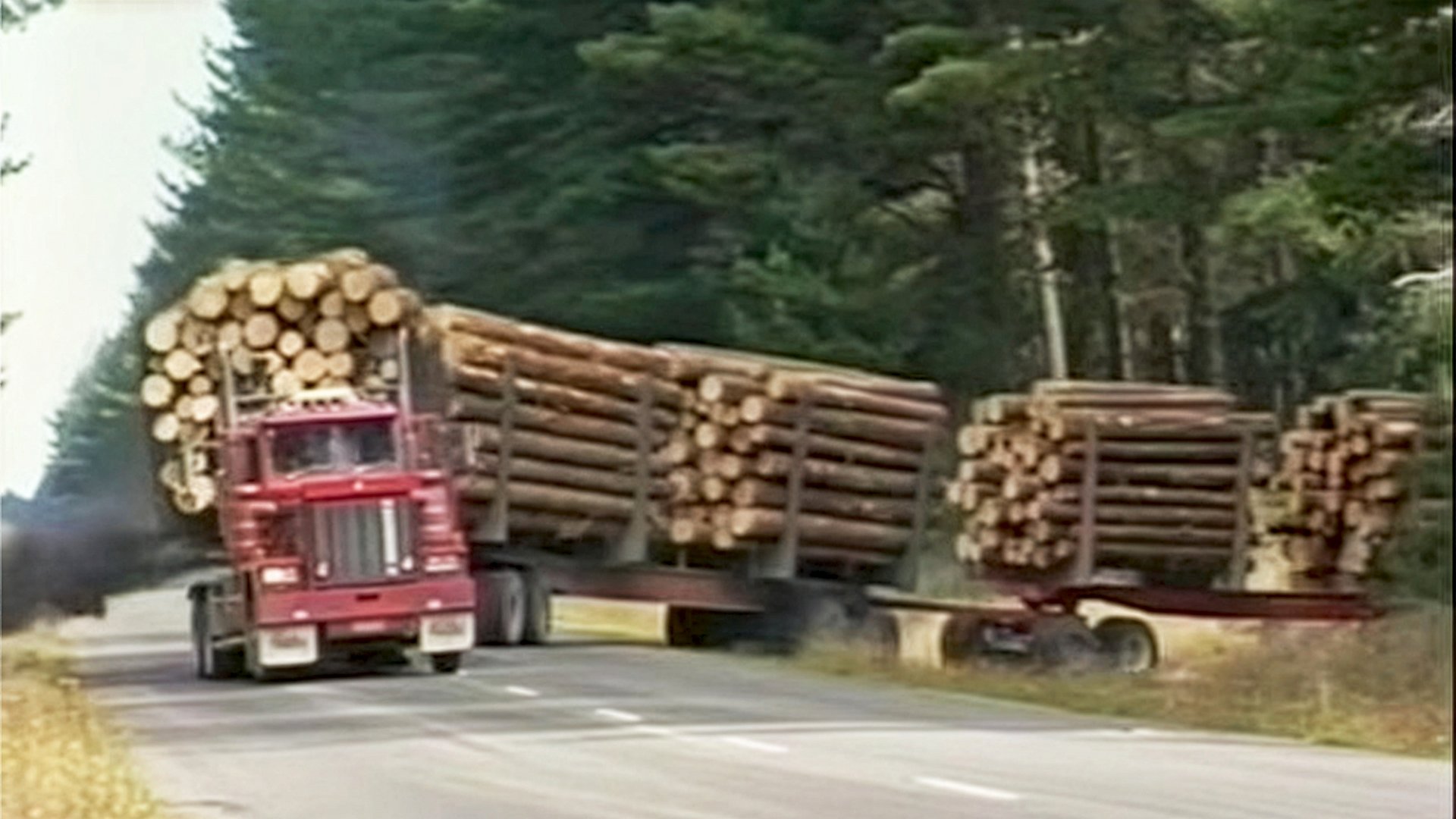
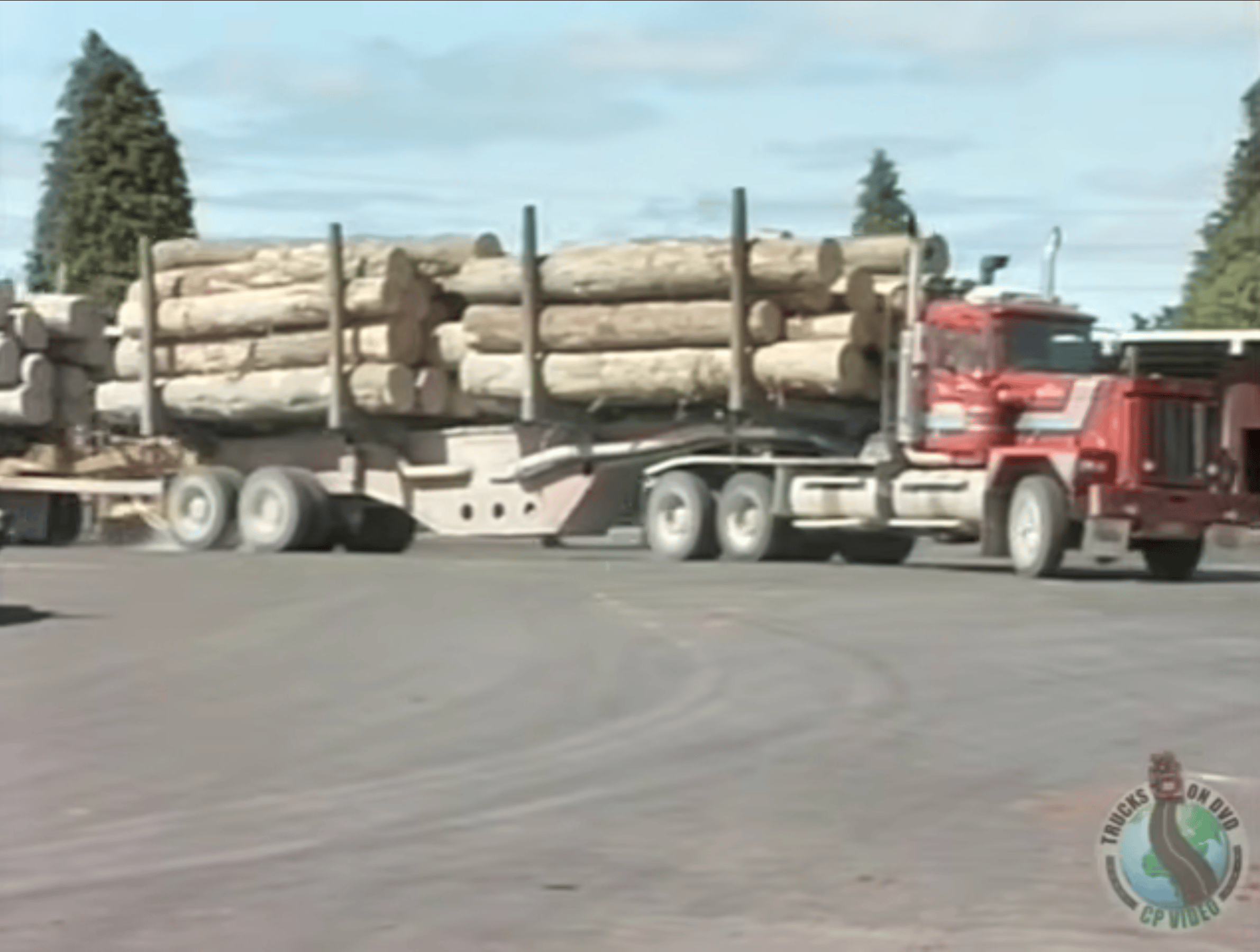
One adage I’m learning to be more and more true over time is this: “Necessity is the mother of invention.” Take, for example, this Pacific P510 semi-truck built to haul logs in New Zealand toward the end of the 20th century. Rigs down there work hard—not unlike the Pacific logging trucks found in Oregon, Washington, and British Columbia—and sometimes, they have to pull three or even four trailers at a time. This requires a ton of power, and since the hood isn’t long enough to fit a second Caterpillar diesel engine, they simply added one to the leading trailer for good measure.
A 23-minute video of the powered truck-and-trailer combo lives on YouTube today. The channel Trucks on Video – CP Productions unearthed the original footage and posted it with a detailed description, seemingly from NZ Trucking magazine, explaining that it was filmed in the Kaingaroa State Forest. Formerly a barren volcanic scrubland, it was repurposed in the 1920s and 1930s to grow radiata pines and Douglas fir trees, among other species. Commercial production has been huge there ever since, as it’s the largest plantation forest in New Zealand, covering almost 1,100 square miles.
If that geography and history lesson seems tangential, just know that piece of land was crucial to the workhorse’s development. As the video’s description notes, the Magee family commissioned the build to run it under its Marathon Trucking company. A mechanical 14.6-liter Caterpillar 3406B with a turbocharger powered the tractor, while an identically sized Caterpillar 3406A—also with a turbo—powered the lead trailer. Combined, they made something like 900 horsepower.
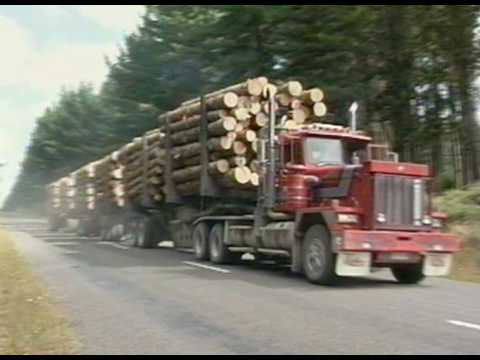
Twin Cat Powered Pacific P510 – New Zealand 1991
Both engines were connected to separate Allison automatic transmissions and equipped with CAT’s BrakeSaver tech, which is basically an oil turbine brake that forces motor oil into a rotating assembly between the engine’s flywheel and clutch to slow down the rotation of the crankshaft. The air intakes for the trailer’s engine were located on the back of the cab to prevent it from sucking in too much dust. Both engines reportedly had their own throttle control in the cab, and according to this fascinating comment on the video with firsthand knowledge of the truck, it was a real pain in the butt to get it all working:
“Graeme Kelly of Kraft Engineering built the bolsters for it, which were spring loaded at the top so no extension pins. It was high but loaders were able to push against the top of the bolsters and they would fold inwards allowing the loader to carefully place the logs inside the bolsters. The tops would automatically spring back into position once the logs were forward enough.
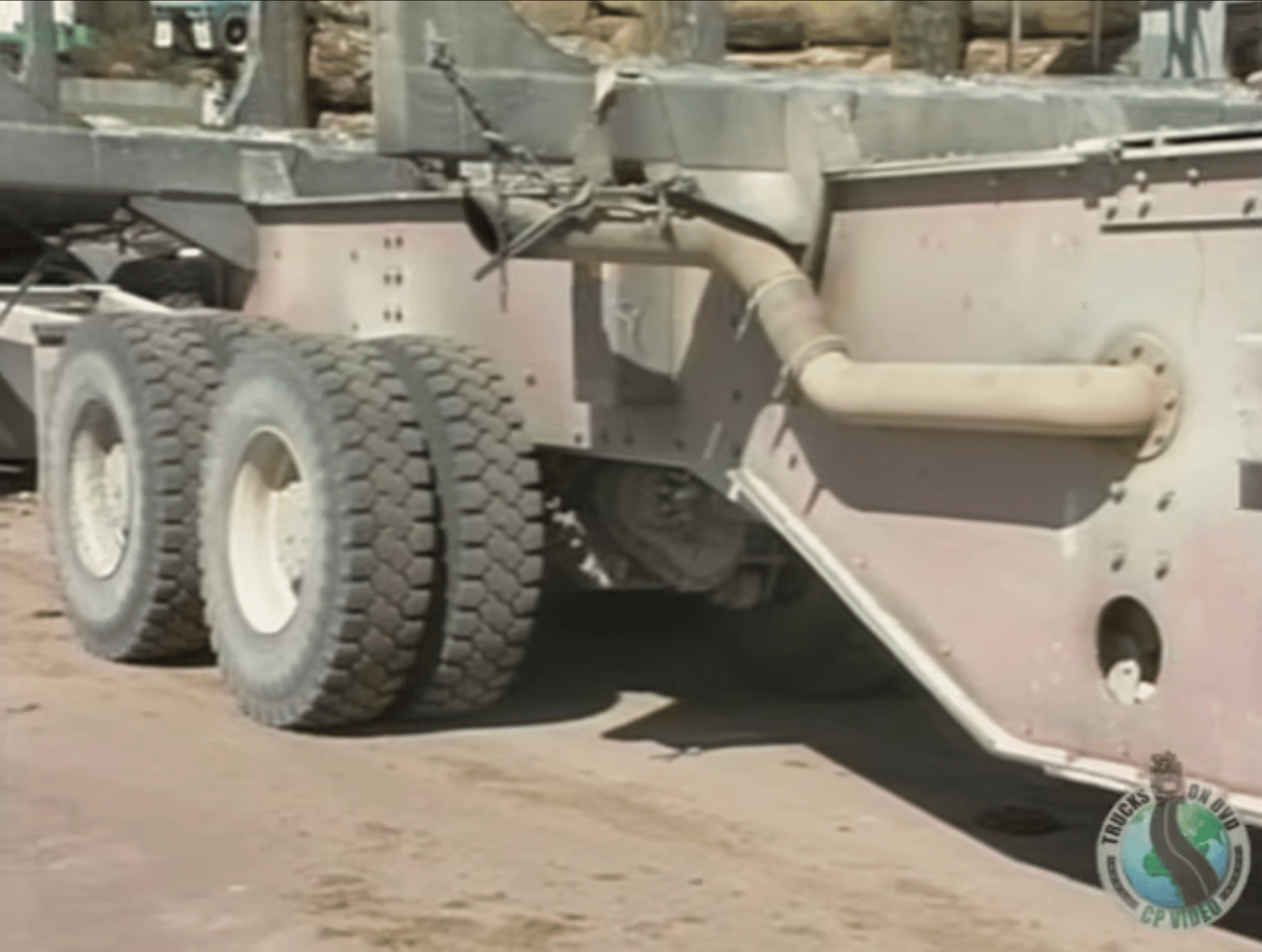
I worked alongside Lance and Mark and their father Nolan [Magee]. Lance told me that the first lot of Meritor Rockwell diffs couldn’t handle the weight, so they tried hard to purchase a set of Renault diffs like the ones that I had in my Mack Superliner as I was driving for Maroa Logging during this time early 1990’s. So because they couldn’t get the Renault differentials, they managed to secure a set of Mercedes Benz diffs with hub reduction planetaries and that’s what you see in this video in the front trailer.
One of the biggest problems when they first started was keeping dust out and a clean air supply to the second engine… The first engine was dusted and that’s when they relocated the air intake and air rams up over and above the subframe of the truck. This proved to be effective. Both engines were driving two Allison Auto Transmissions with transmission retarders and this thing was so effective going downhill, it was scary without touching the brakes…
I still talk to Lance today from time to time, we talk about the days in The mighty Kaingaroa Forest. Lance was gifted this actual truck not long ago and is restoring it. He rang me to ask if I knew where the front trailer is and I was told that it may have been cut up for scrap metal. Such a shame.”
It’s important to point out that this concept isn’t unique to this rig. Back in the 1960s, Freightliner tested what it called the Power Dolly, a powered-axle connector for multi-trailer setups with a Cummins V6 to assist in steep climbs. It didn’t get out of the prototype phase.
Self-powered trailers are again getting some attention in recent years, although they all have electric drivetrains. Most of them are travel trailers, like the Pebble Flow and Aboard T4, so they aren’t the same as the diesel-slurping red semi we’re focusing on here. The closest modern equivalent that I’ve seen is Revoy’s battery-powered “backpack” trailer, which effectively turns any existing tractor-trailer setup into a hybrid.
Respectively, I think this Pacific P510 would sneer at any of the examples I just gave. None of them have a fat exhaust pipe sticking out the side of the trailer frame. None of them have a driveline that runs to the rear axles, as they all have in-hub motors. To use a cliché, this machine is simply built different.
I could watch video of it running up and down remote logging roads all day. The slower-paced footage of the Pacific having its carts unloaded at the mill is also nice, so you can give it a proper gander.
Got a tip or question for the author? Contact them directly: caleb@thedrive.com
Loading comments…
Comments couldn’t be loaded. Please refresh the page.