
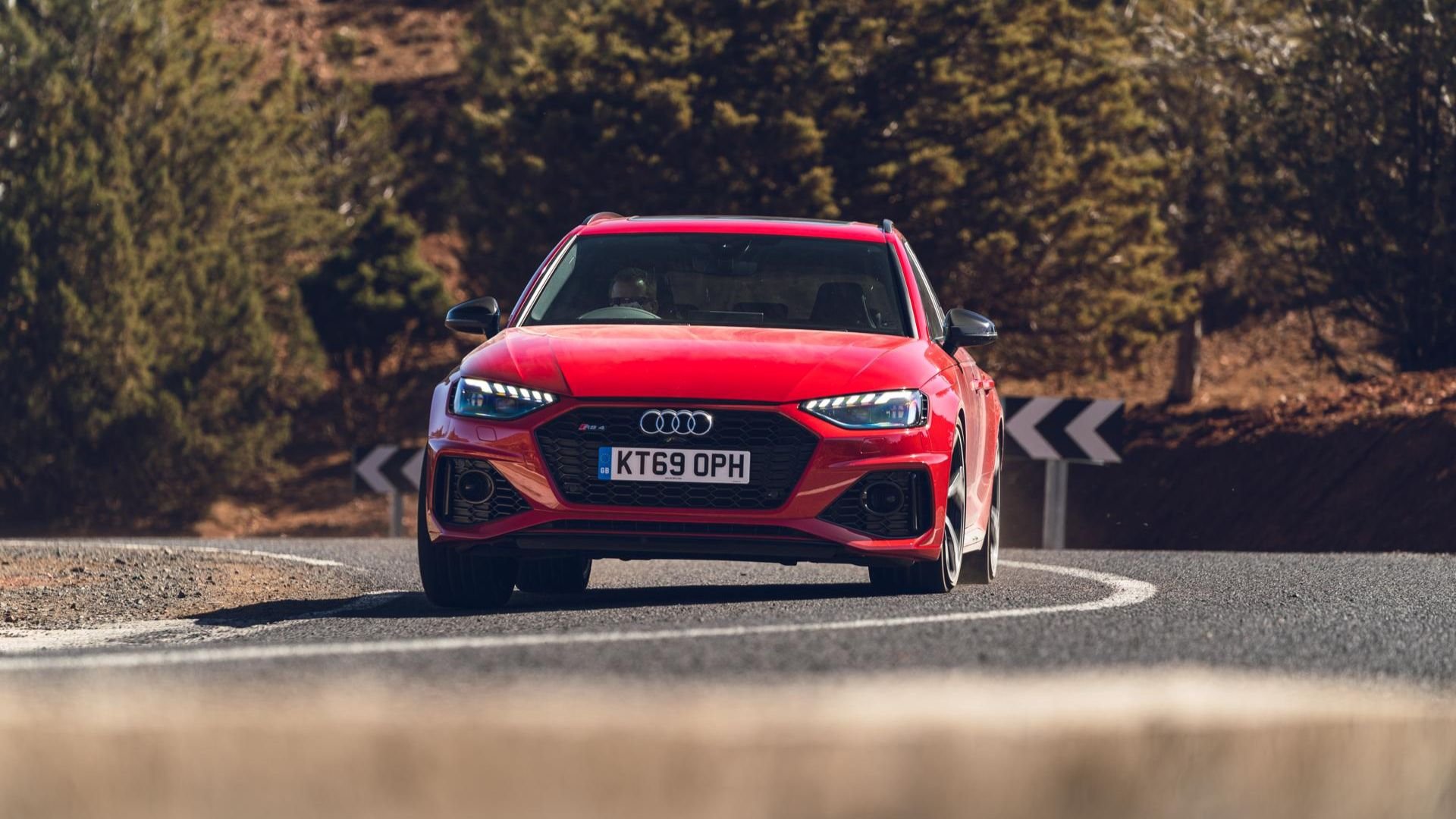
The folks at Ingolstadt sure knew what they were doing with the new Audi Nuvolari. Yes, in some ways it’s simply a stopgap supercar, but it’s also a reminder that the company employs passionate engineers who want to build emotionally engaging cars. Unfortunately for them, Audi is busy trying to relaunch pretty much its entire product line.
As you might imagine, that makes it tricky to pitch passion projects. In times like these, Audi is looking to make the most of what it has in front of it, and in the age of increasingly software-defined vehicles, a lot of that boils down to tech. We may not be getting a more affordable Nuvolari, but we are going to see its tech trickle down to the rest of Audi’s lineup.
Rouven Mohr, Audi CTO and head of R&D, called the Nuvolari the company’s “North Star” during a Monterey Car Week Q&A attended by The Drive. This short-lived halo model will guide Audi in tuning its broader portfolio.
What sort of cars might benefit from the Nuvolari’s niche performance tricks? Audi hasn’t quite decided yet. Mohr says the company wants to get back to building cars that attract enthusiasts, but the reality of the company’s situation makes it impossible to promise anything right now.
“You’ll see other emotional products,” Mohr said. “This does not mean R8—yes or no. This is not decided. We have different priorities at the moment.
“But you can be sure that it will be not the last emotional car of Audi because this is also something that [CEO] Gernot Dollner, Massimo and myself, we are standing for,” Mohr continued. “All of us, we love cars. And emotionality is very important also for a brand that wants to sell more volume. But you need an emotional connection.”
Audi hopes the tricks learned from Nuvolari will help make its other cars more engaging, too. Programming from its newfangled all-wheel-drive system, for example, will make its way into Audi’s more mainstream offerings.
“You will find a different interpretation in the standard cars of the intelligent drivetrain, meaning that the torque distribution in the car is done on a very intelligent and self-learning base,” Mohr said. “You will see it in the future of Quattro, even on the standard cars, in two kinds of interpretations.”
“One interpretation is to maximize traction and driving fun,” Mohr said. “But you can use this technology also to have the most efficient four-wheel drive system based on self-learning.”
The former will be the default for RS models, according to Mohr, while the latter will be the baseline for its non-enthusiast lineup. This is made possible because Quattro is no longer strictly defined by its mechanical components.
“In the past it was always hardware, which kind of central differential you are using,” Mohr explained. “And then you have a different four-wheel drive system today. It’s a mixture between which kind of hardware you’re using and also which kind of functionality, which kind of software intelligence you have to use for the actuation.”
But when it comes to physical hardware, there are far more limitations to consider.
“It’s clear not everything is possible in the [typical] car. I mean, we cannot do titanium aluminum rings embedded in the carbon structure, like in the rear wing,” Mohr added.
“But let me say the typical click noise, the perfect mixture between haptical elements and digital experience. This kind of feeling embedded in the car was also always Audi’s strength. You come, you close the door, the door has a super solid closing sound, and you sit in the car and you feel relaxed, you feel whole. This is an aspect you see in the Nuvolari, and you will see also in the future Audi cars,” he said.
According to Mohr, Audi is best at connecting with drivers when it goes against the grain.
“Like the first TT,” Mohr suggested. “People were saying, ‘Oh, what is this?’ Also our story with Avant, we have a lot of things that we were going a little bit against what the others were doing. And in this situation, Audi was always most successful.”
And don’t expect Audi’s future treasures to be relegated to the European market.
“America, I can tell you it’s a very important thing for us, especially now,” Mohr said. “We want to strengthen the American market, because Audi in the past unfortunately was losing a little bit of the awareness in the US.”
We’ll be waiting—some of us less patiently than others.
Got a story tip? Let us know at tips@thedrive.com!
Loading comments…
Comments couldn’t be loaded. Please refresh the page.